What is Material Handling Equipment for High-Density Storage? Pallet Racking vs AS/RS
Discover what is material handling equipment for high-density storage. Compare pallet racking vs AS/RS with 2026 pricing, ROI metrics, and buying frameworks.
The Core Question: What is Material Handling Equipment in Modern Warehousing?
When facility planners ask, 'what is material handling equipment,' the answer extends far beyond forklifts and conveyor belts. In the context of high-density storage, material handling equipment encompasses the structural and automated frameworks that dictate a facility's volumetric efficiency, throughput velocity, and labor dependency. Specifically, the choice between advanced pallet racking configurations and Automated Storage and Retrieval Systems (AS/RS) represents the most critical capital allocation decision a supply chain director will make in 2026.
This guide bypasses generic definitions to provide a technical, procurement-focused comparison of static high-density racking versus dynamic AS/RS, complete with current pricing metrics, spatial calculations, and failure-mode analysis.
Procurement Baseline: The Density vs. Throughput Trade-off
Every storage system operates on a sliding scale between storage density (maximizing pallet positions per square foot) and selectivity/throughput (accessing any SKU at any time). Static racking favors high selectivity at lower density, while AS/RS maximizes both but demands significant capital expenditure and facility height.
Static High-Density Pallet Racking: Specifications and Costs
Modern pallet racking is not a monolith. Moving beyond standard selective racking, high-density static systems utilize specific mechanical principles to compress inventory footprints. When evaluating brands like Interlake Mecalux, Ridg-U-Rak, or Schaefer, buyers must specify exact steel gauges and seismic ratings to avoid catastrophic deflection or regulatory fines.
System Configurations and 2026 Pricing Metrics
- Double-Deep Reach Racking: Requires specialized reach trucks. Increases density by 40% over selective racking. 2026 Installed Cost: $85 to $110 per pallet position.
- Drive-In / Drive-Through Racking: Utilizes a LIFO (Last-In, First-Out) or FIFO rail system. Ideal for low-SKU, high-volume batch storage. 2026 Installed Cost: $160 to $220 per pallet position.
- Push-Back Racking: Uses nested carts on inclined rails (LIFO). Offers higher selectivity than drive-in. 2026 Installed Cost: $190 to $260 per pallet position.
- Pallet Shuttle (Semi-Automated): A motorized shuttle runs inside the rails, eliminating forklift travel into the rack. 2026 Installed Cost: $240 to $310 per pallet position, plus $25,000 per shuttle bot.
Critical Engineering and Failure Modes
Procurement teams frequently underestimate the structural requirements for high-density racking. For facilities in seismic zones (IBC 2024/2025 standards), upright frames must be constructed from 12-gauge or 10-gauge structural steel, rather than the standard 14-gauge roll-formed steel. Furthermore, beam deflection is a primary failure mode; specify beams with a maximum deflection ratio of 1/180th of the span under full load to prevent pallet dislodgement during forklift extraction.
Safety compliance is non-negotiable. According to the OSHA Material Handling Storage Guidelines, facilities must implement documented inspection protocols and utilize column protectors rated for at least 10,000 lbs of impact force at high-traffic aisles.
Automated Storage and Retrieval Systems (AS/RS): The Capital Leap
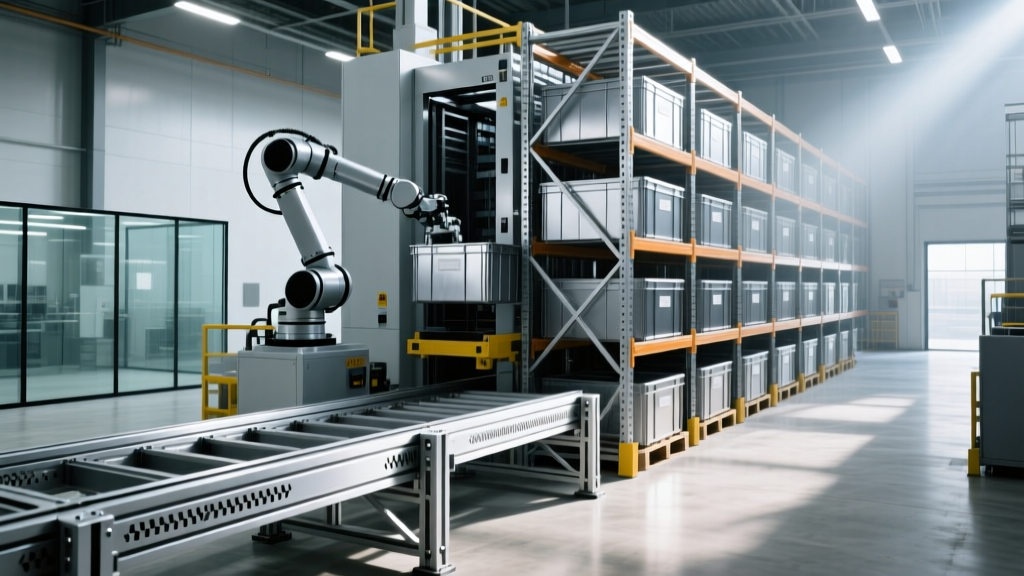
AS/RS represents the pinnacle of automated material handling. By removing human operators from the storage aisles, these systems utilize the full clear height of a building—often reaching 80 to 120 feet—while operating in 'dark warehouse' conditions to reduce HVAC and lighting costs.
AS/RS Sub-Types and Operational Metrics
| System Type | Max Height | Throughput (Loads/Hr) | 2026 Est. Cost (Per Aisle) | Best Application |
|---|---|---|---|---|
| Unit-Load Crane | 120 ft | 60 - 90 | $1.8M - $3.2M | Full pallet storage, deep-lane buffering |
| Mini-Load Crane | 60 ft | 150 - 250 | $800k - $1.5M | Totes, bins, e-commerce piece picking |
| Pallet Shuttle (Automated) | 100+ ft | 40 - 60 (per level) | $1.2M - $2.5M | High-density, low-SKU beverage/food |
| 4-Way Shuttle System | 50 ft | 120 - 180 | $1.5M - $2.8M | Mid-height facilities, flexible scaling |
The 2026 AS/RS Advantage: Energy Regeneration and AI Routing
The latest generation of unit-load cranes from providers like Dematic and SSI Schaefer feature regenerative braking systems. When the crane's hoist lowers a 2,500 lb payload, the kinetic energy is captured and fed back into the facility's microgrid, reducing overall system energy consumption by up to 25%. Additionally, modern Warehouse Execution Systems (WES) utilize machine learning to dynamically re-slot inventory overnight, moving high-velocity SKUs closer to the pick-face without human intervention.
For a comprehensive overview of automated technologies and integration standards, procurement teams should consult the MHI Automated Storage Solutions resource library, which provides critical baseline data on system integration and ROI modeling.
Decision Matrix: Choosing the Right High-Density System
Selecting between advanced racking and AS/RS requires mapping your specific operational variables against system capabilities. Use the following decision framework to guide your capital request.
Scenario A: Choose High-Density Pallet Racking If...
- Building Height is Restricted: Your facility clear height is under 35 feet, making the vertical advantage of AS/RS negligible.
- SKU Proliferation is High: You manage over 5,000 active pallet SKUs with low individual velocity, requiring the 100% selectivity of push-back or double-deep systems.
- Capital Constraints Exist: Your budget is under $500,000, and you need an ROI realization of under 24 months.
- Throughput is Moderate: Your operation moves fewer than 150 pallets per hour, which can be easily serviced by 4 to 6 reach trucks.
Scenario B: Choose AS/RS If...
- Real Estate is Prohibitive: You are operating in an urban or high-cost industrial zone where expanding the building footprint is impossible, forcing vertical expansion (60+ feet).
- Labor Volatility is High: You face chronic forklift operator shortages and need to decouple throughput from human shift availability.
- Product Damage is Costly: Your inventory (e.g., pharmaceuticals, high-end electronics) suffers unacceptable shrinkage from manual forklift handling.
- Throughput Demands are Extreme: You require consistent, predictable movement of 200+ loads per hour across multiple shifts.
Implementation Timelines and Hidden Costs
When building a business case, buyers must account for the stark differences in deployment timelines and hidden integration costs.
2026 Lead Time Realities
Pallet Racking: Standard roll-formed racking typically ships in 8 to 12 weeks. However, custom structural steel or seismic-rated high-density systems currently carry a 14 to 18 week lead time due to specialized fabrication.
AS/RS: Do not expect an AS/RS system to go live in under 14 months. The timeline includes 4 months for engineering and permitting, 6 months for manufacturing, and 4 to 6 months for on-site installation, software integration, and commissioning.
The Software Integration Tax
The physical hardware is only half the AS/RS equation. Integrating the AS/RS Warehouse Control System (WCS) with your existing ERP (e.g., SAP, Oracle) and WMS requires specialized middleware. Budget an additional $150,000 to $300,000 solely for software integration, API development, and user acceptance testing (UAT). Failing to allocate this budget is the primary reason automated material handling projects experience delayed go-live dates.
Final Procurement Directives
Understanding what is material handling equipment in the high-density sector means recognizing that you are not just buying steel or robots; you are buying a throughput algorithm. If your operation relies on flexible, multi-SKU handling with moderate capital, invest in premium push-back or semi-automated pallet shuttle racking, ensuring 12-gauge structural integrity. If your operation demands maximum volumetric efficiency, labor independence, and handles predictable, high-velocity unit loads, the capital expenditure of a unit-load AS/RS will yield a superior 10-year total cost of ownership (TCO). Request site-specific CAD layouts and discrete event simulation (DES) models from at least three tier-one integrators before finalizing your capital expenditure approval.
Related reading
Budgeting Washdown Fleets: Reviews of Auction Platforms for Forklift and Material Handling Equipment in Food & Pharma
Troubleshooting Forklift Attachments for Storeroom Bulk Material Handling Equipment Installations in California