Manual Overhead Bridge Cranes vs Manual Material Handling Equipment
Compare manual overhead bridge cranes to floor-based manual material handling equipment. Learn operator training, rigging, and ergonomic best practices.
When facility managers evaluate manual material handling equipment, they typically default to floor-based solutions like heavy-duty pallet jacks, manual forklifts, or push carts. However, when loads exceed 1,500 lbs or require vertical staging over CNC beds, stamping presses, and maintenance bays, floor-based equipment introduces severe ergonomic and spatial bottlenecks. Transitioning to manual overhead bridge cranes—specifically hand-chain operated hoists on push-travel trolleys—eliminates floor friction and optimizes vertical cube utilization.
This guide details the operational thresholds for upgrading from standard manual material handling equipment to manual overhead bridge systems, complete with configuration specifications, operator training protocols, and ASME-compliant inspection criteria.
The Ergonomic Threshold: Floor-Based vs. Overhead Systems
Floor-based manual material handling equipment is governed by push/pull force limits. A standard manual pallet jack requires roughly 45 to 55 lbs of initial push force to move a 4,000 lb load on pristine concrete. However, degraded floors, slight inclines, or threshold ramps can spike this requirement well over 100 lbs, violating occupational ergonomic guidelines and increasing the risk of musculoskeletal disorders (MSDs).
💡 Ergonomic Benchmark: According to the Canadian Centre for Occupational Health and Safety (CCOHS), sustained push/pull forces should generally not exceed 50 lbs for a single operator. If your floor-based manual material handling equipment routinely demands higher forces, a manual overhead bridge crane is the required intervention.Manual overhead bridge cranes bypass floor friction entirely. By suspending the load on a W-flange or patent track, the operator only needs to overcome the inertia of the trolley wheels and the bridge end-trucks, keeping physical exertion well within safe ergonomic limits even for 2-ton to 5-ton loads.
Anatomy of a Manual Overhead Bridge Crane
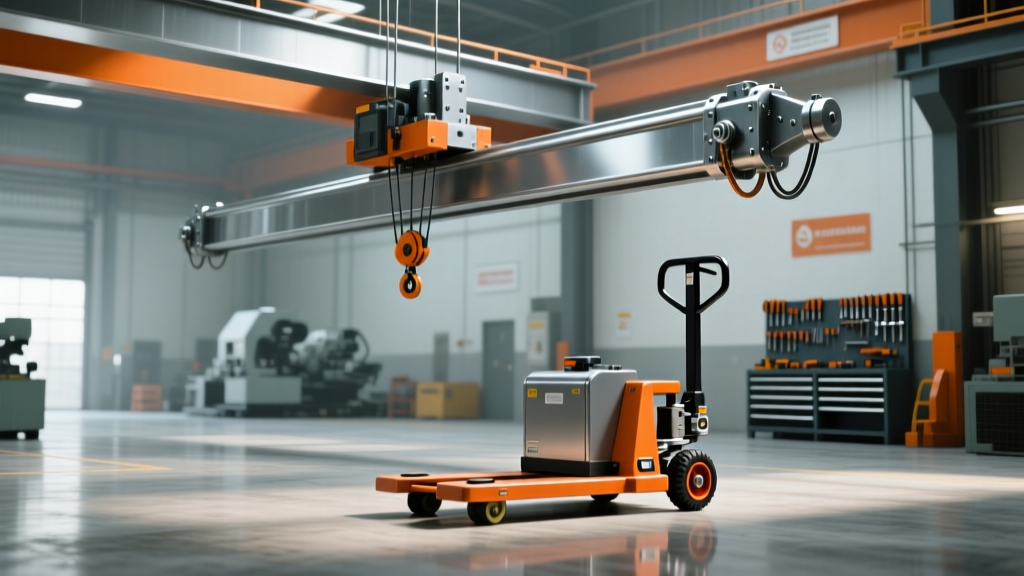
A manual overhead system consists of three primary mechanical assemblies: the bridge girders, the trolley, and the hand-chain hoist. Understanding the specific mechanics of the hoist is critical for operator training.
The Weston-Style Load Brake
Unlike powered hoists that rely on electric motor braking, manual hoists utilize a mechanical Weston-style load brake. When the operator pulls the hand chain, the mechanism disengages the brake friction discs, allowing the load chain to move. The moment the operator stops pulling, the load's weight forces the friction discs to clamp against the ratchet wheel, instantly holding the load in mid-air. If a manual hoist requires excessive force to lift a load, the brake discs are likely contaminated with oil or the friction surfaces are glazed—never assume the gearing is the issue.
Trolley Configurations: Push-Travel vs. Hand-Geared
Selecting the correct trolley configuration dictates the precision and physical effort required for load spotting. Below is a comparison matrix for facilities upgrading their manual material handling equipment strategy.
| Feature | Push-Travel (Plain) Trolley | Hand-Geared Trolley |
|---|---|---|
| Operation Method | Operator pushes/pulls the load or hoist body directly. | Operator pulls a continuous hand chain geared to the trolley wheels. |
| Max Recommended Capacity | Up to 2 Tons (4,000 lbs) | Up to 15 Tons (30,000 lbs) |
| Load Spotting Precision | Low (prone to coasting and load sway) | High (gear reduction allows millimeter-accurate positioning) |
| Ideal Span / Duty Cycle | Short spans (<30 ft), low-frequency lifts | Long spans, high-frequency cross-bridge travel |
| Cost Premium (2-Ton) | Baseline ($300 - $500) | +40% to 60% ($700 - $1,100) |
Operator Training: Hand-Chain Mechanics and Rigging
Operators transitioning from floor-based manual material handling equipment to overhead cranes often apply incorrect physical mechanics to the hand chain. Training must strictly enforce the following operational boundaries, aligned with OSHA 1910.179 standards for overhead and gantry cranes.
1. Hand Chain Pull Force Limits
A properly maintained 2-ton manual hoist requires approximately 55 to 65 lbs of hand chain pull to lift the rated load. Operators must be trained to recognize that if the chain requires more force, the equipment is malfunctioning. Never allow operators to wrap the hand chain around their waist, use a cheater pipe for leverage, or have a second operator pull on the same hand chain. This will strip the internal gears or snap the hand chain links.
2. The Danger of Side-Pulling
Floor-based equipment naturally restricts lateral movement. Overhead cranes do not. Side-pulling occurs when the operator attempts to drag a load horizontally that is not directly beneath the hoist.
⚠️ WARNING: Side-Pulling Failure ModesSide-pulling forces the load chain to grind against the lower sheave housing, causing rapid metal fatigue. More critically, it creates a pendulum effect the moment the load clears the floor, risking severe crushing injuries. The hoist must always be traversed along the bridge beam until the hook is perfectly plumb over the load's center of gravity before lifting.
3. Preventing Two-Blocking
Two-blocking happens when the lower hook block is hoisted until it physically crushes against the upper limit stop or hoist body. On manual hoists, because the operator controls the braking, there is no automatic limit switch to cut the power. Operators must maintain visual contact with the upper block and stop pulling the hand chain when the lower block is at least 6 inches from the hoist housing.
Controlling Load Sway Without Motorized Controls
Powered bridge cranes utilize Variable Frequency Drives (VFDs) to softly accelerate and decelerate, minimizing load sway. Manual systems rely entirely on the operator's body mechanics.
- The 'Walk-With' Technique: For loads under 1,000 lbs, the operator should keep one hand on the hand chain and the other hand lightly resting on the load (if safe and free of pinch points) to dampen oscillation.
- Tagline Deployment: For loads exceeding 1,000 lbs or bulky items with high wind-catch profiles (e.g., large sheet metal dies), a minimum of two taglines must be rigged 180 degrees apart. Operators must pull the taglines to steer, never wrap the tagline around their hands or wrists.
- Trolley Braking: On hand-geared trolleys, operators must reverse the pull direction on the trolley hand chain slightly to engage the gear resistance and stop the bridge travel smoothly, rather than letting the end-trucks slam into the rail stops.
Inspection Protocols: Wire Rope vs. Load Chain
Manual overhead cranes predominantly use welded alloy steel load chains rather than wire rope, requiring specific inspection criteria outlined in ASME B30.2 and B30.16 standards.
Daily Pre-Shift Inspection
- Hand Chain Alignment: Verify the hand chain is not twisted. On dual-fall hoists, a twisted hand chain will bind the internal sprocket and permanently damage the housing.
- Hook Latch Integrity: Ensure the spring-loaded safety latch on the lower hook returns to the closed position immediately after being depressed.
- Brake Test: Lift the rated load 12 inches off the ground, release the hand chain, and observe. The load must stop instantly with zero drift.
Monthly Dimensional Inspection
Inspectors must use calipers to measure the load chain. Grade 80 and Grade 100 alloy chains stretch under prolonged stress. If the nominal link length increases by more than 1%, or if wear at the interlink contact points exceeds 10% of the original link diameter, the entire length of load chain must be discarded and replaced. Note: Never attempt to weld or heat-treat a damaged load chain link.
Lubrication and Environmental Considerations
A common maintenance error is applying heavy grease to the load chain. Grease attracts abrasive metal shavings and concrete dust, creating a grinding paste that accelerates interlink wear. Load chains should be lubricated with a light, penetrating dry-film lubricant or a specific chain oil that sheds particulate matter. Hand chains, which do not bear the load, can be lightly oiled to prevent rust in humid environments.
By understanding the mechanical limits of manual overhead systems and enforcing strict operator training, facilities can safely bridge the gap between standard manual material handling equipment and heavy-duty powered crane systems, optimizing both ergonomics and spatial efficiency on the shop floor.