Bulk Material Handling Equipment Examples: 2026 Cost Guide
Analyze bulk material handling equipment examples for mining and agriculture. Compare CAPEX, OPEX, and TCO for conveyors, elevators, and haul trucks.
The True Economics of Bulk Material Handling
Bulk material handling in mining and agriculture operates on razor-thin margins where a $0.05 per ton variance in operational expenditure (OPEX) can dictate the profitability of an entire site. When procurement teams and plant managers evaluate material handling equipment examples for high-volume applications, the initial purchase price is merely the entry fee. The real financial impact lies in the Total Cost of Ownership (TCO), encompassing energy consumption, wear-part replacement, unplanned downtime, and structural degradation.
As we move through 2026, the capital markets are heavily penalizing operations with high diesel reliance and carbon-intensive logistics. This has triggered a massive shift toward electrified, continuous-flow bulk handling systems. Below, we break down the exact costs, failure modes, and budgeting frameworks required to spec and purchase bulk handling infrastructure for heavy industry.
⚠️ OPEX Warning: The Hidden Cost of Belt SplicesA common budgeting error in 2026 is specifying mechanical belt fasteners over vulcanized splices to save $4,000 per splice during initial CAPEX. On a high-tension ST3150 steel cord belt running at 4.5 m/s, mechanical fasteners increase idler wear by 22% and typically fail within 14 months, leading to a catastrophic belt break. A single unplanned 12-hour downtime event on a 3,000 TPH mining conveyor costs upwards of $85,000 in lost production. Always budget for hot vulcanized splices in high-tension applications.
Mining Sector: Overland Conveyors vs. Diesel Haulage
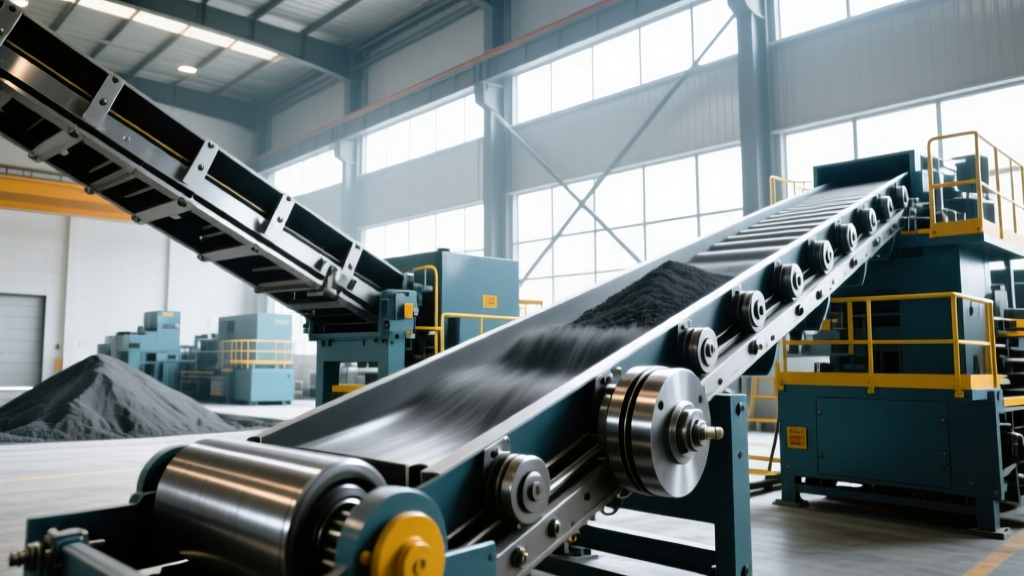
The most significant budgetary decision in modern open-pit mining is the transition from truck-and-shovel fleets to in-pit crushing and conveying (IPCC) systems. Analyzing these material handling equipment examples reveals a stark contrast between capital intensity and operational efficiency.
Cost Matrix: 15km Haulage Comparison
The following matrix compares a fleet of 15 ultra-class haul trucks against a single FLSmidth-designed 15km overland conveyor system moving 5,000 tons per hour (TPH) of copper ore.
| Metric | Cat 793F Truck Fleet (15 Units) | 15km Overland Conveyor (ST3150 Belt) |
|---|---|---|
| Initial CAPEX | $78,000,000 ($5.2M per unit) | $16,500,000 (Includes civil & electrical) |
| OPEX (per ton) | $2.85 (Fuel, tires, operator labor) | $0.28 (Electricity, idler grease) |
| Annual Maintenance | $12.5M (Engine overhauls, 400-ton tires) | $850,000 (Belt tensioning, idler swaps) |
| Useful Life | 7-10 Years (60,000 hours) | 25+ Years (Structure), 8 Years (Belting) |
| Energy Source | Diesel (Subject to volatile pricing) | Grid/Solar (Regenerative braking capable) |
According to safety and operational data tracked by the CDC NIOSH Mining division, removing haul trucks from the pit also drastically reduces the budgetary burden of dust suppression, road grading, and collision-related insurance premiums. Furthermore, modern overland conveyors equipped with regenerative drive systems can actually feed power back into the local grid when transporting material downhill, effectively reducing the electrical OPEX to near zero in high-elevation mines.
Agricultural Sector: Grain and Fertilizer Handling Budgets
In the agricultural sector, bulk handling equipment must combat entirely different adversaries: abrasive grain dust, extreme seasonal throughput spikes, and highly corrosive fertilizers. When reviewing material handling equipment examples for grain terminals and fertilizer blending facilities, the choice of metallurgy and component class dictates the TCO.
Bucket Elevators vs. Drag Conveyors for Fertilizer
Handling urea and potash requires specialized engineering. Standard A36 carbon steel bucket elevators will suffer severe pitting and structural failure within 36 months when exposed to the hygroscopic nature of urea dust combined with ambient humidity.
- CEMA Class 500 Bucket Elevators (Galvanized): Budget $140 to $180 per vertical foot. Suitable for dry, non-corrosive grains like corn and soybeans. Galvanization provides a 15-year lifespan in standard grain applications.
- 304 Stainless Steel Drag Conveyors (UHMWPE Lined): Budget $350 to $450 per linear foot. Mandatory for raw fertilizer handling. The Ultra-High Molecular Weight Polyethylene (UHMWPE) liners reduce the friction coefficient, allowing for smaller drive motors (dropping energy costs by 18%) and preventing the corrosive fertilizer from contacting the steel trough.
Procurement teams often reject 304 stainless steel due to a 45% CAPEX premium over painted carbon steel. However, USDA Economic Research Service analyses on agricultural infrastructure depreciation show that carbon steel fertilizer bins and elevators require complete replacement every 5 to 7 years due to urea-induced corrosion. Specifying 304 SS extends the asset life to 25+ years, yielding a 300% ROI over a two-decade horizon when factoring in avoided capital replacement and downtime.
A 5-Step TCO Framework for Bulk Equipment Procurement
To accurately budget for any bulk handling system in 2026, engineering and finance teams must collaborate using a standardized Total Cost of Ownership model. Relying solely on vendor bid sheets guarantees budget overruns.
- Calculate Specific Energy Consumption (SEC): Do not accept generic motor sizes. Demand the vendor provide the SEC in kWh per ton based on your exact material bulk density and moisture content. A 500 HP motor running at 60% load is vastly less efficient than a correctly sized 300 HP IE5 ultra-premium efficiency motor.
- Map the Wear-Part Replacement Schedule: Build a 10-year spreadsheet detailing the exact cost and labor hours for replacing idlers, belt wipers, elevator buckets, and sprockets. For example, ceramic-lined impact idlers cost 3x more than rubber disc idlers but last 5x longer in high-impact loading zones, eliminating $12,000 in annual labor costs for idler swaps.
- Factor in Dust Containment and Filtration: Environmental compliance is a massive line item. Budget for active dust suppression systems (like Martin Engineering's foam systems) or passive containment hoods. Failing to budget $45,000-$80,000 for proper transfer point engineering will result in six-figure annual cleanup costs and regulatory fines.
- Evaluate Automation and Sensor Integration: Modern systems require acoustic bearing monitors and belt tear detection systems. Budget $15,000 to $25,000 per conveyor for IoT sensor packages. These systems predict idler seizures 30 days before failure, allowing for planned maintenance rather than catastrophic belt fires.
- Decommissioning and Site Remediation: Include the end-of-life cost of dismantling heavy steel structures and removing concrete foundations, which typically adds 4-6% to the initial CAPEX.
Critical Failure Modes and Their Financial Impact
Understanding how bulk equipment fails is the key to building a resilient maintenance budget. The Conveyor Equipment Manufacturers Association (CEMA) publishes rigorous standards that help engineers anticipate these stress points.
Belt Edge Degradation and Mistracking
In mining overland conveyors, belt edge degradation is the number one cause of premature belt replacement. This is rarely caused by the material itself, but by mistracked idlers in the loading zone. If the material is not centered and traveling at the exact same speed as the belt, it creates a lateral shear force. Budgeting for a $22,000 automated belt tracking system with precision-loading chutes prevents the $450,000 cost of replacing a 15km belt three years early.
Bearing Seizure in Agricultural Dust
Grain dust is highly abrasive and infiltrates standard labyrinth seals on elevator pulley bearings. Once inside, the dust mixes with grease to form a grinding paste. A seized head pulley bearing on a 150-foot bucket elevator will snap the elevator belt and drop 40 tons of grain back down the leg, causing a catastrophic boot-up failure. Budgeting for Taconite seals (which feature multiple grease purge chambers) adds only $150 per bearing but prevents $60,000 in emergency repair and grain spoilage costs.
Final Procurement Directives
When analyzing material handling equipment examples for bulk applications, the cheapest initial bid is almost always the most expensive long-term liability. For mining operations, the data overwhelmingly supports the transition to electrified IPCC systems to hedge against diesel volatility. In agriculture, specifying 304 stainless steel and UHMWPE liners for fertilizer handling is non-negotiable for asset longevity. By utilizing a rigorous TCO framework that accounts for energy efficiency, wear-part labor, and environmental containment, facility managers can secure capital approval based on verifiable, decade-long financial projections rather than optimistic vendor promises.
Related reading
Budgeting Washdown Fleets: Reviews of Auction Platforms for Forklift and Material Handling Equipment in Food & Pharma
Which Safety Precaution Applies to Material Handling Equipment in Fabs?