Dock Levelers vs Alternatives: What Are Material Handling Equipment?
Compare hydraulic and mechanical dock levelers against yard ramps, EODs, and dock plates. Discover pricing, failure modes, and TCO for loading bays.
The Procurement Reality: Defining the Loading Dock Gap
When procurement teams type 'what are material handling equipment' into search engines looking for loading dock solutions, they are often met with generic definitions of forklifts and conveyors. In practice, bridging the gap between a standard 48-inch warehouse floor and a variable-height truck bed requires highly specific, heavy-duty engineering. The loading dock is the most dangerous and bottleneck-prone zone in any supply chain facility. Choosing the wrong bridging equipment results in forklift tip-overs, premature lip hinge failures, and severe trailer creep incidents.
This analysis bypasses basic definitions to compare the total cost of ownership (TCO), failure modes, and operational limits of pit-mounted dock levelers against their most common alternatives: edge-of-dock (EOD) levelers, mobile yard ramps, and dock plates. All pricing and operational data reflect current 2026 market conditions and installation standards.
Hydraulic vs. Mechanical Pit Levelers: The Heavyweight Comparison
Pit levelers remain the gold standard for high-throughput facilities. They require a recessed concrete pit (typically 10 to 14 inches deep and 84 inches wide) to sit flush with the warehouse floor when stored. The market is dominated by two primary actuation methods.
Hydraulic Dock Levelers
Hydraulic models, such as the Rite-Hite RHH series or McGuire Hydra-Dok, utilize a dedicated power unit to drive a main lift cylinder and a secondary lip cylinder. They offer push-button operation and precise lip placement.
- Installed Cost: $4,500 to $7,500 per unit (including pit formwork and electrical rough-in).
- Power Requirements: 115V/230V single-phase or 460V three-phase dedicated circuits.
- Maintenance Realities: Requires annual hydraulic fluid flushes. Using the wrong viscosity (e.g., AW32 in standard climates vs. AW15 in sub-zero cold storage) causes sluggish lip deployment and seal blowouts.
- Failure Mode: The primary failure point is the hydraulic hose routing. If hoses are not protected by internal steel guards, debris accumulation in the pit can cause abrasive wear, leading to catastrophic pressure loss while a forklift is crossing the deck.
Mechanical Dock Levelers
Mechanical levelers rely on heavy-duty extension springs and a manual pull-chain to raise the deck. The operator walks the deck down onto the truck bed. Brands like Pentalift and Kelley dominate this space.
- Installed Cost: $2,200 to $3,800 per unit.
- Power Requirements: None (manual operation).
- Maintenance Realities: Spring tension must be adjusted bi-annually. If the springs lose tension, the operator must use excessive body weight to pull the chain, leading to workplace musculoskeletal injuries.
- Failure Mode: Pull-chain snapping and hold-down arm fatigue. Mechanical levelers lack automatic lip extension; if the operator forgets to manually extend the lip, the forklift will drop directly into the truck bed gap.
Direct Comparison Matrix: Pit Levelers
| Feature | Hydraulic Pit Leveler | Mechanical Pit Leveler |
|---|---|---|
| Upfront Capital | $4,500 - $7,500 | $2,200 - $3,800 |
| 10-Year TCO (Maintenance) | ~$3,200 (Seals, fluids, hoses) | ~$1,800 (Springs, chains, pins) |
| Operator Ergonomics | Excellent (Push-button) | Poor (Manual pull-chain) |
| Throughput Speed | High (45 seconds to dock) | Moderate (90+ seconds to dock) |
| ANSI MH30.1 Compliance | Built-in velocity fuses | Requires added lip locks |
When Pit Levelers Fail: Analyzing the Alternatives
Not every facility has the capital for concrete pit excavation, and not every loading bay handles 50 trailers a day. When pit levelers are structurally or financially unviable, facility managers turn to alternatives. However, each alternative comes with strict operational limitations governed by the Material Handling Industry (MHI) ANSI MH30.1 safety standards.
Edge-of-Dock (EOD) Levelers
EOD levelers bolt directly to the vertical face of the dock wall. They do not require a pit. The deck hinges upward and rests on the truck bed.
Critical Warning: The 3-Inch Rule. EOD levelers can only safely bridge a grade variance of +/- 3 inches. If your dock height is 48 inches, and the truck bed is 42 inches (a 6-inch drop), an EOD leveler will exceed its maximum safe slope, causing forklifts to bottom out or lose traction. EODs are strictly for facilities with highly standardized, dedicated fleet trailers or ground-level cross-docking.- Cost: $1,200 to $1,800 installed.
- Best Application: Parcel sorting facilities, dedicated fleet terminals, and ground-level retail backrooms.
Mobile Yard Ramps
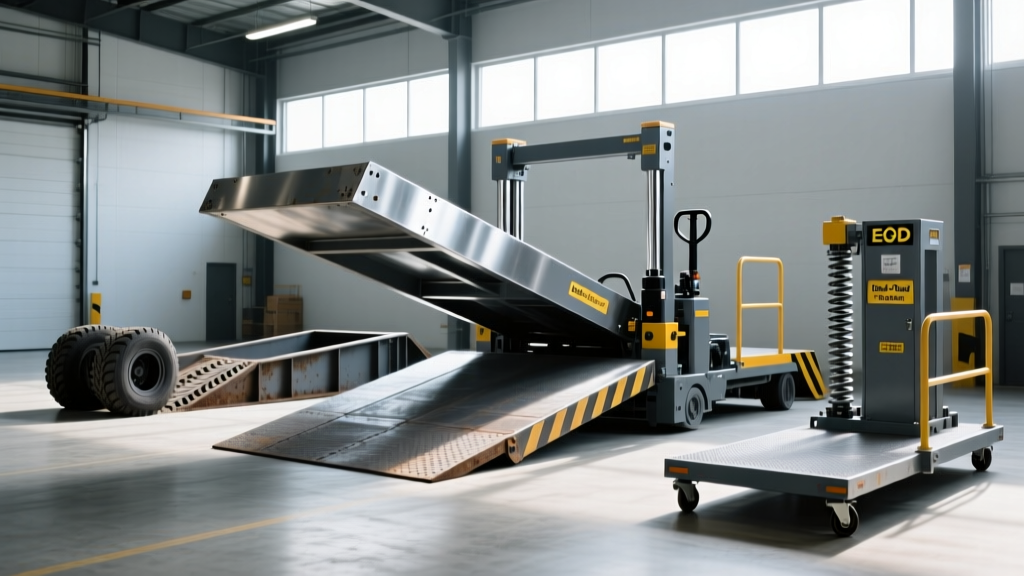
For facilities without raised concrete docks, mobile yard ramps (manufactured by companies like Copperloy and Bluff) allow forklifts to drive directly from the ground into a truck trailer. These are constructed of heavy-gauge steel with serrated grating for traction.
- Cost: $5,000 to $12,000 depending on capacity (15,000 lbs to 30,000 lbs) and width.
- Operational Drawback: They require 15 to 20 feet of concrete apron space to achieve a safe incline angle (typically 15 to 18 degrees). They also require a forklift to reposition them, consuming valuable labor hours.
- Failure Mode: Ramp creep. If the safety chains are not secured to the truck's ICC bar (rear impact guard), the repeated vibration of forklift traffic will push the ramp away from the trailer, creating a fatal drop-off.
Dock Plates and Boards
Dock plates are flat sheets of aluminum or steel used to cover the gap between the dock and the truck. They are the cheapest alternative but carry the highest risk profile.
- Aluminum Boards: $400 to $800. Rated for manual pallet jacks and light electric walkies (up to 3,000 lbs). Never use for counterbalance forklifts.
- Steel Plates: $600 to $1,500. Rated for heavy forklifts (up to 15,000 lbs).
- The Curb Hazard: Plates without built-in curbs (side rails) are a massive liability. If a forklift veers two inches off-center, the drive tires will slip off the plate edge, resulting in a dropped load or a tipped forklift. According to OSHA warehouse safety guidelines, unsecured dock plates are a leading cause of loading dock strike and fall incidents.
Real-World Failure Modes and Safety Interlocks
Understanding equipment limits is only half the battle; anticipating how they fail under 2026 operational stress is what separates competent facility planning from reactive maintenance.
- Lip Hinge Shear Stress: The hinge connecting the deck to the lip is subjected to immense point-loads. When narrow-aisle forklifts with solid pneumatic tires cross the hinge at an angle, the sheer force can crack standard welds. Specify levelers with a continuous, full-width hinge pin (minimum 1-inch diameter alloy steel) rather than intermittent hinge segments.
- Trailer Creep and Separation: As forklifts push into a trailer, the force can push the truck away from the dock. Pit levelers do not prevent this. You must pair your leveler with a vehicle restraint system (dock lock) that hooks onto the trailer's rear impact guard. Operating a leveler without a restraint violates core safety protocols.
- Velocity Fuses: Modern hydraulic levelers must be equipped with automatic velocity fuses. If a truck pulls away while a forklift is on the deck, the fuse detects the rapid drop in hydraulic pressure and instantly locks the cylinder, preventing the forklift from crashing into the driveway.
Decision Framework: Matching Equipment to Your Throughput
Do not default to the most expensive option, but never compromise on load capacity. Use this framework to finalize your loading bay specifications:
Procurement Flowchart
- Scenario A: High-Volume Cross-Docking (50+ trucks/day). Choose Hydraulic Pit Levelers paired with automatic vehicle restraints. The speed of push-button operation and automatic lip extension pays for the capital premium within 14 months through reduced truck dwell time.
- Scenario B: Low-Volume Receiving (1-5 trucks/day) on a Budget. Choose Mechanical Pit Levelers. The lower upfront cost and zero electrical requirements make sense, provided you schedule bi-annual spring maintenance.
- Scenario C: Standardized Fleet Only (No 3rd Party Carriers). Choose Edge-of-Dock Levelers. If your own trucks always present a bed height within 3 inches of your dock, EODs eliminate the need for expensive pit excavation.
- Scenario D: Ground-Level Facility / No Raised Dock. Choose Mobile Yard Ramps with steel serrated grating. Ensure you purchase wheel chocks and safety chains as a mandatory bundle.
Ultimately, answering the question of what material handling equipment is right for your dock requires looking past the brochure. It demands a rigorous analysis of your specific truck fleet variance, forklift axle loads, and the hidden maintenance costs of hydraulic seals versus mechanical springs over a 15-year lifecycle.