Bulk Material Handling and Equipment Guide: Mining & Agriculture
Compare bulk material handling and equipment for mining vs. agriculture. Expert buying guide covering conveyors, elevators, costs, and failure modes.
The Core Divide: Abrasive Ores vs. Combustible Organics
Selecting the right bulk material handling and equipment for heavy industries requires a fundamental understanding of material rheology. Mining operations move high-density, highly abrasive, and often sharp materials like iron ore, copper concentrate, and aggregate. Agriculture moves low-density, fragile, and potentially combustible organic materials like corn, wheat, soybeans, and fertilizer. A system engineered for the former will catastrophically degrade the latter, while a system built for the latter will be destroyed in weeks by the former.
Decision Matrix: Material Characterization- Mining (Iron Ore/Aggregate): Angle of repose 30°–45°. Bulk density 1,500–2,500 kg/m³. High abrasiveness. Requires AR400/AR500 steel, impact beds, and steel-cord belting.
- Agriculture (Grain/Biomass): Angle of repose 25°–30°. Bulk density 600–800 kg/m³. Low abrasiveness but high fragility and combustible dust risk. Requires 304 stainless steel, food-grade epoxy, and centrifugal discharge elevators.
Mining Sector: Heavy-Duty Material Handling and Equipment Selection
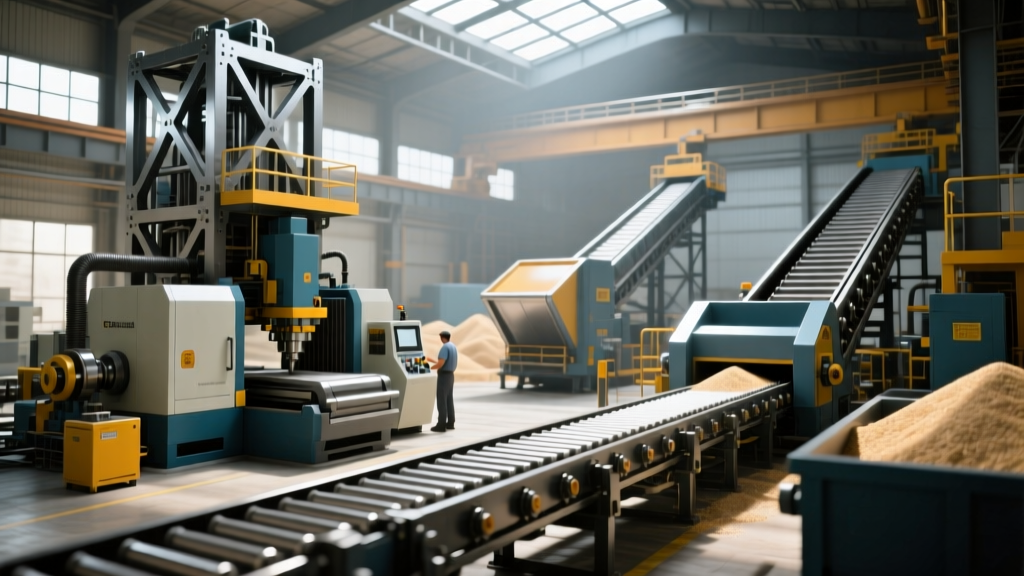
Mining environments demand equipment that can survive extreme tension, impact, and abrasive wear. The capital expenditure for mining conveyors is justified by their continuous 24/7 operation and massive throughput requirements, often exceeding 10,000 tons per hour (TPH).
Overland and Pipe Conveyors
For moving material from the pit to the processing plant, overland belt conveyors are the standard. As of 2026, the shift toward high-tensile steel cord belts (ST2000 to ST5000 ratings) allows for single-flight lengths exceeding 15 kilometers, eliminating costly transfer points. Pipe conveyors, which enclose the material in a tubular shape, are increasingly specified for environmental compliance to suppress dust and prevent material spillage over waterways or public roads.
Buying Specifics: Specify 1200mm to 2400mm belt widths operating at 3.0 to 5.0 m/s. Ensure drive systems utilize Variable Frequency Drives (VFDs) with regenerative braking capabilities for downhill conveyors, which can actually feed power back into the mine's grid. Expect installed costs between $2,500 and $4,500 per linear meter for heavy-duty overland systems.
Apron Feeders and Drag Chains
At the primary crusher or hopper discharge, belt conveyors fail under the impact of raw, blasted rock. Apron feeders utilize overlapping steel pans mounted on heavy-duty crawler chains to handle the shock load. When specifying an apron feeder, demand manganese steel pans (minimum 12-14% Mn content) for work-hardening properties, and ensure the drive sprockets feature replaceable, segmented rims to minimize downtime during maintenance.
| Equipment Type | Estimated Capital Cost | Expected Structural Lifespan | Primary Failure Mode |
|---|---|---|---|
| Overland Belt Conveyor | $1.5M – $8M+ | 25–30 years | Belt edge wear, pulley lagging failure |
| Heavy-Duty Apron Feeder | $350,000 – $900,000 | 15–20 years | Chain elongation, pan cracking |
| Vibrating Grizzly Feeder | $120,000 – $280,000 | 10–15 years | Bearing fatigue, structural resonance |
Agriculture Sector: High-Volume, Low-Degradation Handling
Agricultural bulk handling prioritizes the preservation of the product's physical integrity and the mitigation of explosive dust environments. A cracked corn kernel or damaged soybean coat directly reduces the market value of the crop at the elevator or export terminal.
Bucket Elevators and En-Masse Conveyors
For vertical lift in grain silos and export terminals, continuous bucket elevators are preferred over centrifugal discharge models when handling fragile seeds or pellets. Continuous buckets utilize gravity discharge at the head pulley, significantly reducing product degradation. For horizontal movement, en-masse (drag chain) conveyors move grain in a solid, undisturbed mass, utilizing UHMW (Ultra-High-Molecular-Weight) polyethylene liners to prevent metal-on-grain friction.
Buying Specifics: Target capacities of 10,000 to 30,000 bushels per hour. Specify 304-grade stainless steel for all product contact surfaces to prevent rust contamination and ensure washdown compliance. Budget $120,000 to $350,000 for heavy-duty, galvanized or stainless bucket elevators, including motorized inspection doors and zero-speed switches.
WARNING: Combustible Dust ComplianceAgricultural facilities generate fine organic dust that is highly explosive. Equipment selection must strictly adhere to OSHA's Grain Handling Facilities standard (1910.272) and NFPA 652. Specify explosion-proof (Class II, Division 1) motors, anti-static belting, and integrated dust collection systems that maintain internal velocities above 4,000 FPM to prevent dust settling inside the ductwork.
Hopper and Silo Discharge Systems
Mass flow silos are critical in agriculture to ensure first-in, first-out (FIFO) inventory rotation, preventing grain spoilage. When buying discharge equipment, avoid standard flat-bottom sweep augers for high-moisture grains, which tend to pack and bridge. Instead, invest in live-bottom screw feeders or multi-point aeration systems that fluidize the material, ensuring reliable gravity flow.
Critical Component Upgrades: Where to Allocate Capital
Whether in mining or agriculture, the base structure of a conveyor or elevator is relatively static. The return on investment (ROI) is found in the peripheral components that reduce unplanned downtime. According to the Conveyor Equipment Manufacturers Association (CEMA), up to 80% of conveyor maintenance costs are tied to spillage, mistracking, and bearing failures.
- Primary Belt Cleaners: Do not rely on secondary scrapers alone. Install tungsten-carbide tipped primary cleaners (e.g., Martin Engineering CleanSCrape) directly at the head pulley. Cost: $2,500–$4,500 per unit. ROI is realized within 6 months via reduced carryback and cleanup labor.
- Sealed Spherical Roller Bearings: Standard pillow block bearings fail rapidly in dusty environments. Upgrade to triple-labyrinth sealed, grease-purged spherical roller bearings (e.g., SKF or Timken). Cost: $800–$1,500 per housing. They extend bearing life from 12 months to over 5 years in high-contamination zones.
- Impact Cradles vs. Impact Rollers: At loading zones, replace standard steel impact rollers with slider bed impact cradles featuring UHMW top covers and rubber shock absorbers. This prevents belt punctures from sharp mining aggregates, protecting a $150,000 belt from a $5,000 rock strike.
5-Step Procurement Framework for Bulk Systems
To avoid catastrophic specification errors, engineering and procurement teams should follow this sequential framework when tendering for bulk material handling and equipment:
- Material Rheology Testing: Do not guess the angle of repose or moisture content. Send 50kg samples to a bulk solids testing lab to determine exact flowability, abrasiveness (Miller Number), and bulk density at varying moisture levels.
- Route Topography & Civil Integration: Map the exact footprint. For overland conveyors, utilize LiDAR drone surveys to identify vertical curves and optimize drive placement. Downhill routes require dynamic braking resistors or regenerative VFDs.
- Drive & Motor Sizing: Calculate starting torque requirements, which can be 150% to 200% of running torque in cold climates or fully loaded states. Undersized motors will trip breakers on startup.
- Transfer Point Engineering: The majority of dust and degradation occurs where material drops from one belt to another. Specify engineered transfer chutes with hood and spoon configurations to match the material's trajectory and velocity, minimizing impact and air induction.
- Automation & SCADA Integration: Modern systems must include belt sway switches, pull-cord emergency stops, and acoustic bearing monitors integrated into the plant's central SCADA system. As highlighted by the Society for Mining, Metallurgy & Exploration (SME), predictive maintenance via IoT sensors is now a baseline requirement for Tier-1 mining operations.
"The most expensive bulk handling system is the one you have to retrofit for dust containment and belt tracking six months after commissioning. Front-load your capital expenditure into transfer point geometry and sealing systems, and your operational expenditure will drop by double digits."