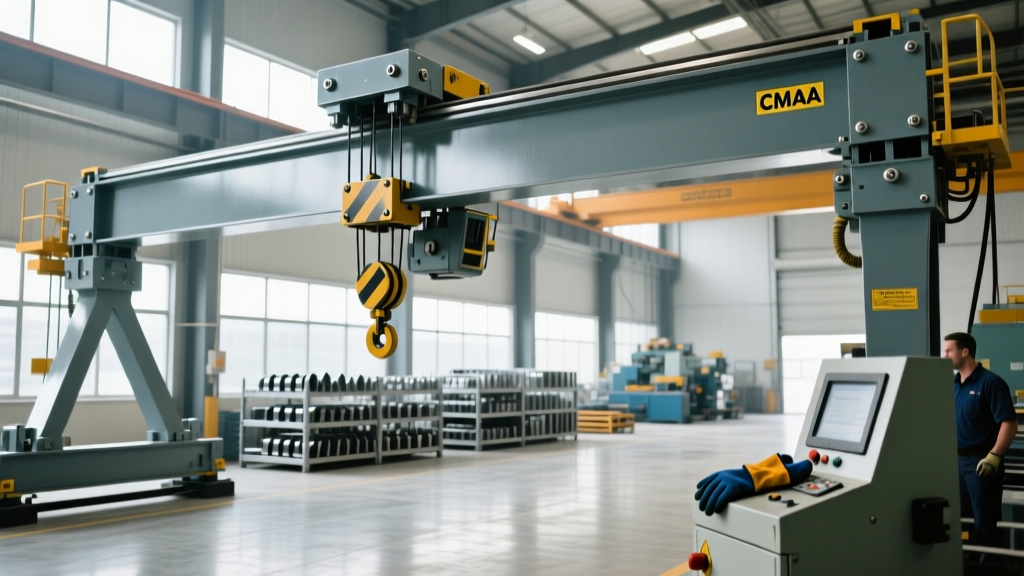
Safe Use of Material Handling Equipment: Bridge Crane Maintenance
Master the safe use of material handling equipment with our bridge crane maintenance guide. Includes CMAA schedules, failure modes, and IoT diagnostics.
The Hidden Costs of Neglecting Bridge Crane Service Intervals
In heavy manufacturing and steel service centers, the daily use of material handling equipment is the lifeblood of production throughput. Among these assets, top-running and underhung bridge crane systems represent the highest concentration of kinetic energy and lifting risk. When facility managers treat overhead cranes as 'run-to-failure' assets, the financial penalties are severe. In high-volume automotive stamping plants, unplanned downtime on a 50-ton double-girder bridge crane can cost upwards of $20,000 per hour in halted line production.
Proper maintenance is not merely about regulatory compliance; it is an operational imperative. Adhering to the Crane Manufacturers Association of America (CMAA) Specification No. 70 (Single Girder) and No. 74 (Double Girder) ensures structural longevity, while strict alignment with OSHA 1910.179 standards mitigates catastrophic liability. This guide details the exact service schedules, component-specific failure modes, and predictive diagnostic frameworks required to maintain modern overhead crane configurations.
⚠️ OSHA Compliance Warning: Under 29 CFR 1910.179(j)(1)(i), a daily visual inspection of the hoist rope, hooks, and functional operating mechanisms is legally mandated before the first shift. Failure to maintain documented daily inspection logs is one of the most frequently cited OSHA violations in material handling facilities, carrying penalties exceeding $16,131 per instance in 2026.Decoding the Inspection Matrix: Daily, Monthly, and Annual
The CMAA technical guidelines categorize crane service into three distinct classes: Normal, Heavy, and Severe. A foundry operating a magnet-equipped bridge crane 24/7 falls under 'Severe' service, demanding compressed maintenance intervals compared to a 'Normal' service warehouse crane used sporadically. Below is the baseline maintenance frequency matrix for a standard heavy-duty top-running bridge crane.
| Interval | Component Focus | Actionable Metrics & Tolerances |
|---|---|---|
| Daily | Wire rope, hooks, limit switches, brakes | Check for upper/lower limit switch actuation. Inspect hook throat opening for >5% stretch. |
| Monthly | Hoist brakes, end truck wheels, festoon systems | Measure brake lining thickness (discard at <1.5mm). Check wheel flange wear (discard at >3mm). |
| Annually | Gearboxes, structural welds, sheaves, runway beams | NDT (magnetic particle) on hook shanks. Gearbox oil analysis for ferrous particulates. Runway rail alignment survey. |
Component-Specific Failure Modes in Top-Running Configurations
Generalized maintenance checklists fail to address the nuanced physics of bridge crane operation. To optimize the use of material handling equipment, maintenance teams must understand the specific degradation pathways of critical sub-assemblies.
Wire Rope Degradation and Sheave Wear
Most heavy-duty hoists utilize 6x37 Independent Wire Rope Core (IWRC) classifications for their balance of flexibility and abrasion resistance. The most common failure mode is not sudden snapping, but progressive fatigue caused by improper sheave-to-rope diameter ratios (D/d). If a sheave groove is worn too wide, the rope flattens; if too narrow, it pinches.
Discard Criteria: Per ASME B30.2, wire rope must be immediately replaced if inspectors identify six randomly distributed broken wires in one rope lay, or three broken wires in one strand in a single lay. Additionally, a reduction of more than 1/3 in the outer wire diameter mandates replacement. Replacing a 50-foot reeving of 3/4-inch 6x37 IWRC typically costs between $1,800 and $3,200, factoring in labor and downtime.
Festoon System and Conductor Bar Failures
The electrification system is the nervous system of the crane. In C-track festoon systems, polyurethane trolley wheels are prone to flat-spotting if the crane sits idle under load or experiences sudden jerks. A flat-spotted wheel creates a rhythmic vibration that eventually shakes the copper terminal lugs loose, resulting in intermittent 480V 3-phase power drops that burn out hoist motor contactors. For enclosed conductor bar systems (like Vahle or Conductix), carbon brush wear must be monitored. When the brush wear indicator line is breached, the copper collector shoe will score the steel conductor rail, turning a $50 brush replacement into a $15,000 busbar overhaul.
Advanced Diagnostics: Moving Beyond the Clipboard
By 2026, leading facilities have transitioned from calendar-based preventive maintenance to condition-based predictive maintenance (PdM), drastically altering the economics of the use of material handling equipment.
Infrared Thermography on Electrical Panels
Loose connections in the crane's main disconnect or hoist reversing contactors generate excess heat. Using a FLIR infrared camera, technicians should scan electrical panels under a minimum 40% load. A thermal anomaly exceeding 15°C (27°F) above ambient phase temperatures indicates a failing connection that will inevitably lead to single-phasing and motor burnout.
Vibration Analysis and IoT Telemetry
Modern hoists, such as the Konecranes CXT series equipped with TRUCONNECT® remote monitoring, utilize embedded sensors to track brake slip, motor starts, and load spectra. For legacy cranes, retrofitting triaxial accelerometers to the hoist gearbox allows for vibration analysis aligned with ISO 10816 standards. An increase in velocity exceeding 4.5 mm/s RMS in the 10Hz to 1000Hz range typically signals early-stage bearing pitting on the high-speed input shaft, allowing for planned replacement during a weekend shutdown rather than an emergency Tuesday morning failure.
💡 Cost-Benefit Data: Predictive vs. Reactive
- Reactive Gearbox Replacement: $18,500 (parts) + $32,000 (expedited downtime) = $50,500
- Predictive Bearing Swap: $1,200 (parts) + $2,400 (scheduled weekend labor) = $3,600
- ROI on annual vibration analysis program ($4,000/yr): 1,160%
Lubrication Protocols: The Most Overlooked Variable
Over-lubrication is as destructive as under-lubrication in bridge crane end trucks. Pumping standard multi-purpose grease into end truck wheel bearings purges the seals, allowing abrasive facility dust (especially in cement or machining environments) to infiltrate the bearing race.
The Standard: Use an NLGI Grade 2 lithium-complex grease with an extreme pressure (EP) additive. Apply exactly 3 to 5 grams per bearing port every 500 operating hours. For the open gearing on the bridge drive, a high-tack, solvent-cutback asphaltic lubricant (such as Mobiltac 375 NC) must be applied to the gear teeth quarterly to prevent flanking wear.
"The most expensive component on a bridge crane isn't the motor or the gearbox; it's the runway beam. If end truck wheels are misaligned by even 1/4 inch, the crane will 'dog-track' and literally chew through the steel flanges of a $200,000 runway structure in under three years. Annual laser-alignment surveys are non-negotiable."
— Senior Rigging Engineer, Heavy Industry Consultants
Actionable 10-Point Service Schedule Checklist
Facility managers and reliability engineers should integrate the following specific checkpoints into their CMMS (Computerized Maintenance Management System) to govern the ongoing use of material handling equipment:
- Hook Latch Integrity: Verify spring-loaded safety latches seat fully across the hook throat; replace if bent or lacking spring tension.
- Load Block Sheaves: Spin sheaves by hand during monthly PMs; any grinding noise indicates sealed bearing failure requiring immediate sheave replacement.
- Bridge Bumpers: Inspect polyurethane or rubber end-stops for dry rot or compression set exceeding 25% of original thickness.
- Runway Rail Joints: Check splice bars and bolts on crane rails; thermal expansion gaps must remain between 1/8" and 1/4".
- Pendant/Radio Control: Test the emergency stop (E-Stop) circuit weekly; it must physically sever the main control circuit, not just pause software logic.
- Hoist Brake Adjustment: Measure the air gap on DC disc brakes; adjust to manufacturer specs (typically 0.015" to 0.020") to prevent drag and overheating.
- Wire Rope Reeving: Check for 'bird-caging' or core protrusion, which indicates shock-loading or improper spooling on the drum.
- Limit Switch Redundancy: Test both the working upper-limit switch and the secondary 'ultimate' upper-limit switch independently.
- Structural Bolt Torque: Annually verify torque on end-truck-to-bridge-girder connection bolts using a calibrated hydraulic torque wrench.
- Operator Cab Ergonomics: For cab-operated cranes, inspect HVAC and joystick dead-bands; operator fatigue directly correlates to load-sway collisions.
Optimizing overhead crane systems requires shifting from a mindset of passive compliance to active reliability engineering. By enforcing strict adherence to CMAA tolerances, leveraging infrared and vibration diagnostics, and respecting the exact discard criteria of high-wear components, facilities can ensure that the use of material handling equipment remains safe, uninterrupted, and highly profitable.