AMRs vs AGVs for Bulk Material Handling Equipment Manufacturers
Compare AMRs and AGVs for bulk facilities. Learn how bulk material handling equipment manufacturers choose heavy-duty mobile robots in 2026.
The Automation Gap in Heavy-Duty Bulk Transport
When engineers design large-scale processing plants for cement, grain, mining, or chemicals, the primary focus is typically on fixed infrastructure: screw conveyors, bucket elevators, and pneumatic transport lines. However, a critical bottleneck remains in the intermediate transport of bulk materials. Moving 2-ton Flexible Intermediate Bulk Containers (FIBCs), mobile raw material hoppers, and intermediate bulk containers (IBCs) from railcar discharge points to fixed conveyor intakes requires mobile automation.
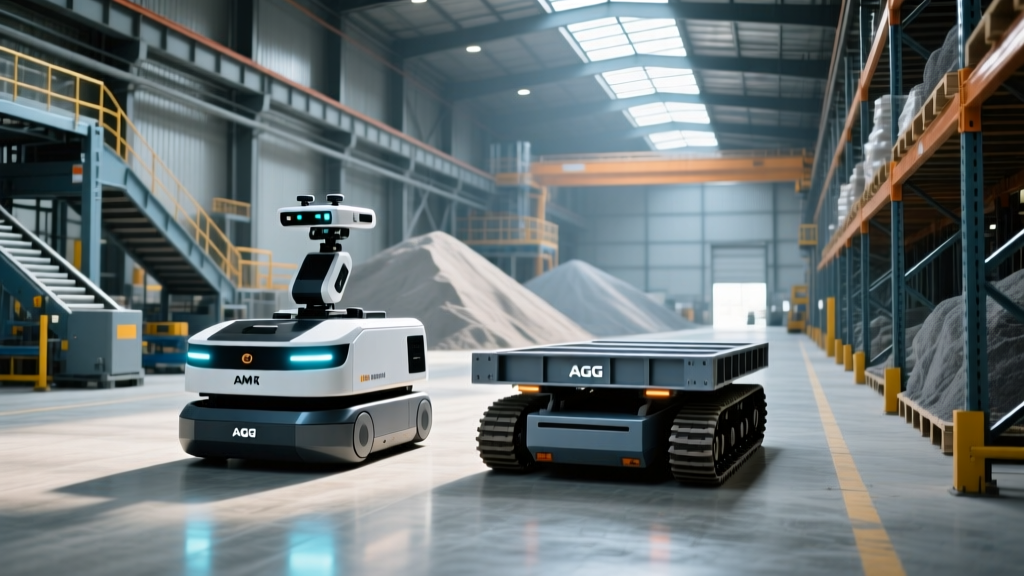
In 2026, leading bulk material handling equipment manufacturers are increasingly integrating heavy-duty mobile robotics to bridge this gap. But specifying the right technology requires a hard look at the environmental and operational realities of bulk facilities. The choice between traditional Automated Guided Vehicles (AGVs) and Autonomous Mobile Robots (AMRs) is not merely a matter of software preference; it is dictated by airborne particulate matter, payload mass, and route volatility.
2026 Market Data Highlight: According to recent industry analyses tracked by the Automated Guided Vehicle Systems Industry Group, heavy-duty mobile robotics (payloads exceeding 3,000 lbs) represent the fastest-growing automation segment in bulk processing, with a 22% year-over-year adoption rate in mining and agricultural sectors.Core Differences: Navigation, Payload, and Infrastructure
Before evaluating specific use cases, procurement teams must understand the fundamental engineering differences between these two platforms. While OTTO Motors' comprehensive guide on AGV vs AMR architectures outlines the general warehouse differences, bulk environments introduce extreme variables like floor degradation and sensor interference.
| Feature | Traditional Heavy-Duty AGV | Heavy-Duty LiDAR AMR |
|---|---|---|
| Navigation Tech | Magnetic tape, inductive wire, or optical grid | 3D LiDAR SLAM, mmWave radar fusion |
| Route Flexibility | Low (fixed paths, difficult to reroute) | High (dynamic obstacle avoidance) |
| Dust Tolerance | Excellent (immune to optical interference) | Moderate (requires sensor fusion/radar) |
| Max Payload (Standard) | Up to 50,000+ kg (custom heavy-haul) | Typically 1,500 kg to 3,000 kg |
| Base Unit Cost | $150,000 - $350,000+ | $110,000 - $160,000 |
| Infrastructure Cost | $30,000 - $100,000 (floor cutting/wiring) | $5,000 - $15,000 (fleet software/map) |
The Case for AGVs: Extreme Payloads and High-Dust Environments
Traditional AGVs remain the undisputed champions of extreme mass and high-particulate environments. When bulk material handling equipment manufacturers design systems for cement kilns or ore processing, airborne dust is a constant reality.
Overcoming the LiDAR 'Whiteout' Effect
AMRs rely on LiDAR to map their environment by bouncing laser beams off surrounding structures. In facilities handling fly ash, cement, or fine grain dust, airborne particulates scatter these laser beams. This creates a 'whiteout' effect on the LiDAR point cloud, causing the AMR's localization algorithm to fail and triggering an emergency stop.
AGVs utilizing inductive wire guidance (a wire embedded in the concrete floor) or heavy-duty magnetic tape are entirely immune to optical interference. For moving 20-ton mobile hoppers from a rotary dump to a primary jaw crusher, a heavy-duty AGV platform—such as those engineered by KUKA's heavy-duty mobility platforms—provides uninterrupted uptime regardless of air quality.
⚠️ Warning: Floor Degradation in Bulk FacilitiesIf specifying magnetic tape AGVs in a bulk facility, be aware that heavy bulk spills and aggressive floor cleaning (pressure washing with caustic chemicals) will degrade standard magnetic tape within 6 to 8 months. Procurement teams must specify heavy-duty, epoxy-encased magnetic tape or opt for inductive wire guidance cut directly into the concrete substrate to survive the harsh environment.
The Case for AMRs: Dynamic Routing and Intermediate Bulk Containers
While AGVs dominate the heaviest payloads, AMRs excel in facilities where the environment is dynamic and payloads are in the 1,000 kg to 2,500 kg range. This is particularly relevant for chemical blending, fertilizer production, and plastic resin manufacturing.
Navigating Shifting Bulk Piles and Cross-Traffic
In aggregate yards or fertilizer blending plants, bulk piles constantly shift in size and shape, and front-end loaders frequently cross designated aisles. An AGV on a fixed wire path will simply stop and wait if a loader blocks its route, halting the entire material flow. An AMR, utilizing 3D LiDAR and advanced SLAM (Simultaneous Localization and Mapping), will dynamically calculate a new path around the loader or the shifted bulk pile, maintaining continuous flow to the extrusion hoppers or packaging lines.
'The shift toward AMRs in bulk handling is driven by the need to move FIBCs (super sacks) of raw resin to extrusion lines. The footprint is smaller, the deployment takes days instead of months, and the vehicles can adapt when we reconfigure the silo layout for a new product run.'
— Lead Automation Engineer, North American Polymer Processing Facility
The 2026 Sensor Fusion Breakthrough
To combat the aforementioned dust issue, 2026 has seen the widespread commercialization of mmWave radar fusion in heavy-duty AMRs. By combining traditional LiDAR with solid-state radar—which penetrates dust and fog without scattering—AMRs can now operate reliably in moderate-dust bulk environments that would have blinded 2023-era models.
Cost-Benefit Analysis: CapEx vs. OpEx
When consulting with bulk material handling equipment manufacturers, facility managers must look beyond the sticker price of the robot. The total cost of ownership (TCO) shifts dramatically based on facility layout changes.
- AGV CapEx: High initial infrastructure cost. Cutting concrete for inductive wires in a reinforced silo foundation can cost upwards of $80,000. However, the per-vehicle cost for extreme payloads (20+ tons) is often lower than attempting to build an AMR capable of that mass.
- AMR CapEx: Lower infrastructure cost (primarily software licensing and Wi-Fi/mesh network upgrades). However, heavy-duty AMRs require expensive, custom-engineered top-modules (like automated roller decks or vacuum lifts) to interface with bulk hoppers, which can add $40,000 to the unit price.
- OpEx & Maintenance: AGVs require physical maintenance of the guide paths (repairing tape, checking wire continuity). AMRs require software maintenance, map updates, and higher compute-edge processing costs, but eliminate physical path maintenance.
Decision Framework: Which Should Your Facility Specify?
Use this if-then framework to determine the correct mobile automation spec for your bulk handling project:
- Is the payload over 5,000 kg (11,000 lbs)?
Yes ➔ Specify a heavy-duty AGV. Current AMR drive-trains and battery densities struggle with this mass efficiently over multi-shift operations.
No ➔ Proceed to step 2. - Is the environment subject to heavy airborne dust (e.g., cement, fly ash, fine grain)?
Yes ➔ Specify an inductive wire or magnetic AGV to avoid LiDAR whiteout.
No ➔ Proceed to step 3. - Do the transport routes cross paths with manual heavy machinery (loaders, forklifts) or change frequently?
Yes ➔ Specify an AMR with 3D LiDAR and mmWave radar fusion for dynamic obstacle avoidance.
No ➔ Proceed to step 4. - Is the facility floor heavily degraded or uneven?
Yes ➔ AGVs with rigid wire guidance handle minor floor undulations better than AMRs, which rely on clear floor features for localization mapping. If AMR is required, invest heavily in floor leveling first.
Integration with Fixed Bulk Equipment
Regardless of the mobile platform chosen, the handoff between the mobile robot and the fixed bulk equipment is where most failures occur. Ensure your bulk material handling equipment manufacturer designs the receiving hoppers with automated, proximity-triggered rotary airlock valves. The mobile robot must communicate via standard APIs (like VDA 5050) to the facility's PLC, confirming exact alignment before the hopper grate opens, preventing catastrophic bulk spills onto the facility floor.
Related reading

Integrating New Material Handling Equipment: AGV Navigation Specs
Conveyor Belts for Bulk Material Handling Equipment: Case Studies