Battery vs Propane: Material Handling Equipment Financing in 2026
Compare battery and propane forklifts through a 2026 case study. Learn how material handling equipment financing impacts TCO and fleet decisions.
The Fleet Dilemma: Propane vs. Lithium-Ion in Modern Warehousing
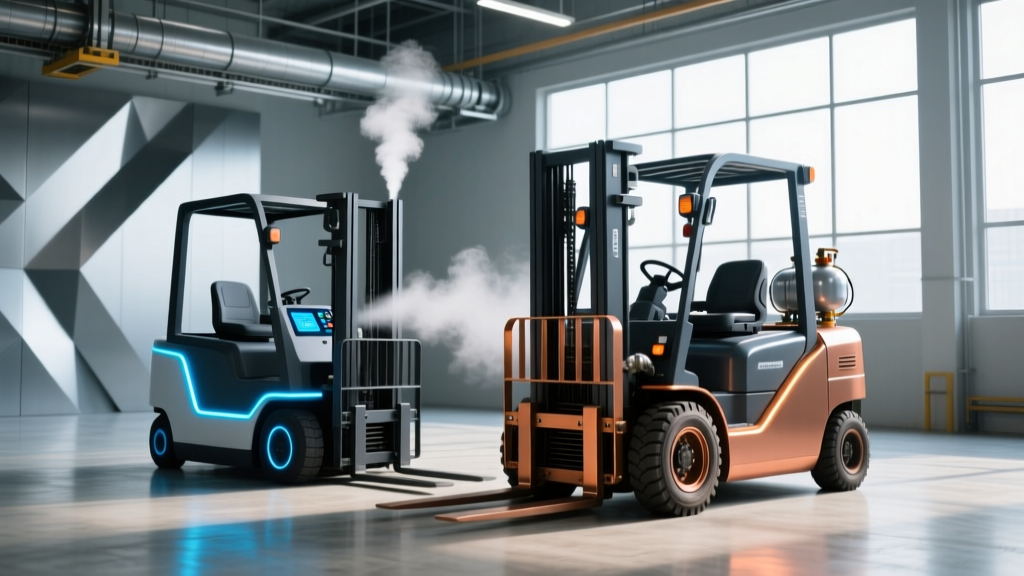
Transitioning a forklift fleet from internal combustion (IC) propane to lithium-ion (Li-ion) electric power is no longer just an environmental initiative; it is a complex financial restructuring. While Li-ion trucks offer zero tailpipe emissions and eliminate battery swap-room infrastructure, the upfront capital requirements fundamentally alter how companies approach material handling equipment financing. For facility managers, the decision between a Toyota 8FGU25 (5,000 lb. propane pneumatic) and its Li-ion equivalent requires a granular analysis of total cost of ownership (TCO), tax depreciation schedules, and lender asset classifications.
Case Study: Midwest 3PL Cross-Dock Transition
Facility: 120,000 sq. ft. cross-dock operation in Columbus, Ohio.
Fleet: 15 Class 5 pneumatic forklifts operating two 10-hour shifts.
The Shift: In late 2025, the facility replaced 15 aging LP gas forklifts with 5,000 lb. Li-ion electric sit-down models. The transition required installing four 15kW high-frequency fast chargers, drawing $42,000 in electrical infrastructure upgrades.
Financial Hurdle: The facility's traditional equipment lessor refused to bundle the $42,000 electrical infrastructure into the forklift operating lease, classifying it as 'real property improvement' rather than 'movable equipment.' This forced the 3PL to secure a separate facility improvement loan at a 14% APR, whereas the primary material handling equipment financing for the trucks secured a 7.5% rate.
5-Year Total Cost of Ownership (TCO) Matrix
When evaluating material handling equipment financing options, lenders and CFOs look closely at the 60-month TCO. The following matrix breaks down the operational realities of maintaining a single 5,000 lb. capacity forklift over a standard 5-year, 10,000-hour lifecycle.
| Cost Category | Propane IC Forklift | Li-Ion Electric Forklift |
|---|---|---|
| Base Equipment Purchase Price | $32,000 - $36,000 | $48,000 - $55,000 (incl. integrated battery) |
| Fuel / Energy (10,000 hrs) | $28,500 (assuming $4.10/gal LP) | $8,400 (assuming $0.14/kWh) |
| Scheduled Maintenance (Fluids, Filters) | $6,200 | $1,100 (greasing, brake checks) |
| Infrastructure / Charging Setup | $2,500 (cage, external tank pad) | $8,000 (charger, panel upgrade) |
| End-of-Term Residual Value (Est. 20%) | - $6,800 | - $4,500 (Li-ion battery degradation risk) |
| Net 5-Year TCO | $62,400 | $60,000 |
While the Li-ion model achieves a lower net TCO over five years, the front-loaded capital requirement is nearly 50% higher. This delta dictates the financing strategy.
Navigating Material Handling Equipment Financing
Securing optimal material handling equipment financing requires understanding how lenders classify the assets on their UCC-1 financing statements. The physical nature of propane versus electric power sources creates distinct lending risks.
Capitalizing Battery Infrastructure vs. Fuel Contracts
Propane forklifts rely on OpEx fuel contracts. You lease or buy the truck, and the local gas supplier provides the tanks and fuel on a per-gallon delivery basis. Lenders love this model because the collateral (the forklift) is a standalone, easily liquidated hard asset. If the borrower defaults, the lender repossesses the truck and sells it at auction.
Li-ion electric forklifts, however, require on-site charging infrastructure. High-frequency fast chargers cost between $6,000 and $12,000 each and require hardwired 480V three-phase electrical drops. Many equipment financing companies strictly prohibit using equipment loans to fund 'real property improvements' like trenching, conduit, and electrical panels. To finance a Li-ion fleet, facility managers must often negotiate a Vendor Master Agreement that bundles the charger into the truck's MSRP as a 'factory-installed accessory,' allowing the lender to classify the entire package as movable equipment.
⚠️ Warning: The Split-Ownership TrapNever finance a Li-ion battery under a separate agreement from the forklift chassis. If the truck and battery are financed by two different entities, or if the battery is on an operating lease while the truck is purchased, you create a 'split-ownership' scenario. In the event of a default or insurance total-loss claim, untangling the lienholder rights between the chassis and the power source can delay payouts by months. Always insist on a single UCC-1 filing covering the integrated unit.
Lease Structures and Residual Value Risks
The Tax Cuts and Jobs Act (TCJA) bonus depreciation schedule phases down to 20% in 2026. This reduction makes purchasing with cash or standard term loans less attractive from a first-year tax shield perspective, pushing many fleets toward Fair Market Value (FMV) operating leases.
When structuring an FMV lease for electric forklifts, lessors will scrutinize the lithium-ion battery's health metrics. Unlike lead-acid batteries—which are universally understood and easily replaced for $5,000—Li-ion batteries are proprietary, serialized, and integrated into the truck's Battery Management System (BMS). Lessors often apply a 15% to 20% residual value haircut on electric models compared to propane models to hedge against the risk of battery degradation rendering the truck un-leasable at the end of a 60-month term. To counter this, negotiate a guaranteed buy-back clause with the OEM dealer, shifting the residual risk from the financial institution back to the manufacturer.
Maintenance & Downtime Cost Variables
Financing payments are fixed, but maintenance costs are variable and directly impact the cash flow required to service the debt. According to OSHA's powered industrial truck guidelines, proper maintenance is not just a financial issue but a strict regulatory compliance requirement.
- Propane IC Engines: Require oil changes every 250 hours, coolant flushes, spark plug replacements, and catalytic converter inspections. In multi-shift environments, a propane forklift will spend roughly 4% to 6% of its total lifecycle hours in the shop for scheduled PM (Preventative Maintenance).
- Li-Ion Electric Drivetrains: Eliminate engine, transmission, and exhaust maintenance. However, they introduce new failure modes: BMS software faults, cooling fan failures in the battery casing, and contactor welding. While shop time drops to roughly 1.5% of lifecycle hours, the cost per repair event is significantly higher due to the requirement for certified high-voltage technicians.
Application-Specific Recommendations
The choice between propane and Li-ion should be dictated by your specific operational profile, which in turn informs your material handling equipment financing strategy.
When to Finance Propane Fleets
- Outdoor Lumber and Aggregates: If your Class 5 pneumatic forklifts operate primarily outdoors in freezing temperatures or heavy dust, propane remains superior. Li-ion batteries suffer from voltage sag in sub-32°F environments unless equipped with expensive integrated thermal management systems.
- High-Intensity Multi-Shift with No Downtime: If you run three 8-hour shifts with only 30-minute breaks, propane allows for a 5-minute tank swap. While Li-ion opportunity charging is fast, it requires strict operator discipline to plug in during breaks; failure to do so results in dead trucks by hour six.
- Cash-Flow Constrained Startups: If your facility lacks the capital for electrical panel upgrades, the lower upfront equipment cost and OpEx fuel model of propane preserves working capital.
When to Finance Li-Ion Electric Fleets
- Food, Beverage, and Cold Storage: Propane emissions are unacceptable in USDA/FDA regulated environments. Li-ion electric trucks produce zero emissions and eliminate the risk of lead-acid battery acid contamination. Furthermore, Li-ion batteries do not suffer the same catastrophic capacity loss in cold storage (-10°F to 34°F) as traditional lead-acid batteries.
- High-Utilization Single/Double Shifts: If your trucks can be plugged into high-frequency chargers during two daily 30-minute breaks and a 1-hour lunch, Li-ion opportunity charging will easily sustain the fleet without requiring a battery swap room.
- Leveraging Clean Energy Incentives: Consult with your CPA regarding local utility rebates for EV infrastructure and federal clean vehicle credits. Programs outlined by the SBA and associated green energy initiatives can sometimes be layered with equipment financing to offset the initial CapEx of chargers.
Strategic Takeaways for Fleet Managers
The transition from propane to battery power is a financial restructuring as much as an operational one. When evaluating material handling equipment financing in 2026, do not look at the sticker price of the forklift in isolation. Map out the electrical infrastructure requirements, negotiate vendor master agreements to bundle chargers into the equipment loan, and secure guaranteed residual buy-backs to protect your FMV lease structures. By aligning your power source with your specific shift patterns and environmental constraints, you can leverage modern financing to turn a high-CapEx liability into a long-term OpEx advantage.
'The biggest mistake facilities make is treating a lithium-ion forklift purchase like a propane forklift purchase. You aren't just buying a truck; you are buying a localized micro-grid. Your financing structure must reflect that infrastructure reality.' — Director of Fleet Procurement, National 3PL Provider