AMR vs AGV: CA Storeroom Material Handling Installations 2026
Compare AMRs and traditional AGVs for California storerooms. Includes 2026 cost analysis, Cal/OSHA compliance, and SLAM vs wire-guided navigation specs.
The transition from Automated Guided Vehicles (AGVs) to Autonomous Mobile Robots (AMRs) is no longer a speculative upgrade; it is a financial and operational imperative for West Coast logistics hubs. In 2026, the average warehouse wage in California's Inland Empire and Silicon Valley corridors exceeds $26.00 per hour, pushing facility managers to evaluate automation ROI with extreme precision. While traditional AGVs have moved pallets for decades, the rise of SLAM (Simultaneous Localization and Mapping) navigation has fundamentally altered the deployment matrix for confined spaces.
2026 West Coast Automation Data Highlight:• Average AMR deployment ROI in CA high-bay storerooms: 14.2 months.
• Infrastructure modification costs for wire-guided AGVs: $18 - $24 per linear foot.
• Cal/OSHA citations for automated vehicle pedestrian separation increased 22% year-over-year.
Navigation Architectures: Magnetic Tape vs. LiDAR SLAM
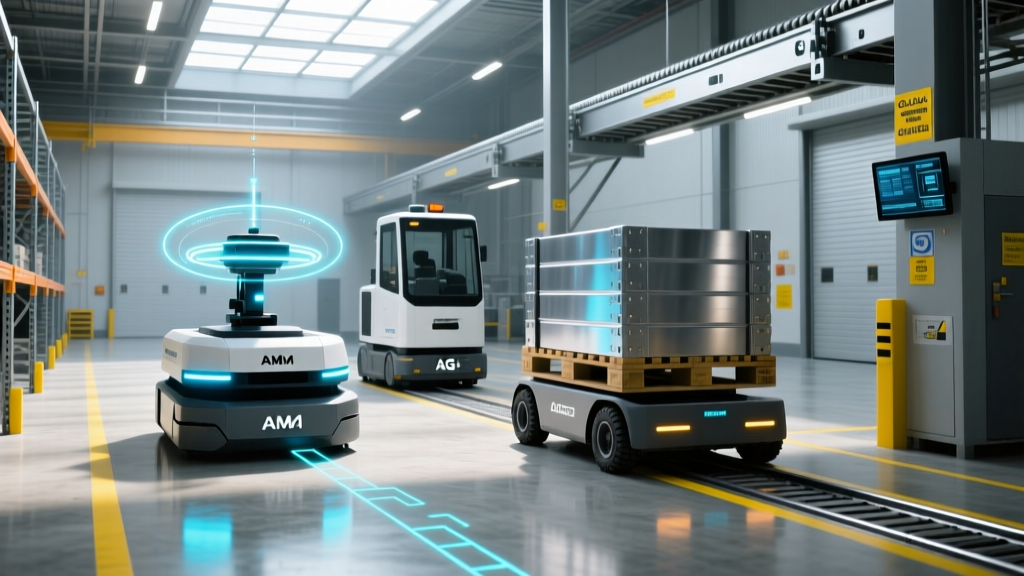
The core distinction between an AGV and an AMR lies in how it perceives and reacts to its environment. Traditional AGVs operate on fixed, predefined paths. They rely on magnetic tape, painted lines, or induction wires embedded in the concrete. If a pallet is dropped in the path, a standard AGV will halt and trigger an alarm, requiring human intervention to clear the obstacle and reset the system.
Conversely, AMRs utilize onboard compute modules paired with 2D and 3D LiDAR sensors—such as the SICK microScan3 Pro or Hokuyo UST-series—to map the facility dynamically. An AMR navigating a narrow storeroom aisle will detect a forklift blocking its path, calculate an alternative route using its internal map, and reroute without dropping its payload or halting the broader workflow.
Hardware Comparison Matrix
| Feature | Traditional Wire-Guided AGV | Vision-Guided AGV (e.g., Seegrid) | SLAM AMR (e.g., MiR250 / Fetch Freight1500) |
|---|---|---|---|
| Navigation Method | Induction wire / Magnetic tape | Overhead 3D camera mapping | 2D/3D LiDAR SLAM + Odometry |
| Obstacle Avoidance | Stop-only (E-stop bumpers) | Stop and basic reroute | Dynamic path recalculation |
| Infrastructure Needed | High (floor cutting, taping) | Low (requires stable overhead lighting) | None (maps existing environment) |
| Route Changeover Time | Days to Weeks | Hours (re-driving the route) | Minutes (software update via fleet manager) |
| Unit CapEx (2026 Est.) | $18,000 - $25,000 | $30,000 - $40,000 | $32,000 - $48,000 |
Regional Nuances: Navigating California's Regulatory Matrix
When scoping storeroom integrated material handling equipment installations, California logistics directors face a unique regulatory and operational landscape that heavily favors the flexibility of AMRs over rigid AGV systems. The state's building codes, energy mandates, and labor laws dictate how automation must be deployed.
Seismic Bracing and Charging Infrastructure
California's stringent seismic building codes require all heavy, freestanding equipment to be anchored to the slab. Traditional AGV charging stations, which often utilize large, heavy lead-acid battery swap mechanisms or high-current contact pads, require extensive core drilling and epoxy anchoring. If a facility reconfigures its storeroom layout—a common occurrence in high-turnover 3PL (third-party logistics) operations—relocating these anchored AGV chargers incurs severe concrete repair and re-certification costs.
Modern AMRs utilize lithium-iron-phosphate (LiFePO4) batteries with opportunity-charging protocols. Their charging pads are low-profile, draw less peak current, and can be mounted to structural columns rather than the floor, bypassing extensive slab modification and complying more easily with local seismic retrofitting mandates.
Title 24 Energy Compliance
California's Title 24 energy efficiency standards heavily regulate industrial power consumption. AMR fleet management software (such as Zebra's Fetchcore or MiR Fleet) includes intelligent energy-routing algorithms. These systems dispatch the robot with the highest state-of-charge (SoC) to the next task and route low-SoC units to chargers during off-peak utility hours, ensuring facility managers avoid peak-demand utility penalties common in Southern California Edison and PG&E territories.
Cal/OSHA Compliance and Pedestrian Separation
Safety is the primary friction point in automated storerooms. According to Cal/OSHA Title 8 Section 3328, machinery and equipment must be designed and installed to prevent operator contact with hazardous moving parts. While this statute was written with traditional machinery in mind, enforcement agencies increasingly apply these principles to mobile robotics.
Warning: The 'Blue Spot' FallacyMany traditional AGVs rely on a projected blue LED spot on the floor to warn pedestrians of an approaching vehicle at blind intersections. In 2026, Cal/OSHA inspectors routinely flag this as insufficient in high-noise, high-traffic storerooms. AMRs equipped with 360-degree PL-d rated safety LiDAR (creating virtual 'slowdown' and 'stop' zones dynamically based on the robot's speed and turning radius) provide a much stronger defense against regulatory citations.
Furthermore, the OSHA Guidelines for Robotics Safety emphasize the necessity of redundant braking systems. When specifying an AMR for a California facility, ensure the unit features an independent, hardware-level safety controller (like a Pilz PNOZ or SICK Flexi Soft) that cuts power to the drive motors if the primary software stack crashes, engaging mechanical fail-safe brakes instantly.
Financial Breakdown: CapEx vs. Hidden OpEx
Facility managers often default to traditional AGVs due to a lower initial unit price. However, evaluating the Total Cost of Ownership (TCO) reveals a different reality for storeroom environments.
- Infrastructure OpEx: Magnetic tape degrades under heavy forklift traffic. In a busy 50,000 sq. ft. storeroom, re-taping AGV routes costs approximately $4,500 to $6,000 annually in materials and labor. AMRs eliminate this cost entirely.
- Downtime Costs: If a wire-guided AGV's induction wire is severed by a dropped pallet jack, the entire loop goes down. Repair requires concrete sawing, wire splicing, and epoxy curing (12-24 hours). An AMR encountering a blocked zone simply maps around it, resulting in zero downtime.
- Software Licensing: AMRs require annual fleet management software licenses, typically ranging from $2,500 to $4,000 per robot, per year. This is a new OpEx line item that AGV deployments generally do not carry.
Step-by-Step AMR Deployment in Legacy Storerooms
Deploying SLAM-based robotics in older, poorly lit, or highly dynamic storerooms requires a methodical approach to ensure the LiDAR does not suffer from 'map drift' or localization failure.
- Environmental Audit (Week 1): Identify 'glass zones' and highly reflective surfaces (e.g., polished aluminum racking). LiDAR lasers pass through glass or scatter off mirrors, causing localization errors. Apply matte-black anti-reflective tape to the bottom 3 feet of glass partitions.
- Static Feature Mapping (Week 2): Drive the AMR manually through the facility to build the base map. Ensure the map captures permanent structural features (steel columns, load-bearing walls) rather than temporary features (pallet stacks, seasonal racking).
- Virtual Keep-Out Zones (Week 3): Use the fleet manager software to draw red 'no-go' polygons around floor drains, dock plate edges, and areas with severe Wi-Fi dead zones.
- Integration with WMS (Week 4-6): Connect the AMR fleet API to your Warehouse Management System (e.g., SAP EWM, Manhattan Active). Configure REST API webhooks so that when a picker scans a barcode at a packing station, the WMS automatically dispatches the nearest available AMR for pallet retrieval.
Decision Framework: Which Architecture Wins?
The choice between an AGV and an AMR is not about which technology is universally superior; it is about matching the technology to the physical and operational constraints of the specific facility.
'If your storeroom moves the exact same SKU from Point A to Point B, 500 times a day, and the environment never changes, buy a wire-guided AGV. If your routes change monthly, your aisles are shared with manual forklifts, and floor space is at a premium, the AMR is the only logical investment.' — Director of Automation Integration, Inland Empire Logistics Consortium
Choose Traditional AGVs if you are operating a newly constructed, dedicated automated storage and retrieval system (AS/RS) environment where human pedestrian traffic is strictly prohibited, and the routing is permanent. Choose AMRs if you are retrofitting an existing, multi-use California storeroom where agility, rapid reconfiguration, and strict adherence to dynamic pedestrian safety zones are paramount. By prioritizing SLAM navigation and intelligent fleet routing, facility managers can secure a resilient, future-proof material handling operation capable of adapting to the volatile demands of modern supply chains.