2026 Buyer's Guide: Selecting Machining Centers CNC
Compare VMC, HMC, and 5-axis machining centers CNC for 2026 production. Includes pricing, spindle specs, and a TCO framework for equipment buyers.
The 2026 Capital Allocation Matrix
Allocating capital for machining centers CNC requires navigating a complex matrix of spindle configurations, automation readiness, and tooling interfaces. In 2026, the baseline cost of entry for a production-grade vertical machining center (VMC) has stabilized, but the premium for integrated automation and 5-axis kinematics demands rigorous financial justification. Buyers must move beyond basic work envelope dimensions and evaluate machines based on specific part geometries, chip evacuation physics, and long-term spindle rigidity. This guide provides a technical and financial framework for selecting the optimal CNC architecture for your production environment.
Configuration Decision Framework
The choice between Vertical, Horizontal, and 5-Axis configurations dictates your facility's throughput and part complexity limits. Below is a comparative analysis of benchmark models representing each category, reflecting current 2026 market pricing for fully equipped units (including chip conveyors, probing, and high-pressure coolant).
| Configuration | Reference Model | Equipped Price Range (2026) | Spindle Taper | Optimal Part Geometry |
|---|---|---|---|---|
| Vertical (VMC) | Haas VF-3SS | $110,000 - $135,000 | CAT 40 | 2.5D Prismatic, shallow cavities, plate work |
| Horizontal (HMC) | Haas EC-400 | $160,000 - $195,000 | CAT 40 | Deep pockets, high-volume cubic parts, heavy casting |
| 5-Axis Trunnion | Haas UMC-750SS | $210,000 - $260,000 | HSK-A63 / CAT 40 | Complex aerospace, impellers, compound angle features |
| 5-Axis Swivel Head | Mazak Variaxis i-800 NEO | $350,000 - $450,000+ | HSK-A63 | Large structural aerospace components, deep molds |
Spindle Taper and Tooling Interfaces
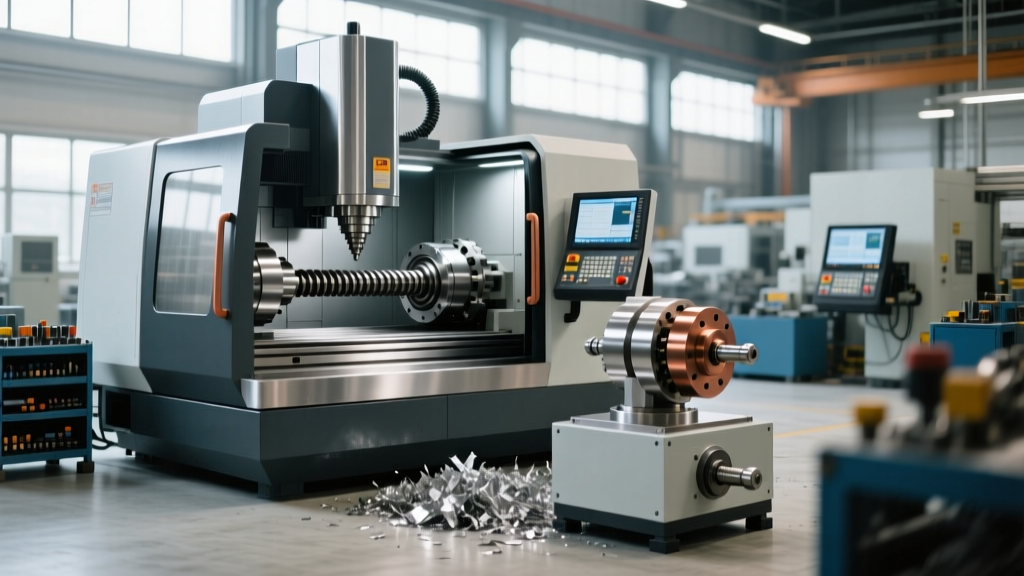
One of the most critical, yet frequently misunderstood, specifications when evaluating machining centers CNC is the spindle taper interface. The industry standard CAT 40 (or BT 40) taper relies on a 7:24 taper ratio. While highly effective for standard milling operations up to 8,000 RPM, CAT 40 interfaces suffer from radial expansion at higher speeds due to centrifugal force. As the spindle flange expands, the toolholder is pulled deeper into the spindle, altering the Z-axis gauge line and compromising depth tolerances.
For operations requiring 12,000 RPM or higher—common in aluminum aerospace structural milling and high-feed mold machining—mandating an HSK-A63 tooling system is non-negotiable. The HSK (Hollow Shank Taper) utilizes a 1:10 taper with simultaneous face-and-taper contact. The hollow shank design allows the drawbar collet to expand outward, locking the toolholder flange tightly against the spindle face as RPM increases, actually improving rigidity and Z-axis repeatability at high speeds.
⚠️ Procurement Warning: Upgrading from CAT 40 to HSK-A63 after machine delivery is mechanically impossible without a complete spindle teardown and replacement. Always specify HSK-A63 during the initial build if your CAM toolpaths dictate spindle speeds exceeding 12,000 RPM or if you require micrometer-level Z-axis repeatability for hard metal finishing.Kinematics: Trunnion vs. Swivel Head
When stepping into 5-axis machining centers CNC, buyers must choose between Trunnion (Table/Table) and Swivel Head (Head/Head or Head/Table) kinematics. This decision directly impacts payload capacity and chip evacuation.
Trunnion Table (A/C Axis)
In a trunnion setup, the table tilts (A-axis) and rotates (C-axis). Models like the Haas UMC-750SS utilize this design. Trunnion tables excel in undercutting and provide superior rigidity for heavy cutting because the spindle head remains strictly vertical or horizontal, avoiding the side-loading forces that plague swivel heads. However, the tilting table drastically reduces the effective work envelope and payload capacity. A 1,000 lb static table load may drop to 400 lbs when tilted at a 90-degree A-axis angle due to the offset center of gravity.
Swivel Head (B/C Axis)
Swivel head machines, such as the Mazak Variaxis series, keep the workpiece stationary on a massive, fixed table while the spindle articulates. This architecture is mandatory for large structural aerospace components (e.g., titanium bulkheads or wing spars) where the part weight exceeds the trunnion's tilt capacity. The trade-off is reduced rigidity during heavy roughing, as the cutting forces are applied laterally against the spindle head's rotary axes bearings.
Automation Readiness and Pallet Systems
Labor scarcity in 2026 makes automation readiness a primary selection criterion. The integration of machining centers CNC with automated material handling differs vastly between VMC and HMC architectures.
- HMC Pallet Pools: Horizontal machining centers are inherently designed for automation. An HMC equipped with a 6-pallet or 10-pallet pool (e.g., Haas Pallet Pool or Mazak Palletech) allows operators to load raw material on offline stations while the machine cuts uninterrupted. Expect to add $65,000 to $95,000 to the base HMC price for a multi-pallet system. The ROI is typically realized within 14 months in high-mix, high-volume environments due to spindle utilization rates exceeding 85%.
- VMC Cobot Tending: Vertical machining centers rely on external automation. Integrating a collaborative robot (such as a Universal Robots UR10e or FANUC CRX-10iA) with a VMC requires an automatic door actuator, air blast chip clearing, and a gripper end-of-arm tooling (EOAT). A fully integrated cobot cell adds approximately $75,000 to $90,000 to the project cost. VMC automation is best suited for high-volume, low-mix production where cycle times exceed 4 minutes, allowing the cobot to manage multiple machines.
'The hidden bottleneck in automated VMC cells is rarely the robot's speed; it is the chip evacuation. If gravity does not pull the chips away from the part and fixture, the cobot will inevitably load a blank into a nest full of chips, causing a catastrophic fixture crash. HMCs solve this inherently with horizontal gravity drop.' — Manufacturing Engineering Lead, Tier 1 Aerospace Supplier
Calculating True Total Cost of Ownership (TCO)
The sticker price of machining centers CNC represents only 60% to 70% of the first-year capital expenditure. Buyers must account for critical peripherals that are often excluded from base quotes but are mandatory for modern production standards.
| Peripheral / Option | Estimated Cost Adder | Technical Justification |
|---|---|---|
| Renishaw OMP60 Spindle Probe | $8,500 - $11,000 | Mandatory for automated part zeroing and in-cycle adaptive tool compensation. |
| 1000 PSI High-Pressure Coolant | $10,000 - $14,000 | Required for breaking chips in sticky alloys (Inconel, 316 SS) and deep hole drilling. |
| Spindle Chiller Unit | $4,500 - $6,500 | Prevents thermal growth in the spindle housing during 24/7 operations, maintaining Z-axis accuracy. |
| Through-Tool Air Blast | $2,500 - $3,500 | Critical for dry machining graphite or clearing chips from deep pockets before probing. |
Control System Nuances and Look-Ahead
The CNC controller dictates the machine's ability to execute complex 3D surface finishes. When selecting machining centers CNC for mold and die or aerospace contouring, evaluate the control's look-ahead capability. Standard controls may process 200 to 400 blocks of code ahead, which causes the machine to decelerate at sharp vector changes, resulting in dwell marks on the workpiece.
For complex 5-axis simultaneous toolpaths generated by CAM software like Mastercam or hyperMILL, specify high-speed machining options that offer 1,000 to 2,000+ block look-ahead (such as the FANUC 31i-B5 with AICC II or the Haas NGC with High-Speed Machining option). This allows the control to anticipate vector changes and maintain a constant feed rate, reducing cycle times on 3D contours by up to 30% while improving surface finish quality. Always request a standardized test cut (such as the NAS 979 circle-diamond-square test) during the machine commissioning phase to verify servo tuning and contouring accuracy before final sign-off.
Final Procurement Directives
Selecting the right equipment requires aligning machine kinematics with your specific part geometry and volume requirements. Do not over-invest in 5-axis trunnion capabilities if 90% of your revenue comes from 2.5D prismatic HMC pallet work. Conversely, do not bottleneck complex aerospace contours on a 3+2 VMC setup. Map your part family matrix against the configuration frameworks above, mandate HSK tooling for high-speed applications, and budget accurately for the automation and TCO peripherals required to keep the spindle cutting in 2026.