How 2026 AI Trends Are Reshaping 5-Axis CNC Machines
Discover how AI, volumetric compensation, and automated probing are transforming 5-axis CNC machines in 2026 for aerospace and medical part production.
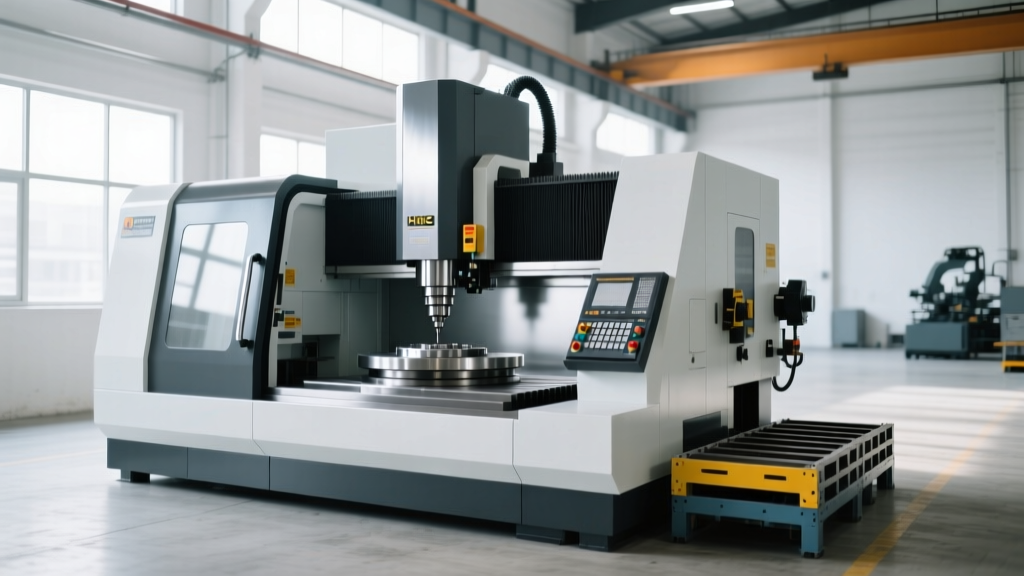
The evolution of 5-axis CNC machines has fundamentally shifted from purely kinematic precision to cognitive manufacturing. In 2026, the integration of edge-computing AI, closed-loop thermal compensation, and automated volumetric mapping is redefining complex part production. Manufacturers machining aerospace superalloys and medical-grade titanium are no longer relying solely on mechanical rigidity; they are leveraging machine learning algorithms that predict tool wear, suppress chatter in real-time, and dynamically adjust feed rates based on spindle load telemetry.
2026 5-Axis Market & Performance Data
- Market Adoption: 68% of Tier 1 aerospace suppliers now mandate 5-axis simultaneous machining for structural airframe components.
- Cycle Time Reduction: AI-optimized toolpaths are yielding an average 22% reduction in cycle times compared to traditional CAM outputs.
- Scrap Mitigation: Real-time spindle monitoring reduces scrap rates in Inconel 718 roughing operations by up to 34%.
- Price Bracket: Entry-level 5-axis trunnion machines (e.g., Haas UMC-500) start around $165,000, while high-end 5-axis milling centers (e.g., Hermle C42) exceed $650,000 fully loaded.
Cognitive Machining: AI-Driven Toolpath and Chatter Suppression
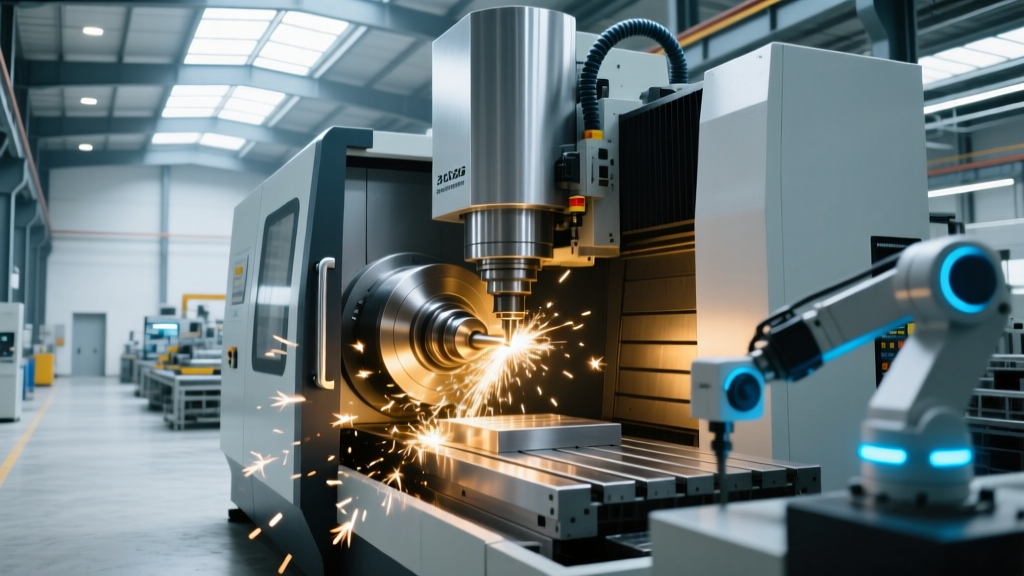
The most significant technological leap in 2026 is the migration of AI from the CAM programming stage directly into the CNC controller. Modern systems like the Siemens Sinumerik ONE and Heidenhain TNC 7 utilize embedded neural networks to analyze acoustic emissions and spindle load data at millisecond intervals.
When machining thin-walled aerospace structures from Ti-6Al-4V, harmonic chatter is a primary cause of surface finish degradation and tool fracture. Legacy machines relied on the operator to manually reduce feed rates when chatter occurred. Today's 5-axis CNC machines utilize predictive chatter avoidance algorithms. By mapping the frequency response function (FRF) of the specific tool-holder-spindle assembly, the controller dynamically alters the spindle speed by a fraction of a percent to shift the cutting frequency away from the resonant harmonic, maintaining a stable cut without sacrificing material removal rates (MRR).
Adaptive Feed Control in Superalloys
When roughing Inconel 718, work hardening and uneven stock allowance from forgings cause sudden spikes in cutting forces. 2026 adaptive control modules monitor the torque on the X, Y, and Z linear axes alongside the B and C rotary axes. If the spindle load exceeds the programmed threshold (typically 85% of peak torque), the system instantaneously scales the feed rate down by 15-20%, preventing catastrophic insert chipping, then resumes the optimal feed rate once the tool exits the hard spot.
Hardware Innovations: Direct Drive Torque Motors and Thermal Stability
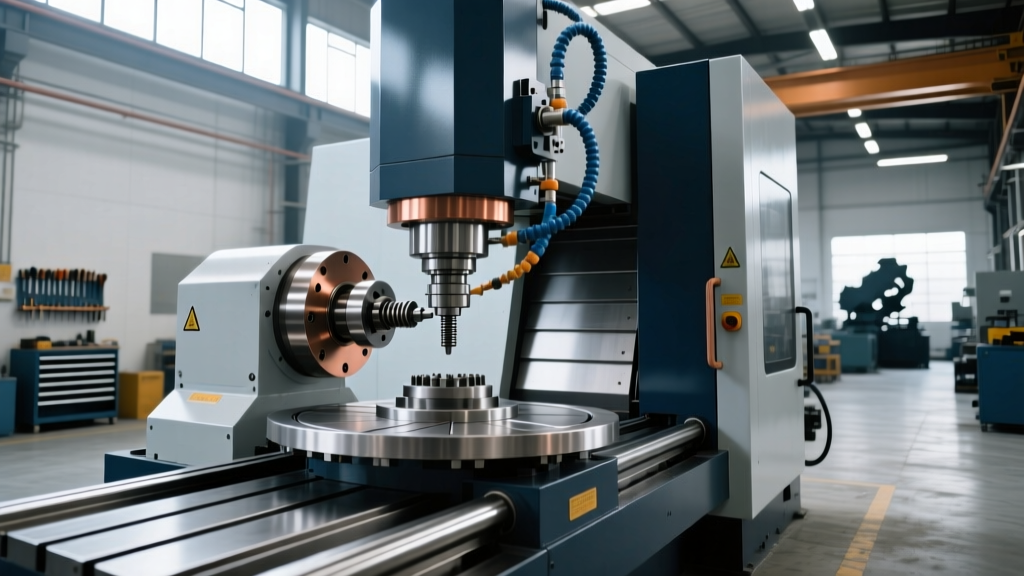
While software gets the spotlight, the physical architecture of 5-axis CNC machines has seen critical upgrades to support the demands of AI-driven continuous cutting. The industry has largely abandoned worm-gear driven rotary tables in favor of direct-drive torque motors. These motors eliminate backlash entirely and provide the instantaneous torque required for aggressive 5-axis simultaneous contouring.
However, direct-drive motors generate significant heat, which is the enemy of 5-axis accuracy. Thermal growth in the B and C axes can easily push the tool center point (TCP) out of tolerance by 15 to 30 microns over an 8-hour shift. To combat this, premium manufacturers like DMG MORI and Hermle have integrated liquid-cooling jackets directly into the torque motor stators. By circulating chilled glycol at a constant 20°C (68°F), these machines maintain thermal stability, keeping TCP deviation under 3 microns regardless of the duty cycle.
⚠️ Critical Thermal Warning: Never run a high-precision 5-axis medical implant job (e.g., titanium spinal cages with 5-micron tolerances) immediately after a cold start. Even with liquid-cooled motors, the spindle bearings and ball screws require a minimum 45-minute automated thermal warm-up cycle at varying RPMs (e.g., 2,000 to 12,000 RPM) to reach thermal equilibrium. Failing to execute a warm-up macro will result in Z-axis growth of up to 40 microns.Automated In-Process Metrology and Volumetric Compensation
A standard 3-axis CNC machine has 6 geometric error parameters. A 5-axis CNC machine has 21 geometric error parameters, including squareness, straightness, and the critical intersection errors of the rotary axes. Manual calibration of these 21 parameters is virtually impossible to maintain in a dynamic shop floor environment.
In 2026, automated volumetric compensation has become standard on mid-to-high-tier 5-axis machining centers. Using integrated laser measurement systems (such as Renishaw XM-60 or API Radian laser trackers) combined with high-speed touch probes, the machine can run a self-calibration routine during weekend downtime. The system measures the actual spatial positioning errors across the entire working envelope and generates a 3D compensation matrix. This matrix is uploaded directly to the controller, mathematically correcting the toolpath in real-time to account for geometric imperfections, foundation settling, and ambient temperature shifts.
Step-by-Step: Automated Kinematic Calibration Workflow
- Thermal Equilibration: Execute the 45-minute spindle and axis warm-up macro.
- Probe Qualification: Calibrate the spindle-mounted touch probe on the master reference sphere.
- Kinematic Cycle Execution: The machine automatically probes the calibration sphere at 40+ distinct spatial coordinates, utilizing various B and C axis orientations.
- Error Mapping: The controller calculates the exact pivot point (Center of Rotation) and identifies deviations in the rotary axis intersection.
- Matrix Application: The updated kinematic data is written to the controller's variables (e.g., Haas Macro Variables or Siemens system parameters), instantly correcting TCP positioning.
2026 Configuration Matrix: Choosing the Right 5-Axis Architecture
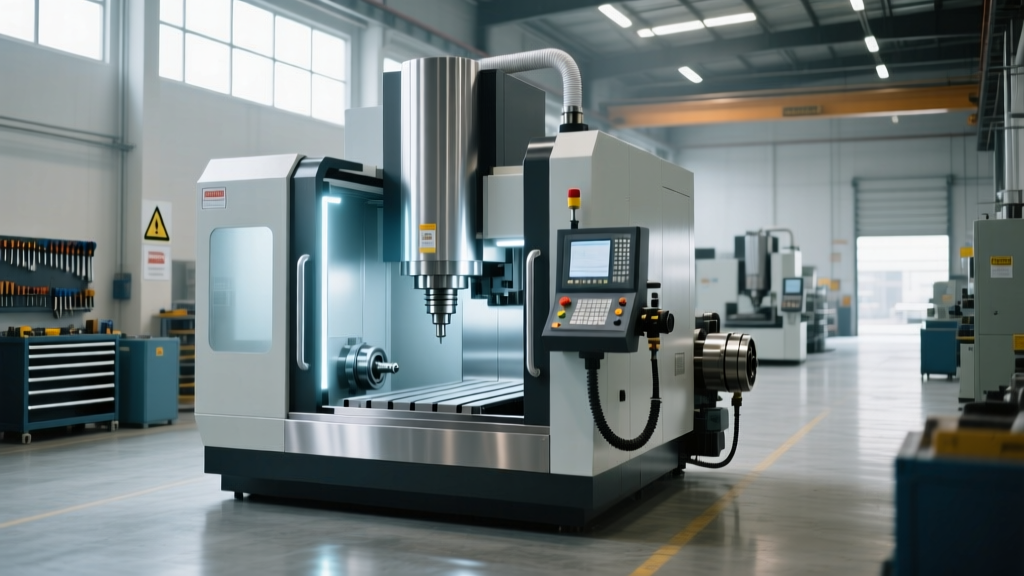
Selecting the correct 5-axis configuration is paramount. The choice between a trunnion table, a swivel head, or a twin-table setup dictates the machine's payload capacity, chip evacuation efficiency, and suitability for specific part geometries. According to multi-axis machining guidelines from Sandvik Coromant, matching the machine kinematics to the part envelope is the primary driver of tool life and surface finish quality.
| Configuration | Kinematics | Ideal Application | Limitations |
|---|---|---|---|
| Trunnion Table (A/C or B/C) | Rotary motion on the table; spindle moves linearly. | Aerospace structural parts, impellers, valve bodies. Excellent chip evacuation. | Payload limits (typically < 500 kg). Heavy parts cause sag and require constant kinematic recalibration. |
| Swivel Head (B/C or A/C) | Rotary motion on the spindle head; table is stationary or linear. | Large, heavy aerospace forgings, mold bases. Unlimited table payload. | Reduced rigidity at full extension. Chip evacuation into the head seals can be problematic. |
| Twin-Table / Pallet Changer | Trunnion mounted on an automated pallet pool system. | High-volume medical and automotive production. Lights-out manufacturing. | Highest capital cost ($400k+). Requires complex fixture repeatability management. |
Strategic Implementation: When to Upgrade Your 5-Axis Fleet
Upgrading to a 2026-spec 5-axis CNC machine is a capital-intensive decision ranging from $165,000 for entry-level models to over $850,000 for turnkey automated cells. Shop owners must base this decision on measurable bottlenecks rather than the desire for newer technology. Evaluate your current operations against the following decision framework:
1. The Setup-Time Bottleneck
If your 3-axis VMCs or 4-axis HMCs require multiple setups, custom fixtures, and manual edge-finding to machine a complex part, and your setup time exceeds 30% of your total lead time, a 5-axis trunnion machine will yield an immediate ROI. The ability to machine 5 sides of a part in a single clamping eliminates cumulative fixture errors and reduces setup time to under 15 minutes.
2. The Tool Life Degradation Metric
When machining deep cavities or steep walls on a 3-axis machine, you are forced to use long-reach tooling, which deflects and degrades surface finish. If you are replacing end mills prematurely due to chatter or burning through inserts in hard metals because you cannot maintain the optimal lead angle, a 5-axis machine allows you to tilt the tool or the part. This keeps the cutting force directed into the rigid spindle bearings and allows the use of shorter, more aggressive tooling, often extending tool life by 40% to 60%.
3. The Tolerance Stack-Up Failure
For parts with tight true-position tolerances (e.g., ±0.005 mm across multiple planes), every time you unclamp and reclamp a part on a 3-axis machine, you introduce a new layer of error. If your CMM inspection reports are showing tolerance stack-up failures directly tied to secondary operations, transitioning to 5-axis simultaneous machining is not optional; it is a quality mandate.
The 2026 landscape of 5-axis CNC machining centers demands a holistic approach. Success is no longer defined merely by the purchase of the hardware, but by the integration of AI-driven controllers, rigorous thermal management protocols, and automated volumetric calibration. Shops that master these technological intersections will dominate the high-mix, high-complexity manufacturing sector for the next decade.