CNC Horizontal Machining Centers: 2026 Buying Guide
Evaluate CNC horizontal machining centers for 2026. Compare Haas, Mazak, and Makino HMC specs, pricing, pallet automation, and ROI frameworks.
The Capital Case for CNC Horizontal Machining
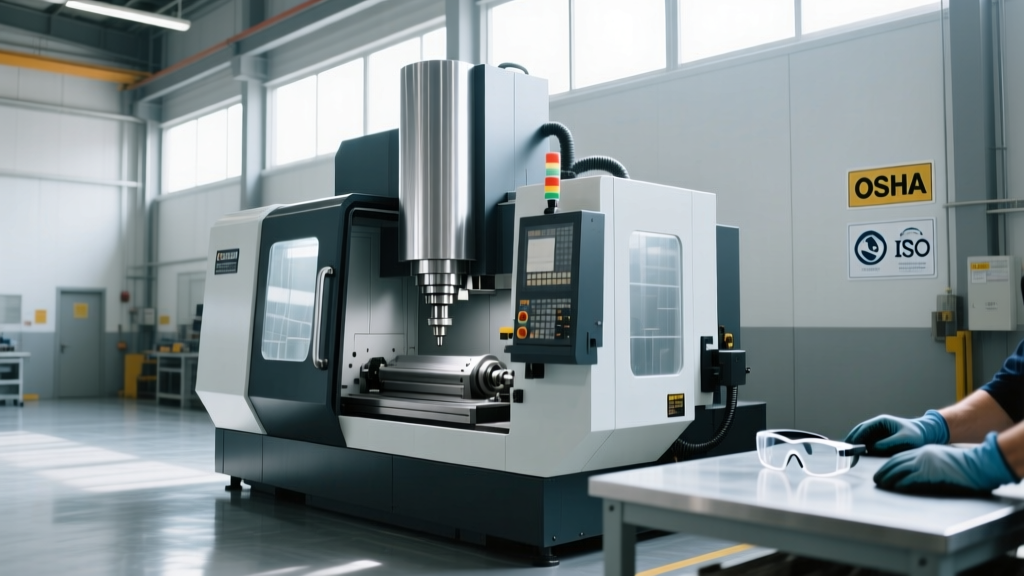
Transitioning from vertical to horizontal configurations represents a fundamental shift in production philosophy. While vertical machining centers (VMCs) dominate low-volume, 2.5D prismatic work, CNC horizontal machining centers (HMCs) are engineered for high-density, multi-face production and unattended operation. The primary mechanical advantage of the horizontal orientation is gravity-assisted chip evacuation. In deep-cavity milling or high-volume stringy chip materials like 6061-T6 aluminum and 304 stainless steel, horizontal spindles prevent chip recutting, extending tool life by 20% to 40% compared to VMC equivalents.
2026 Industry Benchmark Data:Average Spindle Utilization (VMC with manual loading): 35% - 45%
Average Spindle Utilization (HMC with 2-pallet APC): 85% - 92%
Source: Association for Manufacturing Technology (AMT) 2025-2026 Automation Reports.
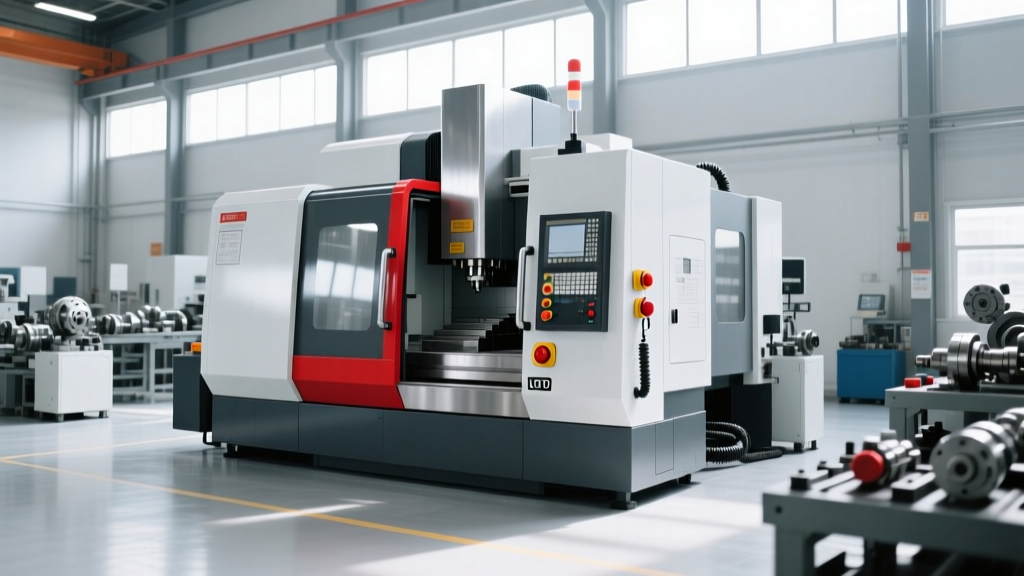
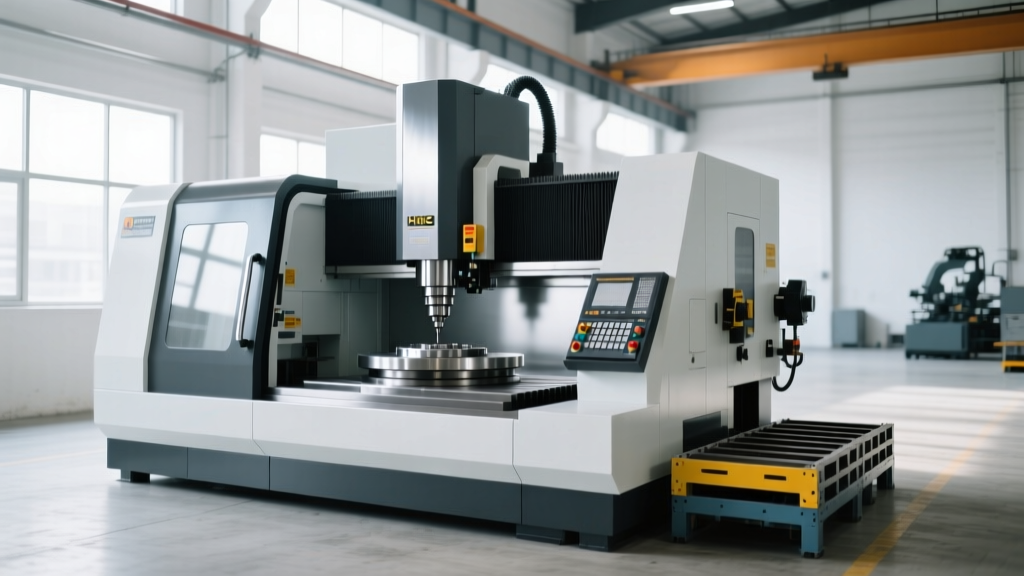
When evaluating CNC horizontal machining equipment for your shop floor, the decision must be driven by part geometry, batch volume, and the cost of non-cutting time. An HMC is not merely a different spindle orientation; it is a comprehensive production cell built around an integrated rotary 4th-axis and automated pallet changing (APC) system.
VMC vs. HMC: The Application Decision Matrix
Use the following framework to determine if a horizontal configuration justifies the capital expenditure over a standard vertical mill or a 5-axis trunnion table setup.
| Production Variable | Vertical Machining Center (VMC) | Horizontal Machining Center (HMC) |
|---|---|---|
| Part Geometry | 2.5D prismatic, single-face dominant, shallow cavities. | Cubic parts requiring 4+ faces machined in a single setup (e.g., valve bodies, pump housings). |
| Chip Evacuation | Poor in deep pockets; requires high-pressure coolant flushing or peck cycles. | Excellent; gravity drops chips directly into the bed conveyor, ideal for stringy/ductile materials. |
| Batch Size | High-mix/low-volume (HMLV) or prototyping. | High-volume production or HMLV utilizing tombstone fixturing for family-of-parts setups. |
| Operator Dependency | High; operator must load/unload, blow off chips, and index parts manually. | Low; APC allows load/unload on Pallet 2 while Pallet 1 is cutting, enabling lights-out machining. |
Critical Hardware Specifications for 2026 HMCs
Modern horizontal machining centers are defined by their rigidity, thermal stability, and automation readiness. When reviewing machine tool quotes, scrutinize the following subsystems.
Spindle Taper and High-Speed Dynamics
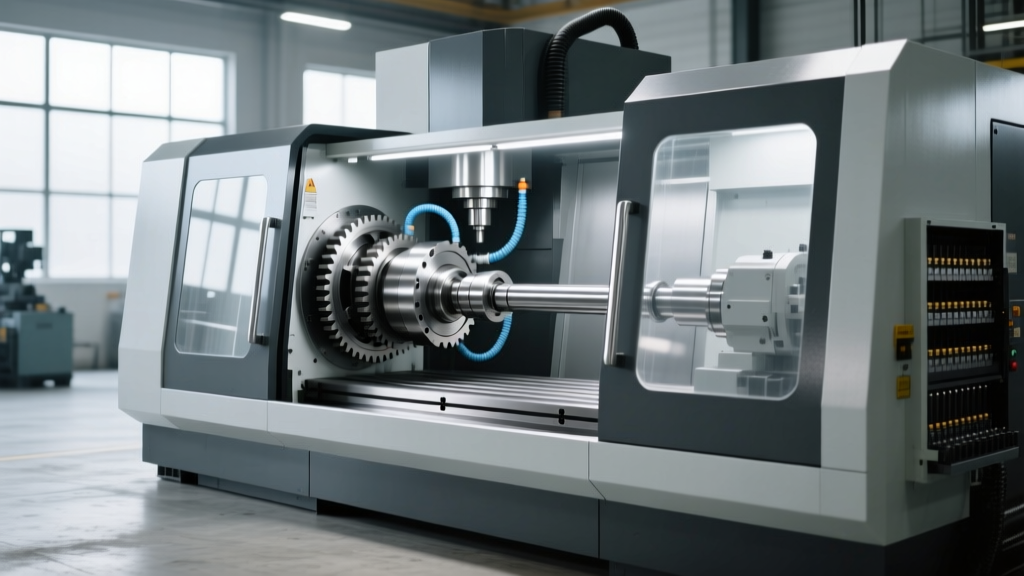
The choice between a 40-taper (CAT40/BT40), 50-taper (CAT50/BT50), and HSK-63A interface dictates your material capabilities. For heavy roughing in titanium or Inconel, a 50-taper spindle with a 2-speed gearbox providing up to 800 ft-lbs of torque at low RPMs is mandatory. However, for aerospace aluminum structural components, an HSK-63A spindle is the 2026 standard. Unlike standard V-flange tapers that rely solely on friction, the HSK interface utilizes simultaneous face-and-taper contact. This dual-contact design prevents the tool holder from pulling out of the spindle nose at speeds exceeding 14,000 RPM, maintaining radial stiffness and ensuring tight tolerances (±0.0002 inches) during high-feed finishing passes.
Through-Spindle Coolant (TSC) and Pressure
Standard flood coolant is insufficient for deep-hole drilling on horizontal setups where the tool is parallel to the ground. Specify a minimum of 1,000 PSI Through-Spindle Coolant (TSC) for standard operations, and opt for 2,000 PSI systems if you are machining deep gun-drilled ports or using solid carbide deep-hole drills. High-pressure TSC breaks chips at the cutting edge and evacuates them through the tool flutes, preventing the catastrophic tool deflection common in horizontal deep-cavity milling.
Tombstone Fixturing and Hydraulic Power Units (HPUs)
The true ROI of an HMC is unlocked via multi-sided tombstone fixturing. While manual tombstones rely on hand-pumped hydraulic clamps (typically maxing out at 4,000 PSI), automated HMCs utilize integrated Hydraulic Power Units (HPUs) routed through the B-axis rotary table's central union. A 3,000 to 5,000 PSI centralized HPU allows for high-density clamping, securing 16 to 32 parts per tombstone. This reduces load/unload times from 25 minutes down to 45 seconds per cycle.
2026 Market Pricing and Tier Breakdown
Capital equipment pricing has stabilized following the supply chain volatility of the early 2020s, but automation packages command a premium. Below is a comparative breakdown of the dominant HMC tiers available on the market.
| Tier / Brand | Representative Model | Base Price (Est.) | Fully Loaded w/ Automation | Best Application |
|---|---|---|---|---|
| Entry / Value (Haas) |
EC-500 | $185,000 - $210,000 | $260,000 (with 2-pallet APC) | Job shops transitioning to lights-out; general aluminum/steel prismatic parts. |
| Mid / Production (Mazak) |
HCN-5000 | $360,000 - $410,000 | $550,000+ (Pallet Pool / SmoothAi) | High-volume automotive/aerospace; requires advanced Mazatrol conversational programming. |
| Premium / Precision (Makino) |
a61nx | $520,000 - $580,000 | $850,000+ (MMC2 Linear Pallet System) | Tier 1 aerospace, tight-tolerance hydraulic manifolds, hard metals. |
Automation Configurations: Rotary vs. Linear Pallet Pools
The standard 2-pallet Automatic Pallet Changer (APC) is merely the entry point for CNC horizontal machining automation. For facilities targeting 80+ hours of unattended weekend cutting, linear or matrix pallet pools are required.
- Rotary Pallet Pools (RPP): Typically hold 6 to 12 pallets in a circular footprint. Ideal for shops with limited floor space running family-of-parts where setup times are minimized by leaving dedicated fixtures on each pallet permanently.
- Linear Pallet Systems (LPS): Systems like the Fastems FPC or Makino MMC2 utilize a rail-mounted shuttle to service multiple machines and hundreds of pallets. These require a larger footprint but offer unparalleled scalability, allowing a single operator to manage 4 to 6 HMCs simultaneously.
"The biggest mistake shops make when buying their first HMC is underestimating the tooling magazine capacity. If you are running a 12-pallet pool with 24 parts per tombstone, you will burn through sister tooling rapidly. Specify a minimum 120-tool magazine with RFID chip tracking to manage tool life across unattended shifts without triggering unnecessary machine alarms."
— Manufacturing Engineering Lead, Tier 2 Aerospace Supplier
Calculating ROI: The Unattended Shift Framework
Justifying a $500,000 CNC horizontal machining center requires moving beyond simple cycle-time comparisons. You must calculate the value of spindle uptime. According to data published by Modern Machine Shop, the average VMC cuts metal only 30% to 40% of the available shift time due to operator loading, chip clearing, and inspection. An HMC with an APC pushes this to 90%.
Follow this step-by-step framework to calculate your true payback period:
- Establish Baseline VMC Revenue: Calculate your current VMC spindle hours per week (e.g., 40 hours available × 35% utilization = 14 cutting hours). Multiply by your shop rate (e.g., $120/hr) = $1,680/week per machine.
- Project HMC Utilization: An HMC running a 2-pallet APC with a 20-minute cycle time will run continuously through lunch breaks and shift changes. Assume 85% utilization over a 50-hour operational window = 42.5 cutting hours. Multiply by shop rate = $5,100/week.
- Factor in Labor Reallocation: An HMC does not necessarily eliminate a headcount; it elevates it. Reallocate the operator from loading parts to performing CMM inspection or programming. Assign a 20% labor efficiency savings to the HMC cell.
- Calculate Payback: Divide the fully loaded HMC cost (including installation, rigging, and initial tombstone tooling) by the weekly revenue delta. A $450,000 Mazak HCN-5000 generating an extra $3,420 per week yields a raw payback period of roughly 131 weeks (2.5 years), excluding tax depreciation benefits like Section 179.
Final Procurement Checklist
Before signing the purchase order for your next CNC horizontal machining center, verify the following non-negotiable specifications:
- B-Axis Rotary Table: Ensure it features a continuous 360-degree roll (not just 0.001-degree indexing) for simultaneous helical interpolation and contouring.
- Chip Conveyor Sizing: Standard hinge-belt conveyors clog with stringy aluminum. Specify a scraper-type or dual-auger conveyor system with a high-capacity coolant tank (minimum 150 gallons) to allow fines to settle.
- Control Memory & Networking: The CNC control (e.g., Fanuc 31i-B or Siemens Sinumerik ONE) must include expanded NVRAM and native Ethernet/IP or MTConnect compatibility to integrate with your shop's ERP and DNC systems for automated program calling based on pallet RFID tags.