Technical Specs & Mechanics of Horizontal CNC Machining Centers
Explore the technical specifications and internal mechanics of horizontal CNC machining centers, including HMC spindles, pallet changers, and rigidity.
The Core Architecture: How Horizontal CNC Machining Centers Work
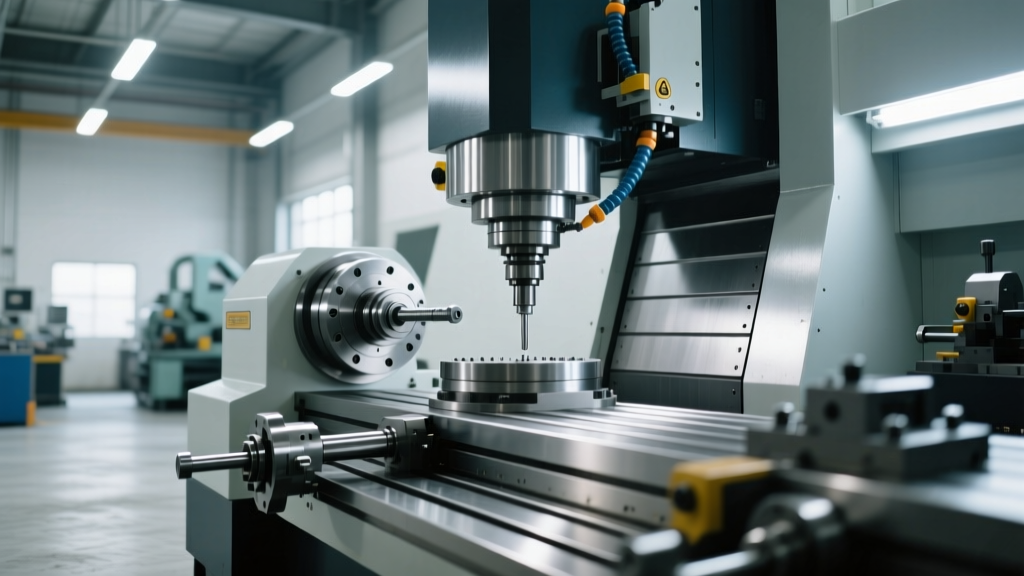
Unlike vertical machining centers (VMCs) where the spindle axis is perpendicular to the ground, horizontal CNC machining centers (HMCs) orient the spindle parallel to the floor. This fundamental geometric shift dictates every subsequent mechanical decision in the machine's design, from axis travel and column rigidity to chip evacuation and workholding strategies.
In a standard HMC configuration, the spindle moves along the Z-axis (in and out toward the workpiece) on a massive, ribbed cast-iron column. The X-axis (left-to-right) and Y-axis (up-and-down) movements are typically handled by the saddle and table assembly. This separation of axis duties allows machine builders to engineer significantly wider guideway spreads on the Z-axis column, yielding superior damping characteristics during heavy interrupted cuts.
Engineering Insight: Gravity Chip EvacuationThe most immediate mechanical advantage of the horizontal spindle orientation is gravity-assisted chip fall. In VMCs, chips accumulate on the workpiece, inside pockets, and on the fixture, often requiring high-volume coolant floods to wash them away or risking recutting. In HMCs, chips fall directly away from the cutting zone into wide, sloped sheet-metal way-covers and high-capacity auger systems, virtually eliminating chip recutting and extending tool life by up to 30% in deep-cavity milling.
Critical Technical Specifications & Spindle Interfaces
When evaluating horizontal CNC machining centers for a production floor, the spindle interface and torque curve are the primary determinants of capability. While CAT40 and BT40 tapers remain common in entry-level 400mm-pallet machines, the industry standard for high-performance 500mm and 630mm pallet HMCs has shifted decisively toward HSK (Hollow Shank Taper) interfaces.
| Specification Tier | Pallet Size | Spindle Taper | Max RPM / Torque | Rapid Traverse Rates | Approx. 2026 Base Price |
|---|---|---|---|---|---|
| Entry-Level Production | 400mm | CAT 40 / BT 40 | 12,000 RPM / 250 Nm | 36 m/min (Linear) | $220,000 - $280,000 |
| High-Performance | 500mm | HSK-A63 | 15,000 RPM / 450 Nm | 60 m/min (Linear) | $450,000 - $650,000 |
| Heavy-Duty / 5-Axis | 630mm - 800mm | HSK-A100 / CAPTO C8 | 10,000 RPM / 1000+ Nm | 50 m/min (Box Way) | $850,000 - $1.4M+ |
The HSK-A63 interface utilizes a dual-contact system: the taper locks radially while the flange face locks axially. At 15,000 RPM, a standard CAT50 toolholder will experience axial growth and radial runout due to centrifugal force expanding the spindle bore. The HSK face-and-taper contact prevents this axial pull-back, maintaining Z-axis accuracy within 3 microns even at peak RPM. For shops machining titanium or Inconel on 630mm pallets, the HSK-A100 or Sandvik Coromant CAPTO C8 interface provides the necessary 1000+ Nm of static torque required for heavy roughing without stalling the spindle motor.
The B-Axis Rotary Table: Curvic Coupling vs. Direct Drive
The integrated rotary table (B-axis) is what transforms an HMC from a simple 3-axis mill into a multi-sided production powerhouse. The mechanical execution of the B-axis dictates whether the machine is suited for heavy indexing or continuous 5-axis contouring.
Hirth (Curvic) Coupling Mechanics
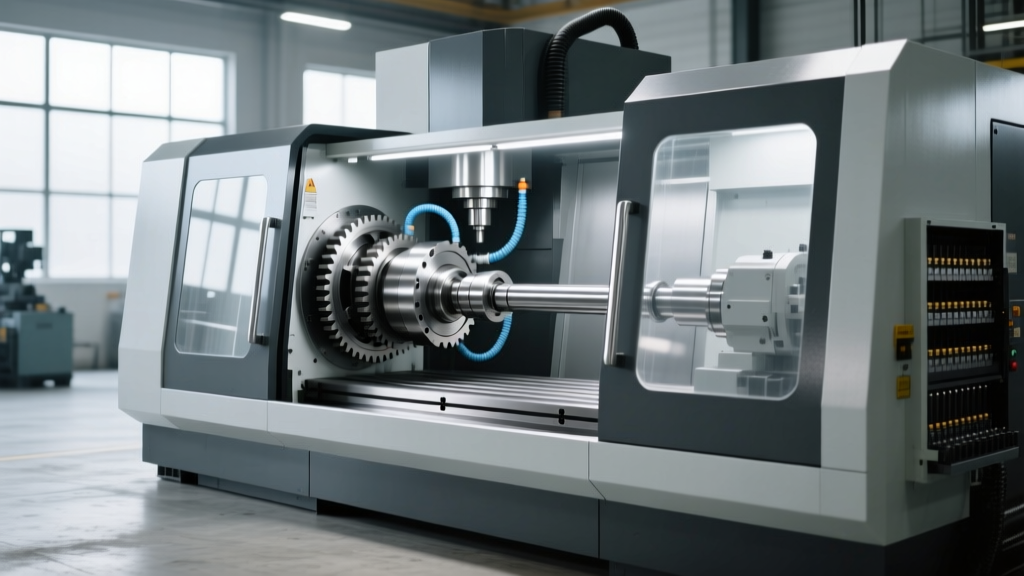
Most standard 4-axis HMCs utilize a Hirth coupling—a series of interlocking, precision-ground radial teeth on the face of the rotary table. When the table indexes to a programmed angle (typically in 1-degree or 0.001-degree increments), a massive hydraulic clamping force pushes the teeth together.
- Advantage: Unmatched static rigidity. Once clamped, the B-axis acts as a solid extension of the machine casting, allowing full spindle horsepower to be applied without table deflection.
- Limitation: Cannot perform simultaneous 5-axis contouring; it is strictly for indexing (3+2 machining).
Direct-Drive Torque Motors (DD)
For full 5-axis horizontal machining centers, manufacturers like Makino and DMG MORI employ direct-drive torque motors. These eliminate mechanical gears and Hirth couplings, using electromagnetic force to rotate and hold the table.
- Advantage: Infinite angular resolution, zero backlash, and the ability to perform complex simultaneous 5-axis toolpaths (e.g., impeller milling) without unclamping.
- Limitation: Lower static holding torque compared to a clamped Hirth coupling. Heavy off-center milling forces can cause micro-deflections if the DD motor's holding torque (often measured in thousands of Nm) is exceeded.
When using a 5-axis DD HMC, keep the workpiece center of gravity as close to the table centerline as possible. A 50kg fixture offset by 200mm on a 500mm pallet generates significant overturning moments that can overwhelm the DD motor's holding brake, resulting in chatter and scrapped parts.
Automatic Pallet Changers (APC) and FMS Integration
The true ROI of horizontal CNC machining centers is unlocked via the Automatic Pallet Changer (APC). While a VMC sits idle during setup, an HMC's APC allows the operator to load, clamp, and indicate the next workpiece on Pallet B while the spindle is actively cutting Pallet A inside the enclosed work envelope.
Modern APCs utilize either a rotary shuttle (common on 2-pallet systems) or a linear matrix (for 6 to 12+ pallet systems). The mechanical sequence involves:
- Pallet Unclamp: Hydraulic pressure releases the locating pins inside the work zone.
- Shuttle Transfer: A servo-driven chain or linear motor swaps the pallets in 5 to 8 seconds.
- Seating and Clamping: The new pallet is pulled down onto four precision ground locating pads with up to 4,000 psi of hydraulic clamping force, ensuring repeatability of ±2 microns.
For high-volume automotive or aerospace tier suppliers, these APCs are integrated into a broader Flexible Manufacturing System (FMS), where automated guided vehicles (AGVs) or rail-guided shuttles deliver raw material to the HMC's load station autonomously.
High-Pressure Coolant and Chip Management Systems
Because HMCs are designed for extended, untended operation (often running 'lights-out' over weekends), chip management and coolant delivery are engineered to a much higher specification than VMCs.
"In untended horizontal machining, a chip jam is not just a nuisance; it is a catastrophic failure point that can crash a $600,000 machine. High-pressure through-spindle coolant and aggressive auger designs are non-negotiable for lights-out production."
— Reference via Sandvik Coromant Milling Knowledge Base
Standard HMCs in 2026 are equipped with Through-Spindle Coolant (TSC) systems operating at 70 bar (1,000 PSI) as a baseline, with high-performance models pushing 150 bar (2,175 PSI) or higher. This pressure is required to break the chip at the cutting edge when machining gummy materials like 300-series stainless steels or high-temperature alloys. Furthermore, the base casting features steeply angled internal walls (minimum 45-degree slopes) and dual, counter-rotating chip augers that push swarf up and out of the machine into a massive external conveyor, preventing the chip pile from reaching the linear guideways.
Decision Framework: When to Specify an HMC
Purchasing an HMC requires a significant capital premium over a VMC. A standard Haas EC-400 horizontal mill represents a substantial investment compared to a similarly sized VF-4 VMC. Use this framework to justify the capital expenditure:
- Choose an HMC if: Your parts require machining on 4 or more sides in a single setup; your production volume justifies the cost of multiple hydraulic tombstone fixtures; you are machining deep cavities where chip evacuation is failing on VMCs; or you require lights-out untended machining via an APC.
- Stick to a VMC if: Your parts are primarily 2.5D or 3D contour milled on a single face; your lot sizes are small (1-5 pieces) making fixture changeover time prohibitive; or your shop ceiling height and floor space cannot accommodate the larger footprint and taller Z-axis clearance required by an HMC and its APC.
Ultimately, the horizontal CNC machining center is a production-volume multiplier. The initial capital outlay for the machine, high-pressure coolant chillers, and custom tombstone tooling is rapidly amortized by the elimination of secondary operations, reduced part handling, and the ability to run unattended shifts.