Multi Axis CNC Machining: Top 2026 Tech Innovations
Explore 2026 multi axis CNC machining innovations, including 6-axis mill-turn hybrids, AI thermal compensation, and direct-drive torque motor upgrades.
The Shift from 5-Axis to 6-Axis Mill-Turn Hybrids
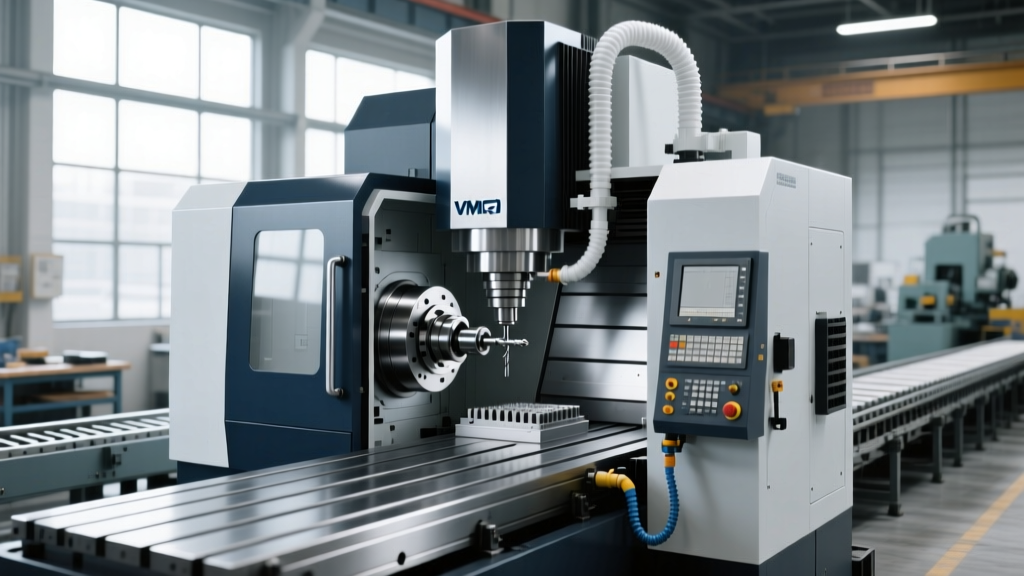
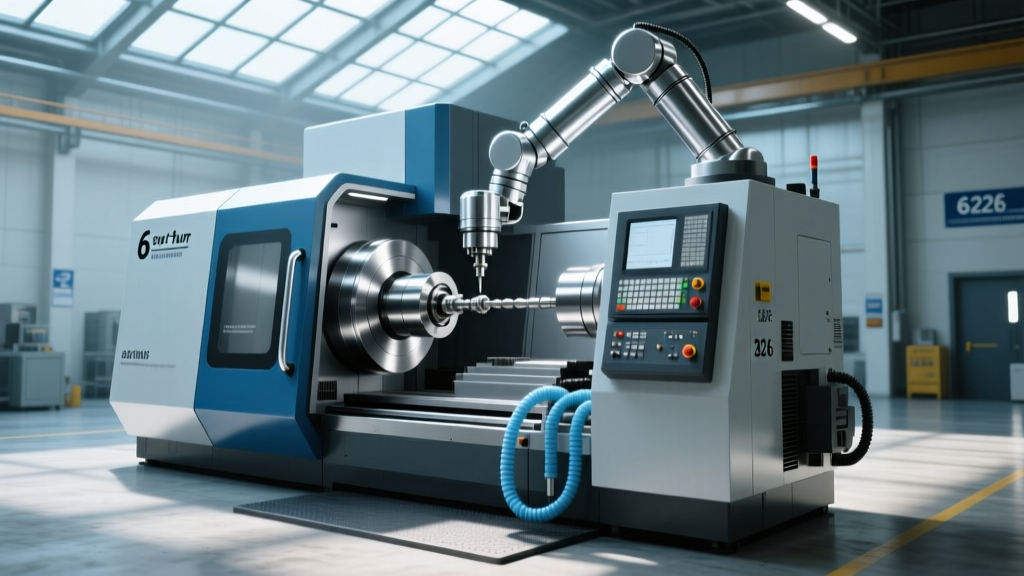
For the past decade, the 5-axis vertical machining center (VMC) has been the undisputed workhorse for complex aerospace and medical components. However, as we navigate 2026, the frontier of multi axis CNC machining has shifted decisively toward 6-axis mill-turn hybrids. Machines like the DMG MORI NTX 2000 and the Mazak INTEGREX i-500 are no longer just lathes with milling capabilities; they are fully integrated manufacturing cells capable of completing 95% of complex parts in a single chucking.
The defining innovation in this space is the integration of a full B-axis milling spindle paired with a lower turret featuring Y-axis and driven tool capabilities. This allows for simultaneous machining: the main spindle executes heavy 5-axis contouring on the top half of a part while the lower turret performs back-working, drilling, and tapping on the sub-spindle. According to the Association for Manufacturing Technology (AMT), shops adopting simultaneous 6-axis mill-turn configurations in 2026 are reporting a 40% to 60% reduction in total part cycle times compared to traditional 3-axis and 5-axis multi-setup workflows.
| Feature | Standard 5-Axis VMC (e.g., Haas UMC-750) | 6-Axis Mill-Turn Hybrid (e.g., DMG MORI NTX 2000) |
|---|---|---|
| Primary Configuration | Vertical Spindle, Trunnion Table | Horizontal Milling Spindle, Main/Sub Spindles, Lower Turret |
| Setup Requirements | Multiple fixtures, soft jaws, manual flipping | Single bar feed or chucking, automated part transfer |
| Simultaneous Operations | Limited to single-point tool engagement | Main spindle milling + lower turret turning/drilling |
| Typical 2026 Base Pricing | $180,000 - $250,000 | $650,000 - $850,000+ |
| Ideal Application | Prismatic parts, molds, structural aerospace ribs | Complex rotational parts, hydraulic manifolds, medical bone screws |
AI-Driven Thermal Compensation and Kinematic Calibration
Thermal growth has historically been the silent killer of multi-axis accuracy. When a 5-axis machine tilts its B and C axes, even a 3-micron thermal expansion in the spindle housing can translate to a 15-micron tool center point (TCP) error at the tip of a 200mm end mill. In 2026, leading OEMs have moved beyond simple spindle cooling jackets, embedding machine learning algorithms directly into the CNC controller.
Okuma’s latest OSP-P500 controllers utilize an advanced iteration of their Thermo-Friendly Concept. Instead of relying solely on ambient temperature sensors, the AI models map heat distribution based on real-time spindle load, axis acceleration, and localized friction. The controller dynamically applies micro-offsets to the X, Y, Z, B, and C axes every 100 milliseconds. This ensures that a machine left idle over a weekend will hold ±2 µm volumetric accuracy from the very first cut on Monday morning, completely eliminating the need for 45-minute warm-up cycles.
Expert Insight: The ROI of AI Thermal StabilityFor job shops running unmanned weekend shifts, AI thermal compensation is no longer a luxury—it is a requirement for scrap reduction. A single scrapped Inconel 718 turbine blisk can cost upwards of $12,000 in raw material alone. Investing an additional $25,000 in premium thermal stability packages and AI kinematic calibration software typically yields a full return on investment within the first 14 months of lights-out production.
Direct Drive Torque Motors: Eliminating Rotary Backlash
The mechanical interface between the rotary table and the machine casting is critical for multi axis CNC machining. Historically, trunnion tables relied on worm gear drives. While worm gears provide high holding torque, they suffer from inherent mechanical backlash, sliding friction, and strict RPM limitations (typically maxing out around 50 RPM). As cutting tool geometries and spindle speeds have evolved, the worm gear has become a bottleneck.
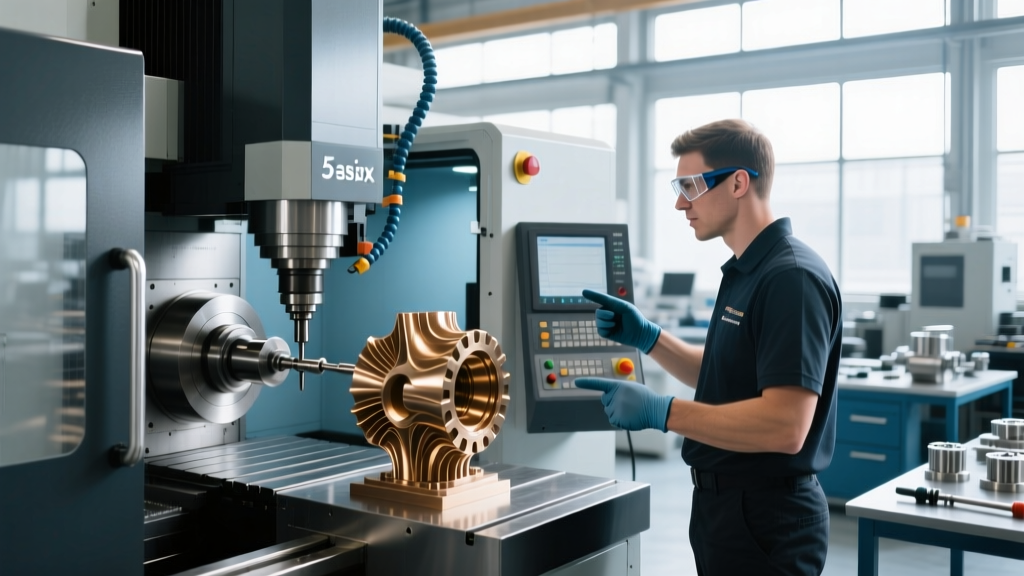
The 2026 standard for high-performance 5-axis and 6-axis machines is the direct drive torque motor. By eliminating the mechanical transmission and coupling the motor rotor directly to the rotary table, manufacturers achieve zero backlash and massive speed increases.
Worm Gear vs. Direct Drive Specifications
- Maximum Rotational Speed: Worm gears are generally limited to 30–60 RPM due to friction and heat generation. Direct drive tables routinely achieve 200–400 RPM, enabling highly efficient 5-axis simultaneous contouring and rapid indexing.
- Backlash and Wear: Worm gears require periodic physical adjustment to compensate for wear-induced backlash. Direct drive motors maintain absolute zero backlash indefinitely, as there are no contacting mechanical teeth to degrade.
- Torque Density: Modern direct drive motors from manufacturers like Kessler and ETEL deliver peak torques exceeding 2,500 Nm, allowing heavy interrupted cuts on titanium without table deflection or clutch slippage.
- Maintenance Downtime: Worm gear boxes require regular oil changes and tensioning. Direct drive systems are essentially maintenance-free, reducing annual preventative maintenance downtime by 12 to 16 hours per machine.
Digital Twins and Real-Time Collision Avoidance
Crashing a 5-axis machine is a catastrophic financial event, often resulting in $50,000 to $100,000 in spindle replacement costs and weeks of downtime. To mitigate this, the integration of native digital twins has become standard in advanced controllers like the Siemens Sinumerik One and the Heidenhain TNC 7.
Unlike traditional CAM simulation software that only checks for geometric toolpath interference, a true digital twin accounts for the actual physical mass of the machine axes, servo lag, and dynamic kinematic behavior. The National Institute of Standards and Technology (NIST) has heavily emphasized the role of digital twins in advanced manufacturing resilience, noting that real-time kinematic monitoring reduces setup collisions by over 85%. In 2026, the Heidenhain TNC 7 controller utilizes a feature called Dynamic Collision Monitoring (DCM), which actively calculates the exact spatial envelope of the tool holder, spindle nose, and table fixtures in real-time. If the predictive algorithm detects a collision trajectory based on current axis velocities, it halts the machine via controlled braking before physical contact occurs, saving the spindle from catastrophic impact.
Capital Expenditure Decision Framework for 2026
Upgrading to advanced multi axis CNC machining equipment requires rigorous capital justification. Shop owners must look beyond the base machine price and calculate the total cost of ownership (TCO), factoring in fixturing, labor, and floor space. Use the following framework to determine if a high-end 6-axis mill-turn or a 5-axis VMC is the correct investment for your operation:
- Evaluate Part Geometry and Lot Sizes: If your parts are primarily prismatic (e.g., aluminum aerospace brackets) and run in batches of 50+, a 5-axis VMC with a tombstone and hydraulic fixturing offers the best cost-per-part. If your parts are rotational with complex off-center features (e.g., hydraulic valves, medical implants) and run in lots of 1 to 20, the 6-axis mill-turn is mandatory to eliminate secondary op setups.
- Calculate Hidden Setup Costs: A $200,000 5-axis VMC often requires $40,000 in custom workholding, zero-point clamping systems, and CMM inspection time between setups. A $700,000 mill-turn center requires only standard collets or a bar feeder, drastically reducing workholding CapEx and eliminating inter-operation inspection bottlenecks.
- Assess Floor Space and Utility Constraints: 6-axis mill-turn machines are massive, often requiring 250+ square feet of footprint, 460V 3-phase power drops exceeding 100 amps, and high-pressure coolant pumps (1000+ PSI) for deep hole drilling. Ensure your facility infrastructure can support these demands before signing the purchase order.
- Factor in the Talent Gap: Programming a 6-axis machine with a lower turret and B-axis requires highly skilled CAM programmers proficient in advanced post-processor customization. If your shop lacks this expertise, budget $30,000 to $50,000 annually for specialized training or turnkey programming services from your OEM dealer.
The landscape of multi axis CNC machining in 2026 is defined by the convergence of mechanical rigidity and software intelligence. By prioritizing direct drive kinematics, AI thermal stability, and digital twin safety protocols, modern machine shops can push the boundaries of complex part production while securing their margins against rising labor and material costs.