Large 5 Axis CNC Machine Selection Guide: 2026 Costs & Specs
Evaluate large 5 axis CNC machine configurations, 2026 pricing tiers, spindle torque requirements, and foundation specs for aerospace manufacturing.
The Capital Reality of Large-Format 5-Axis Machining
Procuring a large 5 axis CNC machine in 2026 represents a capital expenditure ranging from $950,000 for a baseline moving-bridge vertical machining center (VMC) to over $4,500,000 for a fully automated, multi-pallet horizontal boring mill configuration. The aerospace, defense, and energy sectors are driving this demand, shifting away from multi-part assembly toward monolithic machining of complex titanium (Ti-6Al-4V) and Inconel 718 structures. According to industry research from the Association for Manufacturing Technology (AMT), the integration of 5-axis kinematics into large-envelope machines has reduced setup times by an average of 42% for structural airframe components, but it introduces severe demands on machine rigidity, thermal stability, and facility infrastructure.
Facility Warning: Do not finalize a purchase order without a geotechnical survey of your shop floor. Large-format 5-axis machines cutting hardened alloys generate massive dynamic cutting forces. Standard 6-inch industrial slabs will deflect, destroying the machine’s volumetric accuracy.Kinematic Configurations: Matching Envelope to Part Geometry
The term 'large' in 5-axis machining typically denotes an X-axis travel exceeding 2,500 mm (100 inches) and a Z-axis clearance capable of accommodating parts taller than 1,000 mm. Selecting the correct kinematic structure is the most critical decision in the buying process, as it dictates chip evacuation, tool reach, and dynamic stiffness.
| Configuration | Typical Envelope (X/Y/Z) | Best Application | Primary Limitation |
|---|---|---|---|
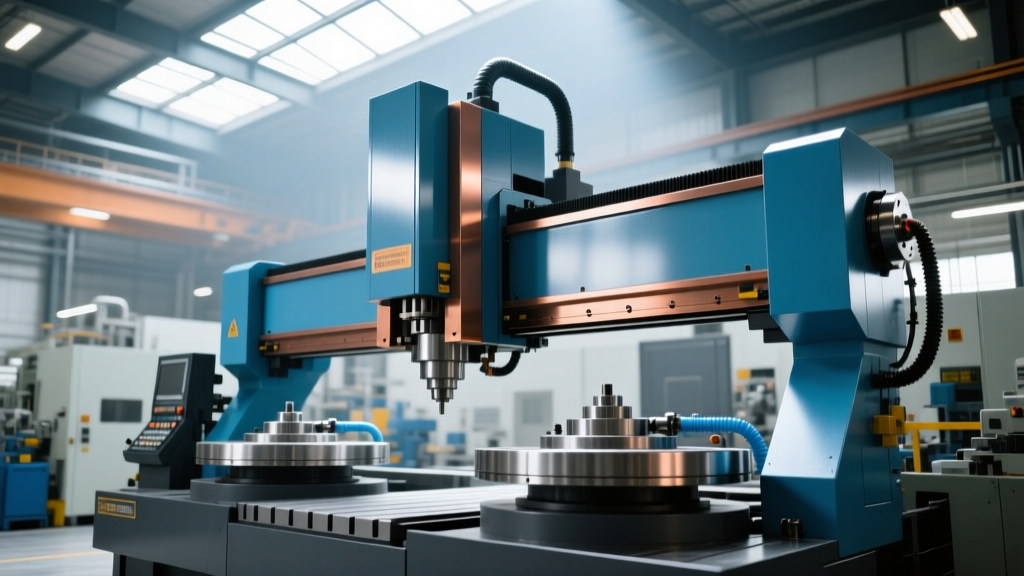
| Moving Bridge (Gantry) | 3000 x 2000 x 1000 mm | Aerospace wing spars, large aluminum monolithic structures. | Bridge mass limits rapid traverse rates; chip accumulation on stationary table. |
| Fixed Bridge / Moving Table | 2500 x 2500 x 1200 mm | Heavy die/mold work, energy sector valve bodies. | Table weight limits payload capacity; Y-axis travel restricted by footprint. |
| Horizontal 5-Axis (HMC) | 2000 x 2000 x 2000 mm | Landing gear components, deep-cavity titanium forgings. | Highest capital cost; complex rotary table integration limits max part diameter. |
Spindle Selection: Torque Curves Over Peak RPM
When specifying a large 5 axis CNC machine for hard-metal removal, buyers frequently make the mistake of prioritizing peak RPM over low-end torque. A 24,000 RPM HSK-A63 spindle is ideal for high-speed aluminum profiling, but it will stall and burn out tooling when attempting to drive a 2-inch indexable face mill through Inconel 718.
The Titanium & Inconel Specification
For heavy aerospace roughing, mandate a spindle capable of delivering a minimum of 1,200 Nm of continuous torque at 400 RPM. Look for spindle manufacturers like Kessler (e.g., the Q-Series) or GMN that utilize integrated liquid cooling jackets to manage thermal growth. Furthermore, specify an HSK-A100 or HSK-A125 toolholder interface. The larger taper and flange contact area of the HSK-A100 provide the radial stiffness required to prevent tool deflection during heavy side-milling operations on deep cavity walls.
Pro Tip: Require the machine builder to provide a certified spindle torque curve graph before signing the contract. Verify that the continuous torque rating (S1 duty cycle) meets your specific CAM toolpath requirements, not just the peak intermittent torque (S6 duty cycle).2026 Pricing Tiers and Hidden Cost Drivers
The base price of a large-format 5-axis machine is only the beginning of the total cost of ownership (TCO). Below is a realistic breakdown of capital and auxiliary costs based on 2026 market pricing for a high-rigidity moving-bridge VMC with a 3000mm X-axis travel.
- Base Machine (incl. standard 12k RPM spindle & basic control): $1,350,000 – $1,800,000
- High-Pressure Coolant System (70 bar / 1000 psi through-spindle): $45,000 – $65,000. Essential for breaking chips in deep-hole titanium drilling.
- Upgraded Spindle (High-torque, 15k RPM, HSK-A100): $85,000 – $110,000
- Automated Pallet Pool (2 to 4 stations): $180,000 – $275,000
- Extended Z-Axis Ram (for deep cavity access): $40,000
- Installation, Laser Calibration, and Foundation Prep: $55,000 – $90,000
According to guidelines published by the NIST Advanced Manufacturing Portal, environmental controls and foundation isolation can account for an additional 8-12% of the total installation cost for precision large-format equipment, a factor frequently omitted from initial capital appropriation requests.
Foundation and Thermal Stability Requirements
A large 5 axis CNC machine is only as accurate as the concrete it sits on. The sheer mass of the machine (often exceeding 35,000 kg) combined with the dynamic forces of roughing requires an isolated foundation.
'In large-format 5-axis machining, thermal gradients in the shop floor caused by seasonal changes or nearby HVAC exhausts can induce microscopic twisting in the machine bed. We mandate isolated foundation pits with a minimum depth of 1.2 meters and 4000 psi compressive strength concrete, surrounded by vibration-dampening cork or elastomeric isolation pads.' — Lead Manufacturing Engineer, Tier 1 Aerospace Supplier
Additionally, specify a machine enclosure with integrated thermal management. The spindle chiller and cabinet cooling units must be routed outside the machine enclosure to prevent ambient heat from altering the localized temperature of the linear scales and ball screws.
Control Systems and Volumetric Accuracy Validation
Managing the simultaneous interpolation of three linear and two rotary axes over a 3-meter travel distance requires advanced CNC controls with active error compensation. The top three contenders in the large-part space are:
- Siemens Sinumerik ONE: Features 'Run MyVirtualMachine' for highly accurate digital twin simulation and advanced collision avoidance, critical when machining multi-million-dollar titanium forgings.
- Heidenhain TNC7: Offers superior dynamic collision monitoring (DCM) and an intuitive graphical interface that reduces programming errors on the shop floor.
- Fanuc 31i-B5: Known for extreme reliability and high-speed look-ahead processing, ideal for complex contoured surfaces requiring millions of lines of G-code.
Factory Acceptance Testing (FAT) Checklist
Never accept delivery of a large 5 axis CNC machine based solely on standard linear laser interferometry. You must validate the rotary axes under load. Include the following mandatory tests in your purchase agreement:
- ISO 10791-7 Cone Frustum Test: Machines a 300mm diameter cone with a 15-degree half-angle to verify the simultaneous 5-axis geometric accuracy and RTCP (Rotary Tool Center Point) performance.
- Loaded Circular Interpolation Test: Uses a loaded telescoping ballbar to measure servo mismatch and backlash in the rotary tables under simulated cutting loads.
- Spindle Thermal Growth Test: Runs the spindle at maximum continuous torque RPM for 4 hours while measuring Z-axis displacement with LVDT sensors to ensure thermal growth remains within the 15-micron tolerance band.
By rigorously defining your kinematic needs, demanding verifiable spindle torque data, and enforcing strict foundation and FAT protocols, you can ensure your capital investment yields the precision and uptime required for modern large-part manufacturing.