Inside 5-Axis CNC Machining Centers: Technical Specs & Kinematics
Explore the technical specifications, kinematics, and spindle dynamics of 5-axis CNC machining centers for complex aerospace and medical production.
Kinematic Architectures: Trunnion vs. Swivel Head Configurations
Multi-axis CNC machining centers resolve complex geometries in a single setup by manipulating the tool vector relative to the workpiece. The foundational decision in 5-axis machine specification is the kinematic configuration: Trunnion (table-table) or Swivel Head (head-head). Understanding the mechanical trade-offs between these layouts dictates payload capacity, undercut accessibility, and volumetric accuracy.
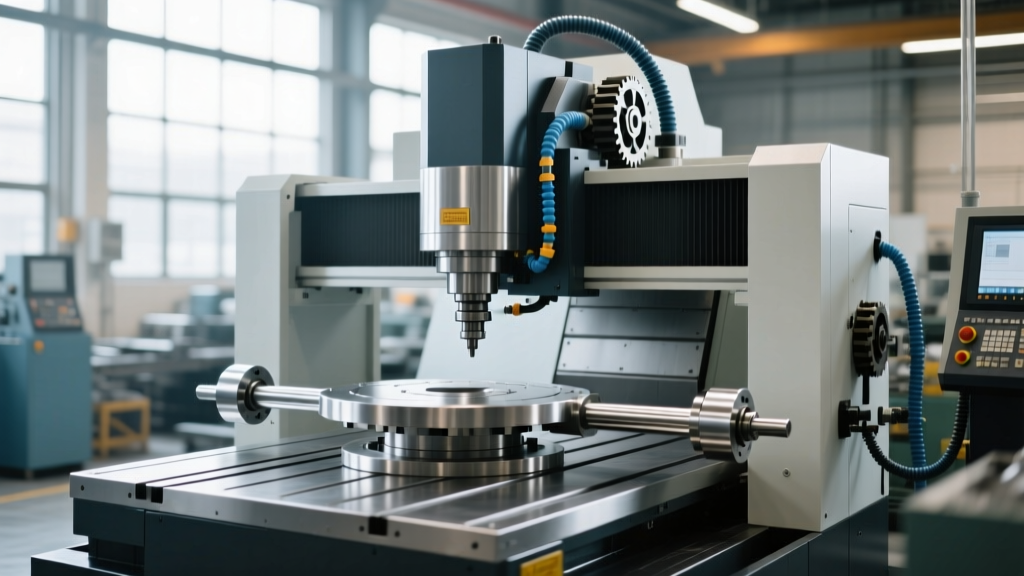
In a Trunnion configuration, the rotary axes (typically A and C) are integrated into the worktable. The spindle remains fixed in the Z-axis orientation while the table tilts and rotates. This design excels in undercut accessibility because the tool can approach the workpiece from extreme angles without the spindle head colliding with the table. However, the A-axis motor must fight gravity to tilt the workpiece, severely limiting payload capacity. A standard trunnion table rated for 500 kg will experience significant servo lag and positioning errors if overloaded.
Conversely, a Swivel Head configuration (typically B and C axes) mounts the rotary mechanisms directly to the spindle carriage. The worktable remains stationary or operates solely as a linear X/Y axis. This allows the machine to handle massive payloads—often exceeding 2,000 kg—because the table does not tilt. The trade-off is reduced Z-axis stroke and limited undercut capability, as the bulky spindle head restricts the tool's approach angle.
| Specification Metric | Trunnion Table (A/C Axis) | Swivel Head (B/C Axis) |
|---|---|---|
| Max Payload Capacity | 300 kg – 800 kg (Typical) | 1,000 kg – 3,000+ kg |
| Undercut Accessibility | Excellent (±120° tilt) | Moderate (±105° tilt limit) |
| Z-Axis Stroke Utilization | High (Spindle travels full Z) | Reduced (Head consumes Z-space) |
| Ideal Application | Aerospace impellers, medical implants | Large structural airframe components, molds |
Spindle Dynamics, Toolholding, and Thermal Stability
The spindle interface is the critical junction transferring torque and rotational velocity to the cutting tool. For modern 5-axis CNC machining centers, the choice between HSK-A63 and Coromant Capto C6 interfaces defines the machine's operational envelope.
HSK-A63 (Hollow Shank Taper) utilizes a dual-contact design, clamping simultaneously on the 1:10 taper and the face flange. According to Sandvik Coromant toolholding guidelines, this dual-contact mechanism prevents the toolholder from pulling out of the spindle at high centrifugal forces, maintaining Z-axis repeatability within 3 µm at speeds up to 24,000 RPM. This makes HSK-A63 the mandatory specification for high-speed machining (HSM) of aluminum aerospace structural parts.
For heavy roughing in titanium or Inconel, where cutting forces exceed 4,000 N, the Capto C6 polygonal interface provides superior torsional rigidity. The absence of a keyway and the large polygonal contact area distribute torque evenly, preventing micro-fretting corrosion common in standard CAT/BT tapers under high-load interrupted cuts.
⚠️ Thermal Growth Warning: Spindle thermal expansion is the primary driver of scrap in 5-axis machining. A steel spindle growing just 1°C will elongate by approximately 11.5 µm per meter. High-end machining centers mitigate this by circulating temperature-controlled glycol (held at 20°C ± 0.1°C) through the spindle housing and utilizing Si3N4 (silicon nitride) ceramic hybrid bearings, which generate 40% less friction heat than traditional steel bearings.Controller Architecture and TCP Management
Hardware kinematics are useless without precise Tool Center Point (TCP) management. In 3-axis machining, the tool tip follows a programmed Cartesian path. In 5-axis machining, as the rotary axes move, the tool tip shifts in 3D space. The CNC controller must calculate and compensate for this shift in real-time, a function known as RTCP (Rotary Tool Center Point) or Traori (Transformation Orientation).
The Siemens Sinumerik ONE controller utilizes advanced nano-interpolation and Traori functions to maintain the exact tool vector, dynamically adjusting the X, Y, and Z linear axes to compensate for rotary axis movement. This allows the programmer to output toolpaths based on the workpiece coordinate system (WCS) without worrying about the machine's specific pivot point geometry. The Fanuc 31i-B5 achieves similar results using its Tool Center Point Control (G43.4), featuring a look-ahead processing capacity of up to 10 million blocks per minute, ensuring smooth velocity transitions across complex 3D surface contours without dwell marks.
Volumetric Accuracy and Metrology Integration
As noted by the National Institute of Standards and Technology (NIST) in their advanced manufacturing frameworks, volumetric accuracy—the machine's ability to position the tool tip anywhere within its entire working envelope—is the true measure of a 5-axis center. Linear axis positioning accuracy (per VDI/DGQ 3441) might be rated at 0.005 mm, but rotary axis runout and geometric squareness errors compound across the workspace.
To combat this, tier-1 machining centers integrate in-process metrology. Systems like the Renishaw machine tool probing systems (e.g., OMP600) map the workpiece datum post-clamping, automatically updating the WCS to account for fixture deflection. Furthermore, integrated laser tool setters (such as the Blum MicroCompact) measure tool length and radius at operational RPM, compensating for centrifugal growth and thermal expansion before the tool ever touches the part.
2026 Market Specifications: Tiered Machine Selection Framework
Selecting the correct CNC machining center requires matching technical specifications to production realities. Below is a decision framework based on current market configurations, pricing, and target industries.
1. The Job Shop / Prototyping Tier: Haas UMC-750SS
- Kinematics: Trunnion Table (A/C axis), integrated into a 50-taper VMC architecture.
- Spindle: 12,000 RPM, 35 HP inline direct-drive.
- Controller: Haas NGC with DWO (Dynamic Work Offsets) for TCPC.
- Volumetric Accuracy: ±0.015 mm (Typical out-of-box).
- Estimated Equipped Price: $235,000 – $260,000.
- Best For: High-mix/low-volume job shops, aluminum prototyping, and general 5-sided machining where extreme aerospace tolerances are not required.
2. The Mid-Tier Production Tier: Hermle C32
- Kinematics: Modified gantry with a swivel rotary table (A/C axis), offering superior rigidity over standard trunnions.
- Spindle: 18,000 RPM, HSK-A63, liquid-cooled.
- Controller: Siemens Sinumerik ONE with Hermle-specific kinematic collision avoidance (HIMS).
- Volumetric Accuracy: ≤ 0.008 mm.
- Estimated Equipped Price: $480,000 – $550,000.
- Best For: Mid-volume medical implant manufacturing, precision optics molds, and automotive turbocharger housings.
3. The High-Precision Aerospace Tier: Makino D500
- Kinematics: Unique tilting spindle head (B-axis) combined with a high-speed rotary table (C-axis), designed to minimize Z-axis overhang.
- Spindle: 20,000 RPM, HSK-A63, core-cooled with active thermal displacement compensation.
- Controller: Makino Pro6 with Super Geometry Intelligence (SGI.5) for nano-level contouring.
- Volumetric Accuracy: ≤ 0.004 mm (Temperature controlled environment required).
- Estimated Equipped Price: $650,000 – $780,000+.
- Best For: 5-axis simultaneous milling of titanium blisks (bladed disks), Inconel turbine components, and tight-tolerance aerospace structural nodes.
Summary of Technical Procurement
Procuring a 5-axis CNC machining center is an exercise in managing mechanical compromises. Prioritize swivel-head kinematics if your raw material blanks exceed 800 kg, but default to trunnion tables if your part geometry demands deep undercut access. Mandate HSK-A63 spindles with ceramic hybrid bearings for any operation exceeding 15,000 RPM, and ensure the chosen controller supports native RTCP to eliminate manual pivot-point calculations. By aligning these technical specifications with your specific payload and tolerance requirements, you secure a manufacturing asset capable of sustaining single-setup profitability.