Safety Compliance & Standards for 5 Axis CNC Machining
Navigate OSHA, ISO, and ANSI safety standards for 5 axis CNC machining. Learn guarding, interlock, and coolant compliance requirements.
Transitioning from standard 3-axis vertical machining centers (VMCs) to multi-axis platforms introduces compounding mechanical hazards that standard safety protocols fail to address. When implementing 5 axis cnc machining, the dynamic movement of the workpiece via trunnion tables or swivel heads creates unpredictable pinch points, high-velocity swarf trajectories, and complex coolant containment challenges. Compliance is not merely about placing a guard over the cutting zone; it requires a holistic engineering approach aligned with stringent international and federal frameworks.
The Unique Hazard Profile of 5-Axis Kinematics
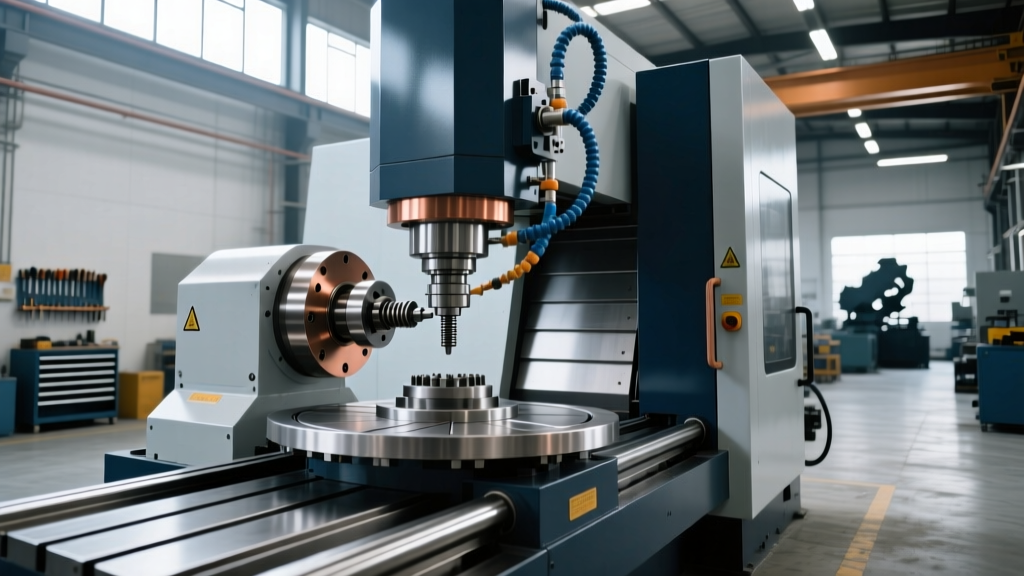
In a standard 3-axis VMC, the workpiece remains static on the table while the spindle moves in X, Y, and Z. In 5 axis cnc machining, the workpiece is typically mounted on a rotary tilting table (A and C axes). This means the part itself is rotating at high speeds—often exceeding 50 RPM for large aerospace structural components—while the spindle simultaneously engages it.
⚠ Critical Hazard Alert: Rotary Table Pinch PointsThe intersection of the tilting A-axis and the rotating C-axis creates severe shear and pinch points. Operators loading heavy fixtures (often exceeding 500 kg) are at extreme risk of crush injuries if the rotary table is accidentally jogged or if residual hydraulic/pneumatic fixture pressure releases during setup. OSHA mandates that all dynamic rotary zones be enclosed with interlocked guarding that prevents table rotation when the enclosure is breached.
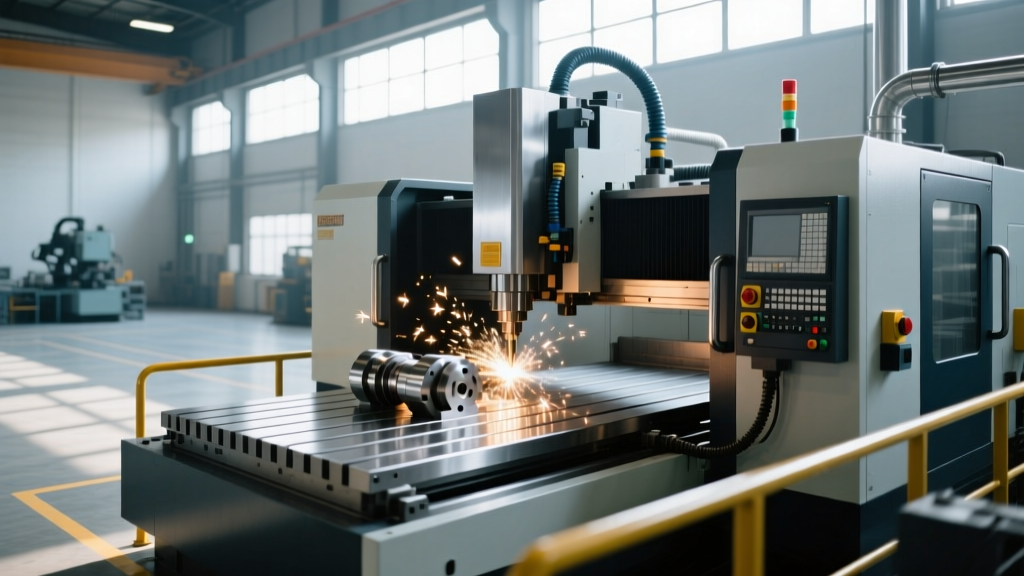
Furthermore, tool paths in 5-axis simultaneous milling often require the spindle to approach the workpiece at compound angles. If a tool shatters or a carbide insert fails, the ejection trajectory is not strictly downward or lateral; it can be directed upward toward the machine roof or outward at acute angles, demanding comprehensive 360-degree impact containment.
Core Regulatory Frameworks: ISO, ANSI, and OSHA
Facilities operating multi-axis equipment must navigate a matrix of overlapping regulations. The foundational baseline in the United States is OSHA 1910.212(a), which dictates general machine guarding requirements. However, OSHA standards are largely performance-based and do not detail the specific kinematic nuances of 5-axis mills.
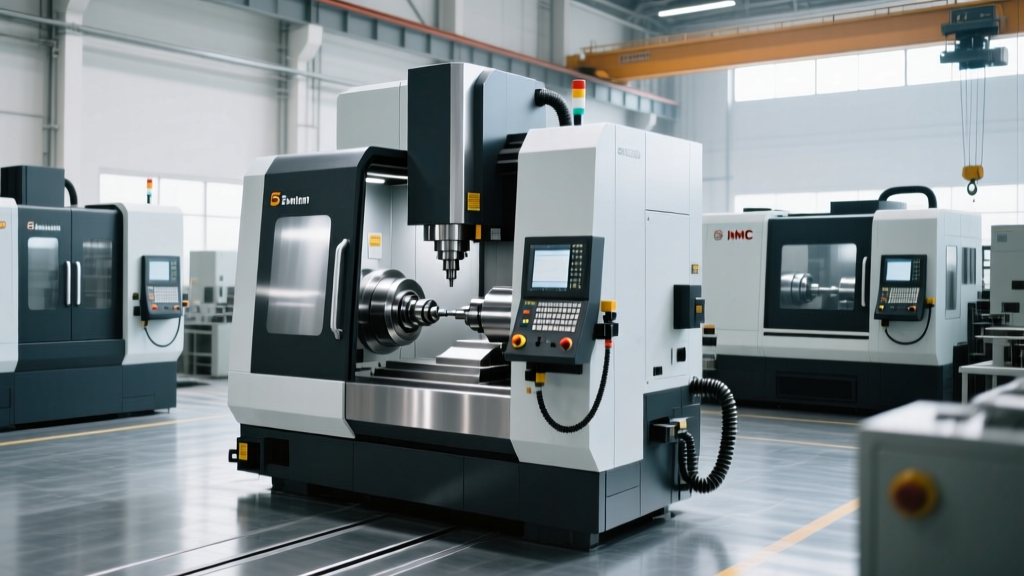
For prescriptive engineering controls, safety managers must reference ISO 16090-2:2017 (Machine tools — Safety — Machining centres and milling machines). This standard specifically addresses the containment of high-velocity projectiles and the safety requirements for movable workpiece holding devices. Additionally, ANSI B11.8 provides specific guidelines for drilling, milling, and boring operations, while NFPA 79 governs the electrical safety and fail-safe logic of the machine's interlock circuits.
3-Axis VMC vs. 5-Axis Machining Center Safety Requirements
| Safety Feature | Standard 3-Axis VMC | 5-Axis Machining Center |
|---|---|---|
| Polycarbonate Glazing Thickness | 8mm - 10mm | 12mm - 15mm (Impact Rated) |
| Door Interlock Type | Mechanical Tongue / Key | RFID Non-Contact Coded (e.g., Pilz PSENcode) |
| Coolant Pressure Containment | Up to 20 bar (290 psi) | Up to 150 bar (2175 psi) with sealed labyrinth |
| Emergency Stop Logic | Category 1 / PLd | Category 4 / PLe (Safe Torque Off on Rotary Axes) |
Engineering Controls: Guarding, Interlocks, and Glazing
Achieving compliance in 5 axis cnc machining requires upgrading physical barriers and electronic monitoring systems to handle the elevated kinetic energy of the process.
Polycarbonate Thickness & Impact Ratings
Standard acrylic or thin polycarbonate windows are entirely insufficient for 5-axis machining, particularly when milling hard metals like Inconel or Titanium where insert failure is common. Safety enclosures must utilize 12mm to 15mm thick, UV-stabilized polycarbonate (such as Makrolon AR or Lexan Margard). These materials offer high-velocity impact resistance and chemical resilience against aggressive semi-synthetic coolants.
💡 Maintenance Directive: Glazing DegradationPolycarbonate degrades when exposed to metalworking fluids and UV light, leading to micro-crazing and a 40% loss in impact strength over time. Facilities must implement a mandatory replacement schedule for all viewing windows every 5 to 7 years, regardless of visible damage, to maintain ISO 16090-2 compliance.
Defeat-Resistant Interlock Systems
Mechanical tongue-style interlocks frequently fail on heavy 5-axis machine doors due to sagging hinges and misalignment, leading operators to defeat them with zip-ties or spare keys—a leading cause of fatal CNC accidents. Modern compliance requires RFID-coded, non-contact safety switches (such as the Pilz PSENcode series or Schmersal CSS series). These switches feature a unique coded actuator that cannot be defeated with a standard magnet or piece of metal, ensuring the machine's safety PLC immediately cuts power to the spindle and rotary axes if the door seal is broken by even 5 millimeters.
Coolant Pressurization and Mist Extraction Compliance
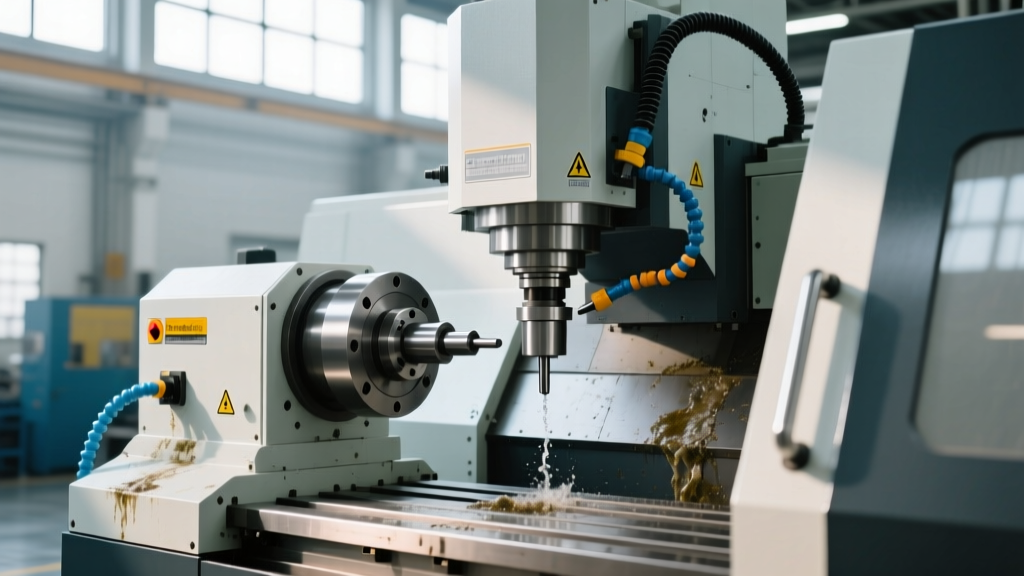
Complex 5-axis parts often require deep-hole drilling and aggressive material removal, necessitating high-pressure coolant systems operating between 70 bar (1000 psi) and 150 bar (2175 psi) to break chips and prevent built-up edge (BUE). At these pressures, coolant atomizes instantly upon contact with the cutting zone, creating dense, respirable mist clouds.
"Exposure to aerosolized metalworking fluids is strictly regulated. Under OSHA guidelines and NIOSH recommendations, facilities must maintain airborne mist concentrations below 0.5 mg/m³. Relying on the machine's standard splash guards is inadequate for 150-bar systems; dedicated centrifugal or HEPA mist collectors with negative-pressure enclosures are mandatory to prevent respiratory hazards and shop-floor slip incidents." — NIOSH Metalworking Fluids Criteria
To comply, 5-axis cells must be fitted with hermetically sealed roof enclosures and integrated mist extraction units (such as those from Absolent or Losma) capable of cycling the enclosure air volume at least 4 to 6 times per minute.
Step-by-Step Compliance Audit Checklist for 5-Axis Cells
Safety managers and plant engineers should execute this specific audit protocol quarterly to ensure ongoing compliance with multi-axis safety standards:
- Verify Safe Torque Off (STO) Logic: Confirm that triggering the E-Stop or opening the primary door initiates an STO command (Category 4 / PLe) on the A and C axis servos, preventing dynamic coasting of heavy rotary tables.
- Inspect Polycarbonate Glazing: Check all viewing windows for chemical crazing, micro-fractures, or delamination. Measure thickness with ultrasonic gauges to ensure it meets the 12mm minimum.
- Test RFID Interlock Redundancy: Attempt to initiate a spindle start with the door closed but the RFID actuator removed. The dual-channel safety relay must prevent startup.
- Audit Fixture Clearance Zones: Run a simulated 3D toolpath verification (using software like VERICUT) specifically to check for collisions between the fixture clamps and the machine's internal way-covers or bellows at extreme A-axis tilt angles (e.g., -30° to +120°).
- Measure Mist Extraction Flow: Use an anemometer at the enclosure exhaust port to verify the mist collector is maintaining the required negative pressure (minimum 0.05 inches of water gauge).
- Check High-Pressure Hose Routing: Ensure all 70+ bar coolant lines inside the work envelope are fitted with burst-containment sleeves and are routed away from the direct path of rotary table movement to prevent abrasion.
Frequently Asked Questions (FAQ)
Does OSHA require specific certification for 5-axis CNC operators?
OSHA does not issue a specific "5-axis certification," but under the General Duty Clause and OSHA 1910.212, employers are legally required to provide documented, machine-specific training. This training must cover the unique kinematic hazards, rotary table loading procedures, and specific emergency stop logic of the exact 5-axis model being operated.
Can we use standard light curtains instead of physical doors on a 5-axis machine?
No. Light curtains (presence-sensing devices) are generally prohibited as the primary safeguarding method for 5 axis cnc machining centers under ISO 16090-2. Light curtains cannot contain high-velocity ejected tool fragments, atomized high-pressure coolant mist, or heavy swarf. Physical, interlocked polycarbonate enclosures are strictly required.
How do we handle safety when using automated robot tending on a 5-axis cell?
When integrating a robotic load/unload system (e.g., a FANCR or KUKA arm), the 5-axis machine and the robot must share a unified safety PLC network via CIP Safety or PROFIsafe. The machine's rotary table must be locked in a specific "load/unload" orientation, and the spindle must be in a Safe Torque Off state before the robot is permitted to cross the physical threshold into the machine's work envelope.