Anatomy of a German 5 Axis CNC Machine: Specs & Kinematics
Explore the technical specifications, kinematics, and control systems that define a German 5 axis CNC machine from brands like Hermle and DMG MORI.
German engineering in multi-axis machining is defined by the relentless pursuit of volumetric accuracy under heavy cutting loads and thermal variance. Unlike standard vertical machining centers (VMCs) retrofitted with add-on rotary tables, a true German 5 axis CNC machine integrates simultaneous kinematics, direct-drive torque motors, and advanced CNC interpolation natively into the machine casting. This technical deep-dive examines the mechanical architecture, control logic, and precise specifications that separate premium European machining centers from standard market alternatives.
Kinematic Configurations: Trunnion vs. Swivel Head
The physical movement of the rotary axes (typically A/B and C) dictates the machine's work envelope, chip evacuation, and collision avoidance. German manufacturers primarily deploy two distinct kinematic chains, each optimized for specific part geometries.
The Modified Trunnion Table (Table-Table)
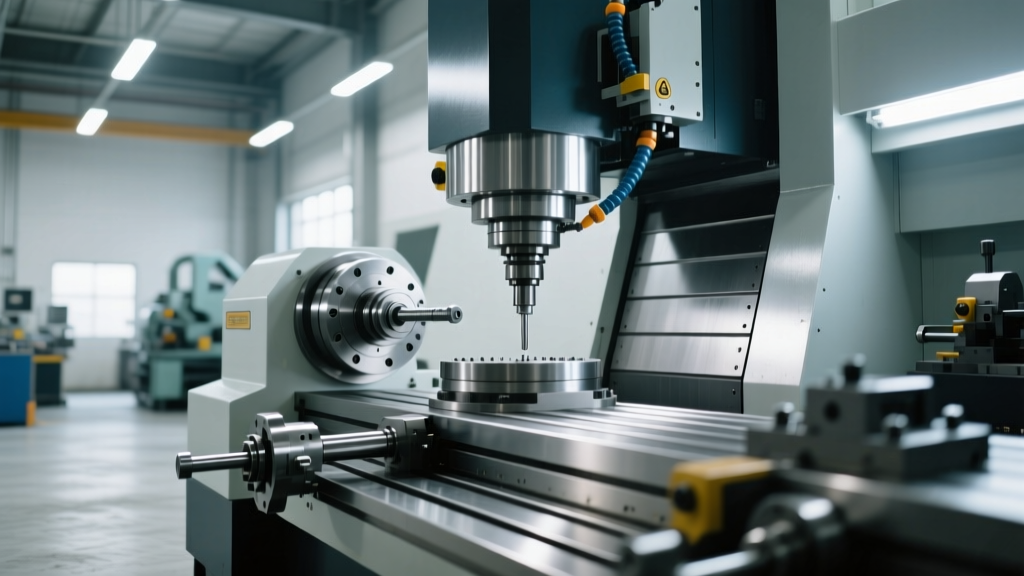
Pioneered and perfected by brands like Hermle, the modified trunnion table mounts both rotary axes to the worktable. The defining feature of the German iteration is the asymmetrical tilt range. While standard trunnions tilt ±90°, German models often tilt from -15° to +115°. This over-travel allows the spindle to access undercuts on the backside of a part without requiring the tool to reach over the centerline, drastically reducing tool overhang and deflection.
Data Highlight: Axis Dynamics- A-Axis Tilt Range: -15° to +115° (Modified Trunnion)
- C-Axis Rotation: Infinite (n x 360° via slip ring or ±360° via drag chain)
- Max Table Load: 600 kg (Typical for 800mm class machines)
The Swivel Head (Head-Head)
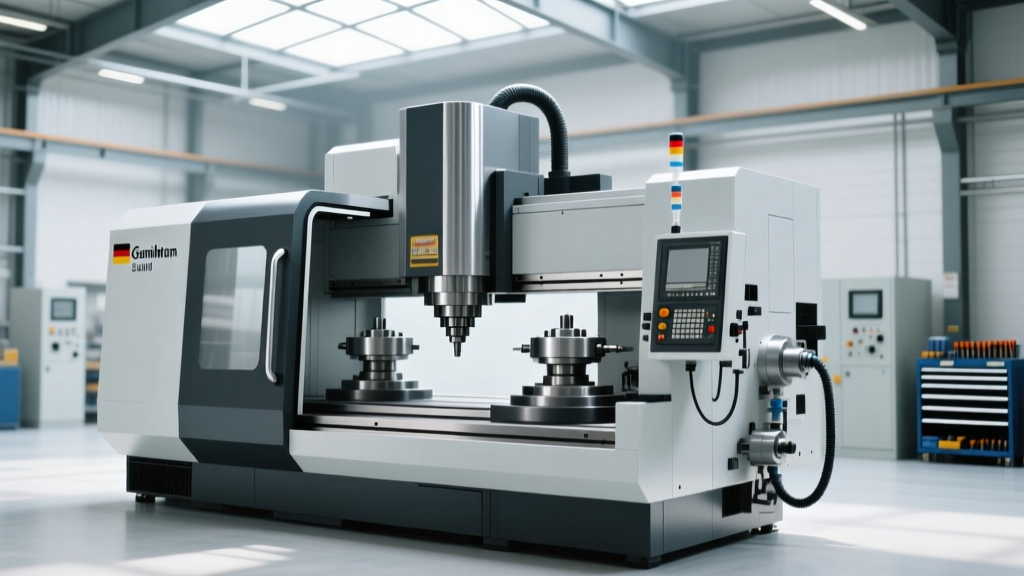
Manufacturers like DMG MORI and Grob frequently utilize swivel head configurations, where the B-axis (tilt) is integrated into the spindle head, and the C-axis rotates the table (or the head, in horizontal configurations). Swivel heads excel in deep-cavity milling and heavy-duty aerospace structural parts because the workpiece remains stationary on a massive, fixed bed, eliminating the payload limitations of a tilting table.
Technical Specification Matrix: Market Leaders
The following matrix compares the baseline technical specifications of three dominant German 5-axis platforms in the 500mm–800mm work envelope class.
| Specification | Hermle C 400 | DMG MORI DMU 50 3rd Gen | Chiron FZ 12 S |
|---|---|---|---|
| Kinematic Type | Modified Trunnion | Swivel Head (B) / Rotary (C) | Swivel Head (B) / Rotary (C) |
| Travel (X/Y/Z) | 600 x 400 x 330 mm | 650 x 520 x 475 mm | 550 x 420 x 380 mm |
| Rapid Traverse | 35 m/min | 35 m/min | 45 m/min |
| Spindle Speed (Std) | 15,000 rpm (HSK-A63) | 15,000 rpm (SK40/HSK-A63) | 24,000 rpm (HSK-A63) |
| Positioning Accuracy | ± 0.004 mm | ± 0.005 mm | ± 0.003 mm |
| Machine Bed Material | Mineral Cast | Polymer Concrete / Cast Iron | Polymer Concrete |
The Core Mechanics: Direct Drive Torque Motors
The transition from worm-gear drives to direct-drive torque motors in the rotary axes is the mechanical hallmark of modern German 5-axis machines. Worm gears inherently suffer from backlash, friction-induced heat, and wear over time. Direct-drive torque motors eliminate the mechanical transmission entirely, coupling the rotor directly to the rotary table or swivel head.
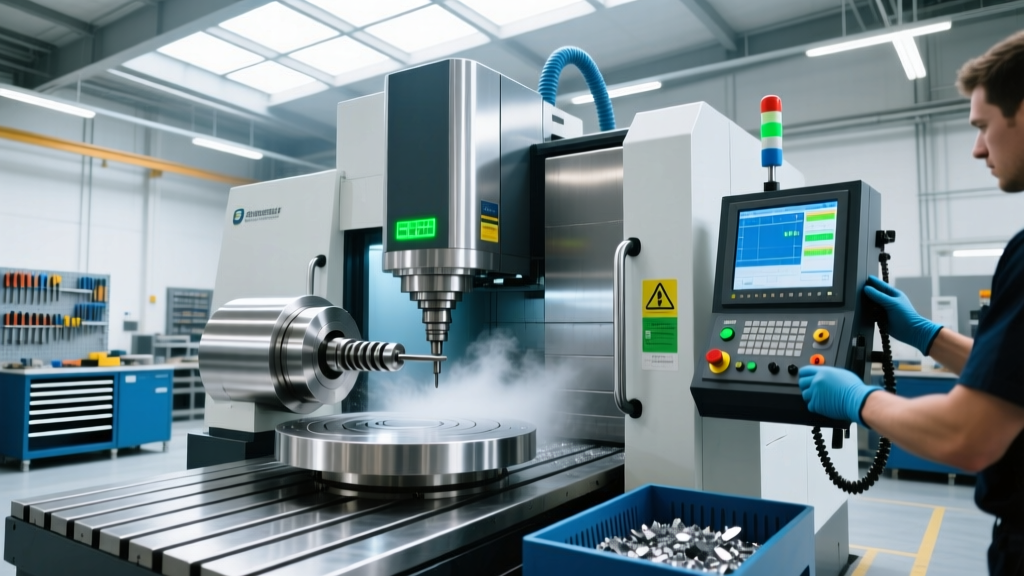
Because torque motors generate significant heat in the stator, German manufacturers integrate liquid cooling jackets directly into the motor housing. This maintains the thermal equilibrium of the axis. Furthermore, to handle the immense cutting forces of roughing operations in titanium or Inconel, these axes feature pneumatic or hydraulic clamping systems. A high-end C-axis torque motor will deliver continuous torque upwards of 800 Nm, with a clamping torque exceeding 3,000 Nm to lock the axis rigidly during heavy off-center milling.
Thermal Stability: The Mineral Cast Advantage
Volumetric accuracy in 5-axis machining is highly sensitive to thermal growth. If the machine bed expands unevenly, the pivot point of the rotary axes shifts, destroying the RTCP (Rotary Tool Center Point) calculation. To combat this, brands like Hermle and Chiron utilize mineral cast (epoxy granite) machine beds instead of traditional cast iron.
"Mineral cast exhibits a damping coefficient up to 10 times greater than cast iron. This massive reduction in high-frequency vibration not only extends carbide tool life by 20-30% during hard milling, but the material's near-zero thermal conductivity ensures the machine geometry remains stable even when ambient shop temperatures fluctuate by ±5°C."
Control Systems and RTCP Interpolation
The mechanical precision of a German 5 axis CNC machine is useless without a control system capable of processing complex 3D toolpaths in real-time. The market is dominated by two primary ecosystems: the Heidenhain TNC series and Siemens Sinumerik ONE. Both systems utilize advanced look-ahead algorithms and RTCP to maintain the tool tip exactly on the programmed surface.
How RTCP (Rotary Tool Center Point) Works
When programming a 5-axis part, the CAM software outputs the tool tip coordinates (X, Y, Z) and the tool vector (I, J, K or A, B, C). As the machine's rotary axes move to align the tool vector with the part surface, the physical pivot point of the spindle shifts in 3D space.
- Vector Calculation: The CNC controller (such as the Heidenhain TNC 7) continuously calculates the exact geometric offset between the rotary axis pivot point and the cutting edge of the tool.
- Real-Time Compensation: As the B and C axes rotate, the controller simultaneously commands the X, Y, and Z linear axes to move in the opposite direction of the pivot shift.
- Collision Avoidance: Advanced German controls integrate 3D collision monitoring, checking the machine kinematics against the STL model of the part and fixturing to halt the feed drive milliseconds before a physical crash occurs.
Pricing, Options, and ROI Considerations
Acquiring a German 5-axis machining center requires a significant capital expenditure, but the ROI is realized through reduced setup times, single-clamping completeness, and superior surface finishes that eliminate manual benching.
Cost Breakdown: Fully Equipped 5-Axis Cell
- Base Machine (500mm class): $280,000 – $340,000
- High-Pressure Coolant (80-150 bar): $25,000 – $40,000 (Critical for deep-hole drilling and chip evacuation in 5-axis cavities)
- Automated Tool Changer (120+ tools): $35,000
- In-Cycle Probing & Kinematic Calibration: $15,000 (Includes Renishaw or Blum laser tool setting and touch probes)
- Pallet Pool / Automation Interface: $60,000 – $120,000
- Total Turnkey Investment: $415,000 – $570,000+
When evaluating platforms like the DMG MORI DMU series or Hermle C-line, buyers must prioritize the integration of automated kinematic calibration cycles. The ability to run a 3D probe cycle that automatically updates the machine's rotary axis pivot point parameters in the CNC control is non-negotiable for maintaining micron-level tolerances over years of production.