Optimizing Your CNC 5 Axis Machining Maintenance Schedule
Master your CNC 5 axis machining maintenance schedule. Learn RTCP calibration intervals, way lube specs, and trunnion bearing service costs.
The Hidden Cost of Neglected Rotary Axes
2026 Downtime Cost Matrix: Unplanned downtime on a multi-axis machining center costs an average of $2,800 per hour in lost aerospace and medical part production. A catastrophic trunnion bearing failure on a machine like the DMG MORI monoBLOCK 65 or Mazak VARIAXIS i-700 can exceed $22,000 in parts and labor alone, not including the 10-14 day lead time for OEM replacement components.Executing complex cnc 5 axis machining operations requires more than just premium tooling and advanced CAM software; it demands a rigorous, data-driven maintenance protocol. Unlike standard 3-axis VMCs, 5-axis machines introduce compounding geometric errors. A mere 0.0002-inch deviation in the B-axis swivel head or C-axis trunnion table will multiply across the tool vector, resulting in scrapped titanium or Inconel components. To maintain volumetric accuracy and protect your spindle investment, maintenance must shift from reactive troubleshooting to predictive calibration.
Daily and Weekly Operator Checklists for 5-Axis Centers
Operator-level maintenance is the first line of defense against thermal drift and way lubrication starvation. These tasks must be integrated into the machine's macro programs or enforced via shop-floor MES (Manufacturing Execution Systems).
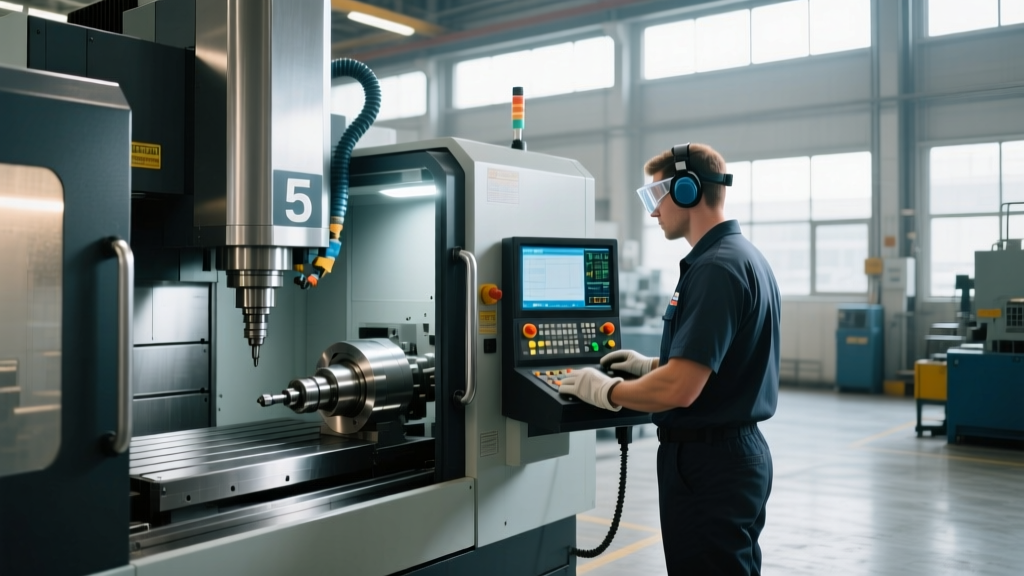
- Daily Spindle & Rotary Warm-Up (15 Minutes): Never begin a 5-axis shift cold. Run a programmed warm-up macro that sweeps the spindle from 2,000 to 12,000 RPM while simultaneously oscillating the B and C axes through their full range of motion. This distributes the OEM grease (e.g., Kluber Isoflex NBU 15) evenly across the ceramic bearing races and prevents dry-start scoring.
- Daily Way Lube Verification: Check the sight glass on the Bijur or Showa lube pump. 5-axis machines consume way lube faster than 3-axis mills due to the constant shifting of the heavy trunnion table. Ensure you are using the correct ISO 68 viscosity fluid, typically Mobil Vactra Oil No. 2, to prevent stick-slip on the linear guideways.
- Weekly Coolant Concentration & Tramp Oil: 5-axis parts often require deep pocketing, demanding high-pressure coolant (up to 1,000 PSI). Check concentration with a refractometer (target 8-10%). Skim tramp oil weekly to prevent anaerobic bacteria growth, which degrades the rust inhibitors and attacks the machine's way covers.
- Weekly RTCP Verification: Run a quick Renishaw OMP60 or spindle-mounted probe cycle on a certified calibration sphere to verify the Rotary Tool Center Point (RTCP) before running high-tolerance aerospace parts.
Quarterly Trunnion and Swivel Head Calibration
Every 500 to 1,000 operating hours, the geometric alignment of the rotary axes must be physically verified. Thermal cycling, heavy cutting forces, and minor collisions slowly degrade the kinematic chain.
Utilizing a wireless ballbar system, such as the Renishaw QC20-W Ballbar, allows maintenance technicians to measure the circularity and backlash of the rotary axes in under 20 minutes. For high-precision cnc 5 axis machining, your target circularity error should remain below 5 microns (0.0002"). If the ballbar test reveals a reverse spike exceeding 10 microns, the rotary axis servo tuning parameters (specifically the position loop gain and acceleration feed-forward) must be adjusted via the Fanuc or Heidenhain control, or the physical pre-load on the roller gear cam must be tightened.
Fluid, Filter, and Spindle Service Intervals
Adhering to a strict fluid and filtration schedule prevents the majority of premature component failures. Below is the definitive service matrix for modern 5-axis machining centers operating in a standard 2-shift environment.
| Interval | Component | Action Required | Specification / Fluid | Est. Cost |
|---|---|---|---|---|
| 500 Hrs | Coolant System | Replace tramp oil skimmer filter & check nozzle pressure | 8-10% concentration | $150 |
| 2,000 Hrs | Way Lube System | Flush lines, replace metering units & check pump pressure | Mobil Vactra Oil No. 2 | $450 |
| 4,000 Hrs | Spindle Chiller | Flush chiller loop, replace desiccant & verify +/- 0.1°C stability | OptiTemp or OEM fluid | $800 |
| 8,000 Hrs | Rotary Bearings | Re-grease trunnion/swivel bearings or check preload tension | OEM lithium complex grease | $2,500+ |
Diagnostic Tree: Troubleshooting 5-Axis Drift and Chatter
When cnc 5 axis machining yields out-of-tolerance parts, the root cause is rarely the cutting tool. Use this diagnostic framework to isolate mechanical and thermal faults.
Symptom: RTCP Positional Drift Exceeding 0.0005" During Long Cuts
Root Cause: Thermal expansion in the B-axis casting or worn rotary encoder seals allowing coolant mist ingress. As the casting heats up unevenly, the pivot point shifts, invalidating the control's kinematic compensation table.
Fix: Implement a mandatory 20-minute macro warm-up cycle before RTCP calibration. If drift persists mid-shift, inspect the absolute encoder (e.g., Heidenhain RCN) for contamination. Clean the encoder glass with isopropyl alcohol and re-seat the O-ring seals. Recalibrate the RTCP using a master tool and probe sphere at the machine's operating temperature.
Symptom: Harmonic Chatter at High B-Axis Angles (e.g., 90° to 110°)
Root Cause: Loss of clamping pressure in the rotary axis brake, or degraded roller gear cam mesh. When the B-axis is tilted, the cutting forces act directly against the brake mechanism. If the hydraulic or pneumatic clamping pressure drops below OEM specs (typically 70-100 bar), the axis will micro-vibrate.
Fix: Check the hydraulic accumulator pressure for the rotary clamps. Bleed the lines to remove trapped air. If pressure is nominal but chatter remains, the roller gear cam requires a preload adjustment to eliminate backlash. Refer to Haas Automation Service Tips or your specific OEM portal for the exact shim thickness and torque specifications for your model's cam follower.
Evaluating OEM vs. Third-Party Service Contracts
Deciding how to manage annual maintenance requires balancing cost against parameter access. In 2026, the landscape of service contracts is sharply divided.
OEM Preventive Maintenance ($6,500 - $9,000/yr)Pros: Access to proprietary servo parameters, guaranteed OEM fluids, and priority spindle replacement. Includes annual laser interferometry and ballbar certification.
Cons: High annual cost; technicians may be scheduled weeks in advance for non-critical visits.
Third-Party Calibration ($2,500 - $4,000/yr)Pros: Highly specialized in metrology (Renishaw/Zeiss calibration). Excellent for ISO 9001/AS9100 audit compliance and geometric error mapping.
Cons: Cannot access locked OEM servo drives to adjust internal kinematic chain parameters or perform proprietary spindle run-in procedures.
For shops running high-mix, low-volume cnc 5 axis machining, a hybrid approach is optimal. Retain a third-party metrology firm for quarterly ballbar and laser calibration to maintain AS9100 compliance, while keeping an OEM preventative maintenance contract for the annual spindle, chiller, and way-lube system overhauls. This ensures your machine's volumetric accuracy is mathematically verified, while the critical mechanical components are serviced by technicians with proprietary diagnostic software access.