What Is Heavy Equipment for Pipeline and Utility Construction?
Discover what is heavy equipment in pipeline and utility construction. Explore sidebooms, rock trenching case studies, and machinery specs.
Defining the Scope: What Is Heavy Equipment in Utility and Pipeline Work?
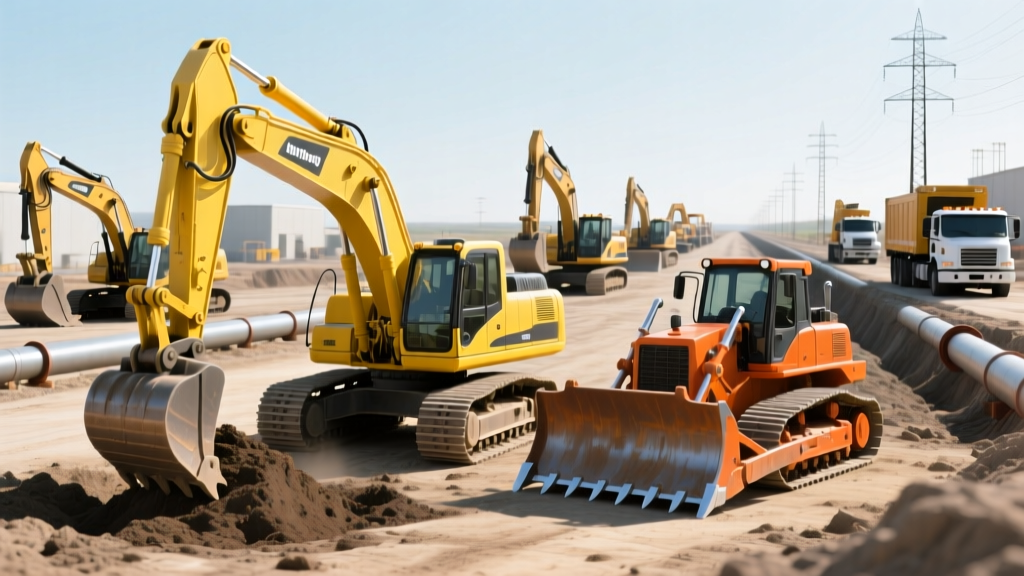
When industry professionals ask, what is heavy equipment in the context of utility and pipeline construction, the answer extends far beyond standard earthmoving. While excavators and bulldozers form the baseline, pipeline right-of-way (ROW) preparation and utility trenching demand highly specialized, purpose-built machinery designed for continuous material handling, precision trenching in extreme geology, and heavy lateral lifting.
Unlike general commercial construction, pipeline projects operate on linear corridors that can span hundreds of miles, crossing diverse topographies from wetlands to solid bedrock. Therefore, heavy equipment in this sector is defined by its ability to maintain continuous forward momentum while executing tasks like pipe stringing, bending, lowering, and backfilling. In 2026, the integration of Tier 4 Final and Stage V emissions-compliant powertrains, combined with automated grade-control and telematics, has redefined the operational baseline for these machines.
Industry Snapshot: Pipeline ROW Specifications- Standard ROW Width: 75 to 125 feet for major transmission lines.
- Minimum Trench Depth: 36 to 48 inches of cover over the pipe, per PHMSA regulations.
- Typical Fleet Size: A 10-mile spread of 36-inch pipe requires roughly 12-15 sidebooms, 4-6 excavators, and 2 bending machines.
Core Machinery Categories for Pipeline Right-of-Way (ROW)
To understand what is heavy equipment for pipeline applications, you must examine the specialized fleet that replaces standard site-work machines. The two most critical categories are sideboom tractors and high-capacity hydraulic excavators configured for trenching.
Sideboom Tractors: The Pipeline Standard
Standard crawler dozers are inadequate for laying large-diameter pipe because their center of gravity and blade configurations do not support lateral loads. Sideboom tractors, such as the Caterpillar 583T or 587T, feature a side-mounted boom and heavy counterweights. This allows them to lift joint sections of steel pipe (often weighing 10,000 to 25,000 lbs per joint) and lower them into the trench while traveling parallel to the excavation.
The Cat 583T, a staple in modern spreads, offers a lift capacity of approximately 20,000 lbs at a 4-foot reach. Priced between $550,000 and $680,000 depending on track shoe configuration (typically 36-inch single-grouser pads for low ground pressure in wetlands), these machines utilize a hydrostatic transmission that allows the operator to feather the travel speed independently of the engine RPM, ensuring smooth, continuous pipe lowering without jerking the weld joints.
Hydraulic Excavators with Tiltrotators and Vacuum Lifters
For municipal utility work and smaller-diameter pipelines (under 24 inches), standard 30-ton class excavators like the Volvo EC300E are heavily modified. Rather than using wire chokers to lift pipe—which creates severe pinch-point hazards under OSHA trenching standards—modern fleets utilize vacuum lifting attachments.
Systems like the Vacuworx RC12 (costing roughly $42,000) use polyurethane pads and a diesel-driven vacuum pump to grip PVC, ductile iron, or coated steel pipe. This eliminates manual rigging, reducing lowering times by up to 40% and virtually eliminating hand injuries in the trench.
Equipment Comparison Matrix: Pipe Lowering & Trenching
| Machine Type | Example Model | Primary Function | Lift/Lateral Capacity | Best Application Scenario |
|---|---|---|---|---|
| Sideboom Tractor | Caterpillar 583T | Continuous pipe lowering | 20,000 lbs @ 4ft reach | Cross-country transmission pipelines (24" - 48" diameter) |
| Crawler Dozer (Ripper) | Caterpillar D8T | ROW clearing & rock ripping | N/A (Drawbar pull: 85,000 lbs) | Fracturing Class II and shallow Class III rock prior to trenching |
| Hydraulic Excavator | Volvo EC350E | Trenching & localized lowering | 12,500 lbs (via quick coupler) | Urban utility routing, road crossings, and tie-ins |
| Pipe Bending Machine | CRC-Evans PB60 | Cold bending of steel pipe | Up to 60" diameter pipe | Creating horizontal/vertical curves to match ROW topography |
Case Study: Rocky Terrain Utility Routing in the Marcellus Shale
To illustrate what is heavy equipment in extreme conditions, consider the geological challenges of routing utility and gathering lines through the Appalachian Marcellus Shale region. This terrain features Class III and Class IV rock with compressive strengths frequently exceeding 8,000 psi.
'In high-compressive shale, traditional trenchers and standard excavator buckets will burn through ground engaging tools (GET) in hours. The equipment selection must shift from cutting to fracturing.'
— Pipeline Geotechnical Engineering Report, Pipeline Research Council International (PRCI)
The Equipment Selection Framework for Hard Rock Trenching
When encountering solid shale, contractors cannot rely solely on excavator teeth. The operational framework shifts to a two-pass mechanical fracturing process:
- Pass 1: Ripping. A Cat D8T equipped with a single-shank ripper and a 120-inch curved shank is used to fracture the bedrock to a depth of 36 inches. The D8T's 15.7-liter engine and high-torque powertrain provide the necessary drawbar pull to shatter the shale matrix.
- Pass 2: Excavation and Hammering. A Cat 390F L mass excavation excavator follows. Where the ripper failed to penetrate, the 390F utilizes a 12,000 ft-lb hydraulic hammer (such as an Atlas Copco MB 1500) to break out localized boulders, followed by a heavy-duty rock bucket with abrasion-resistant (AR) steel liners.
Cost Impact: Trenching in standard soil costs approximately $12 to $18 per linear foot. In unfractured Marcellus shale, utilizing the D8T/390F combination pushes costs to $65 to $95 per linear foot, factoring in accelerated GET wear (replacing ripper tips every 4-6 hours at $120 per tip) and reduced production rates of 400 feet per day compared to 2,500 feet in loam.
Stringing and Bending: Specialized Pipe-Handling Attachments
Beyond earthmoving, heavy equipment in pipeline construction includes specialized material forming tools. Steel pipe is manufactured in 40-foot or 60-foot joints, but the earth is rarely perfectly straight or flat.
Heavy-duty hydraulic bending machines, like the CRC-Evans PB60, are towed or mounted on custom chassis. The PB60 uses a series of hydraulically actuated die shoes to cold-bend pipe up to 60 inches in diameter. The machine applies up to 2.5 million foot-pounds of bending force. Operators use laser-guided protractors and digital inclinometers to achieve precise bend radii, ensuring the pipe fits the trench without inducing dangerous residual stresses on the girth welds.
Frequently Asked Questions (FAQ)
What is heavy equipment classification for pipeline right-of-way clearing?
ROW clearing typically relies on 50,000 to 80,000 lb class crawler dozers (like the Cat D6 or D8) equipped with brush rakes and heavy-duty winches. Mulchers, such as the FAE PT475, are also classified as heavy ROW equipment, utilizing 475-horsepower prime movers to clear timber and stumps to a depth of 12 inches below grade.
Why are sidebooms preferred over excavators for laying large pipe?
Excavators must swing their upper carriage to place pipe, which requires stopping, lifting, swinging, and lowering—a slow, discontinuous process. Sidebooms travel continuously forward alongside the trench, lowering the pipe in a smooth, unbroken motion. This prevents stress on the welded joints and allows the stringing crew to maintain a pace of up to 2 miles per day under optimal conditions.
How do emissions regulations affect 2026 pipeline fleets?
Modern pipeline spreads must comply with EPA Tier 4 Final and EU Stage V emissions standards. This requires heavy equipment to be equipped with Diesel Particulate Filters (DPF) and Selective Catalytic Reduction (SCR) systems. Fleet managers must factor in Diesel Exhaust Fluid (DEF) consumption—typically 3% to 5% of diesel fuel volume—and ensure DPF regeneration cycles do not interrupt critical pipe-lowering operations, which could leave a multi-ton pipe joint suspended over an open trench.