Repairing Timber Mats for Heavy Equipment on Pipeline Sites
Learn how to troubleshoot, repair, and maintain timber mats for heavy equipment used in utility and pipeline construction to prevent ground failure.
The Operational Reality of Pipeline Rights-of-Way
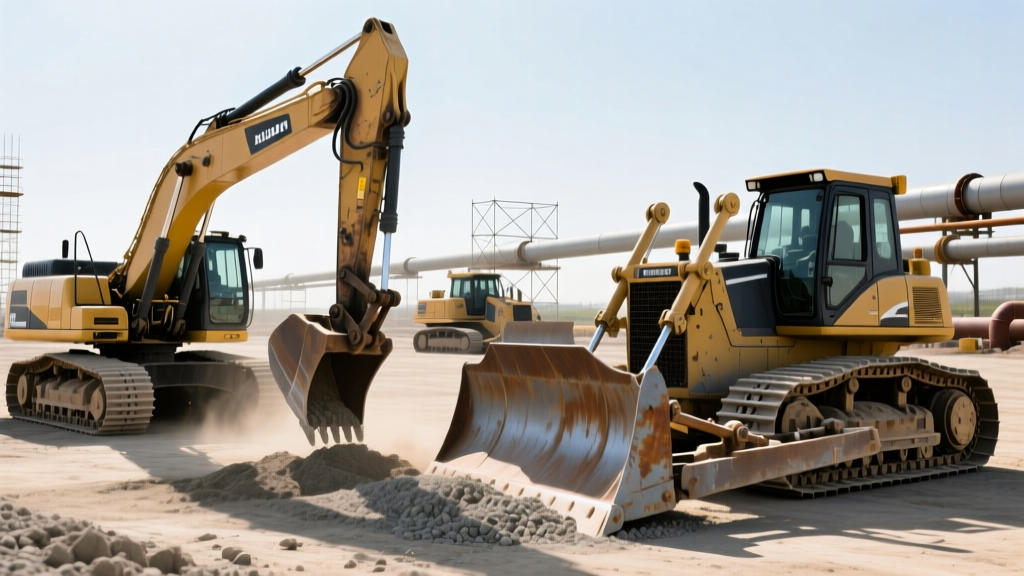
Pipeline rights-of-way present extreme ground-bearing challenges that standard construction sites rarely encounter. When operating a 75,000-pound Caterpillar PL83 pipelayer or a 180,000-pound Ditch Witch T1250 trencher in saturated clay, muskeg, or steep grades, timber mats for heavy equipment are the only barrier between catastrophic sinkage and operational continuity. Unlike static crane lifts, pipeline equipment subjects mats to dynamic torsional loads, high point-pressures from track differential steering, and severe impact loading from trench drop-offs.
Standard 8x20-foot mixed hardwood mats degrade rapidly under these specific utility construction conditions. This guide details how to diagnose, troubleshoot, and execute field repairs on timber mats specifically subjected to pipeline and utility machinery, ensuring ground stability and protecting subterranean assets.
Mat Sizing and PSI Calculations for Pipeline Equipment
Before troubleshooting failures, you must verify that the mat specifications match the equipment's dynamic footprint. A common failure mode in pipeline construction is using mats rated for static crane loads rather than dynamic track loads.
- Sidebooms (Pipelayers): A CAT PL87 exerts a static ground pressure of roughly 12-15 PSI. However, when pivoting with a suspended 40-inch coated pipe, the dynamic load on the leading track edge can spike to over 35 PSI. Mats must be a minimum of 10 inches thick, utilizing high-density species like White Oak or Hickory.
- Trenchers: Ride-on trenchers like the Ditch Witch T1250 feature aggressive track grousers that act like cheese graters on timber surfaces. For these machines, 12-inch thick laminated softwood mats with 1-inch steel tread-plate caps are required to prevent rapid surface shredding.
- Vacuum Excavators: Hydrovac trucks deploy outriggers that concentrate 50,000+ pounds onto a 2x2-foot pad. Standard timber mats will crush. Always use engineered laminated mats with a minimum 1,500 psi fiber-stress rating under outrigger points.
Diagnostic Matrix: Mat Degradation Under Pipeline Loads
Use this matrix to identify the root cause of mat failure based on the specific pipeline equipment operating on the right-of-way.
| Symptom | Root Cause | Pipeline Equipment Trigger | Field Fix / Upgrade |
|---|---|---|---|
| Fastener Shearing | Torsional twisting exceeding bolt shear strength | Sideboom pivoting with suspended load | Retrofit with 1.25-inch UHMWPE flexible rods |
| End-Splitting | Impact loading and lever-arm prying | Trencher track drop-off at trench edge | Install 3/8-inch steel end-banding or strap |
| Surface Crushing | Exceeding timber compression perpendicular to grain | Vac excavator outrigger point-load | Sister with 1/2-inch steel tread plate |
| Longitudinal Bowing | Moisture absorption and uneven soil support | Pipelayer traveling over soft ditch spoil | Shim voids with gravel; reject if camber exceeds 3 inches |
Troubleshooting Fastener and Tie-Rod Failures
Standard timber mats utilize 1-inch or 1.25-inch galvanized steel tie-rods to bind the timbers together. Under a pipelayer, the track differential steering creates immense shear stress. If your crew is replacing snapped steel bolts weekly, the hardware is too rigid for the application.
The UHMWPE Upgrade
When steel tie-rods snap, the mat loses its composite strength, leading to individual timber roll-overs that can throw a track. The solution is to retrofit failing mats with 1.25-inch UHMWPE (Ultra-High-Molecular-Weight Polyethylene) tie-rods. UHMWPE yields and stretches under extreme torsional loads without snapping, absorbing the kinetic energy of the pipelayer's pivot. According to material stress data referenced by the USDA Forest Products Laboratory, allowing slight flexibility in the fastening system significantly extends the fatigue life of the surrounding hardwood fibers by reducing localized bearing stress around the bolt holes.
Addressing Timber Checking vs. Structural Splitting
Field inspectors often condemn mats prematurely due to a misunderstanding of wood mechanics. It is critical to distinguish between checking and splitting.
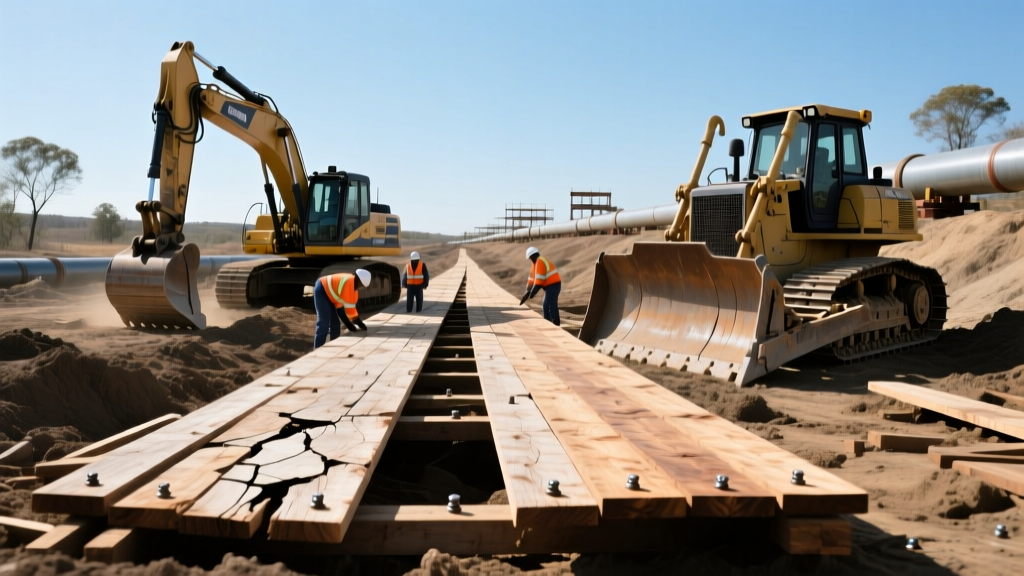
Inspection Rule of Thumb: Checking (cracks running parallel to the grain) is a natural result of the mat drying out in the sun and does not compromise structural integrity. Splitting (cracks running through the fastener lines or horizontally across the grain) is a catastrophic failure mode caused by frost wedging or impact loads. Mats with splits intersecting tie-rod holes must be immediately removed from the active right-of-way.To mitigate end-splitting caused by trenchers driving off the mat edge, fabricate and bolt 3/8-inch thick, 4-inch wide steel strap banding around the leading and trailing ends of the mat. This contains the wood fibers and prevents the lever-action of the track from prying the timbers apart.
Field Repair Protocol for Localized Crushing
When a hydrovac outrigger or a concentrated pipe load crushes the top surface of a mat, you do not need to scrap the entire unit. Localized crush zones can be repaired in the field using marine-grade structural epoxy, provided the damage does not exceed 20% of the mat's surface area.
- Route the Damage: Use a handheld router with a 1/2-inch straight bit to excavate the crushed, punky wood down to solid, dense fiber. Create a clean, square-walled pocket.
- Prepare the Epoxy: Mix a high-modulus, structural wood epoxy (e.g., West System 105 resin with 206 slow hardener). The slow hardener is critical in pipeline summer conditionsi> Ensure no voids remain. The epoxy will cure to a compressive strength exceeding 10,000 PSI, far stronger than the original timber.
- Cure and Plane: Allow 24 hours for full cure. Use a power planer to flush the epoxy patch with the surrounding mat surface to ensure a flat bearing plane for the equipment tracks.
Pipeline Coating Protection: A Critical Warning
When laying mats directly over an exposed, coated pipeline ditch to allow equipment to cross, raw timber mats pose a severe threat to the asset. Modern pipeline coatings, such as 3LPE (3-Layer Polyethylene) or FBE (Fusion Bonded Epoxy), are highly susceptible to micro-abrasions. Dragging raw, splintered oak mats across these coatings can scratch the surface, leading to cathodic protection failures and accelerated corrosion.
Regulatory Compliance Note: The Pipeline and Hazardous Materials Safety Administration (PHMSA) mandates strict protection of pipeline coatings during construction crossing. Never allow raw timber mats to contact coated pipe.The Fix: Always route a 1/2-inch chamfer on all top edges of mats used for ditch crossings. Furthermore, staple a 1/4-inch thick UHMWPE slip-sheet to the top surface of the crossing mats. This creates a frictionless, non-abrasive barrier that protects the multi-million-dollar pipeline coating from the heavy equipment traffic above.