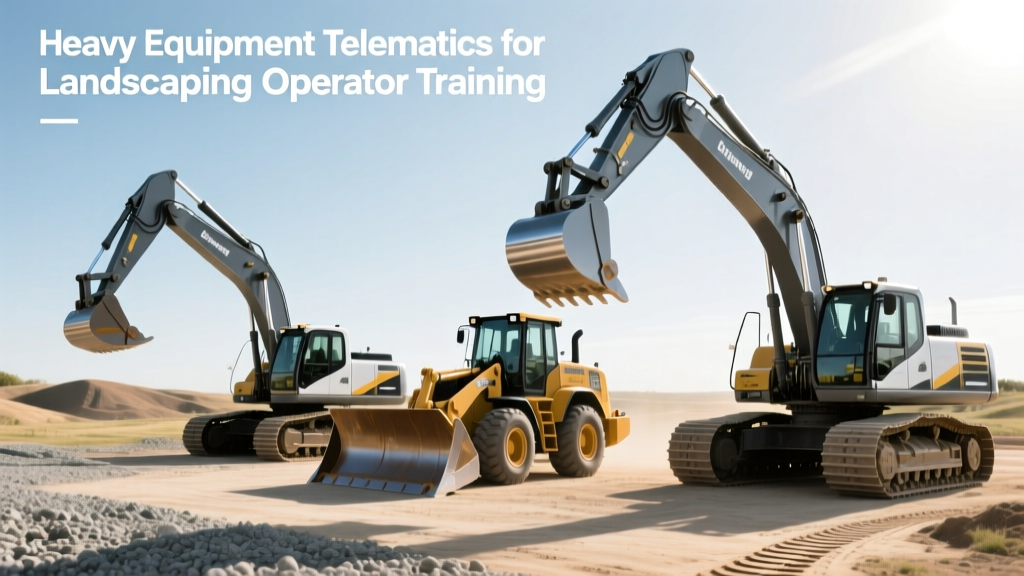
Heavy Equipment Telematics for Landscaping Operator Training
Learn how to use heavy equipment telematics to train landscaping operators, reduce idle time, and optimize compact track loader and mini excavator usage.
Landscaping margins are notoriously tight, often hovering between 10% and 15% net profit. When operators misuse compact track loaders (CTLs), skid steers, and mini excavators, fuel waste, premature undercarriage wear, and diesel particulate filter (DPF) failures silently erode those margins. Integrating heavy equipment telematics into your operator training program transforms raw machine data into targeted, behavioral coaching. Instead of relying on anecdotal observations from the field, fleet managers can now pinpoint exact operational inefficiencies and correct them before they result in catastrophic component failure.
The Bottom Line: Landscaping fleets utilizing telematics-driven operator training typically see a 12-18% reduction in fuel consumption and a 30% extension in rubber track life within the first six months of implementation.The Core Telematics Metrics for Landscaping Fleets
Most landscaping fleets operate machines in the 70 to 110 horsepower range, such as the Cat 299D3 XE or the Kubota KX040-4 mini excavator. These compact machines are highly sensitive to operator abuse. When reviewing data from platforms like Caterpillar's VisionLink or John Deere JDLink, trainers must focus on three critical data streams:
1. Idle Time and DPF Regen Interruptions
Landscaping crews frequently leave machines idling while waiting for material deliveries or taking breaks. An idle time percentage above 20% is a red flag. More critically, excessive idling prevents the exhaust system from reaching the temperatures required for active DPF regeneration. When telematics flags 'Active Regen Interrupted' or 'Parked Regen Required' alerts, it indicates operators are shutting down the machine mid-cycle or idling excessively. A failed DPF replacement on a Tier 4 Final compact engine costs between $2,800 and $4,500.
2. Hydraulic Relief Valve Engagement
When an operator forces a hydraulic auger or tiller attachment against an immovable rock, the system hits its pressure relief threshold (typically 3,000 to 3,500 psi on standard-flow CTLs). Telematics systems track 'time in relief.' Prolonged time in relief generates extreme hydraulic fluid heat, degrades the fluid's viscosity, and blows cylinder seals. Training operators to recognize attachment stall and immediately back off the joystick is a primary coaching objective.
3. High-Speed Travel and Counter-Rotation
Compact track loaders rely on rubber tracks that cost $1,200 to $1,800 per pair. Counter-rotation (spinning the machine in place by driving one track forward and the other in reverse) tears the rubber lugs and accelerates internal steel cord fatigue. Telematics can flag high-speed directional changes and excessive reverse travel, allowing managers to coach operators on using 3-point turns instead of pivot turns.
Translating Telematics Data into Operator Coaching
Data without a delivery mechanism is useless. Dumping a 40-page telematics report on a landscaping crew will cause immediate pushback. Implement the '10-Minute Monday' huddle framework to integrate Bobcat Machine Intelligence or equivalent data into your weekly safety and training routine.
- Isolate the Top 3 Offenders: Filter your fleet dashboard to identify the three machines with the highest idle times, highest fuel burn per hour, or most frequent fault codes from the previous week.
- Contextualize the Data: Do not use the data for public shaming. Frame the huddle around machine health. For example: 'Machine 42 had four interrupted DPF regens this week. Let's review the proper shutdown sequence to let the turbo cool and the regen finish.'
- Field Shadowing: Pair the data with physical observation. If telematics shows an operator is spending 15% of their time in hydraulic relief, ride along for 30 minutes to observe their trenching or grading technique. Often, the operator is using the wrong attachment for the soil density.
- Set Micro-Goals: Assign specific, measurable targets for the week, such as reducing idle time from 35% to under 15%, or eliminating high-speed reverse travel on slopes.
Equipment-Specific Telematics Training Matrix
Different landscaping machines require different coaching strategies based on their telematics profiles. Use this matrix to structure your training modules.
| Equipment Type | Common Operator Abuse | Telematics Alert to Monitor | Coaching Action |
|---|---|---|---|
| Compact Track Loader (CTL) | Pivot turns on asphalt/hardpan | High-speed directional shifts; Left/Right track speed variance | Train on Y-turns and wide sweeping arcs; enforce travel speed limits on hard surfaces. |
| Mini Excavator | Using bucket to drag machine forward | Swing motor pressure spikes; Boom cylinder drift | Retrain on proper blade-assisted repositioning and track alignment. |
| Compact Wheel Loader | Riding the brakes while accelerating | Transmission oil temp warnings; Brake wear indicators | Coach on inching pedal usage and proper approach RPMs for pile engagement. |
| Skid Steer Loader | Overloading bucket beyond tipping load | Rear axle pressure; Hydraulic lift circuit relief time | Review rated operating capacity (ROC) charts; train on proper load distribution. |
Tackling Attachment Flow Mismatches
A hidden source of hydraulic failure in landscaping fleets is the mismatch between machine flow settings and attachment requirements. Modern CTLs offer switchable flow modes (e.g., standard 15-20 GPM vs. high-flow 30-40 GPM). If an operator connects a standard-flow trencher but leaves the machine in high-flow mode, the trencher's hydraulic motor will instantly deadhead, sending fluid directly over the relief valve.
Advanced telematics platforms now track attachment recognition and flow setting mismatches. When training operators, mandate a physical walk-around checklist that includes verifying the cab's digital flow setting matches the attachment's data plate. Penalize repeated flow-mismatch fault codes, as a single afternoon of high-flow abuse can destroy a $2,500 hydraulic auger drive.
Warning: Privacy and PushbackWhen introducing heavy equipment telematics, veteran operators often feel they are being spied on. Mitigate this by being transparent about what is tracked. Clearly communicate that telematics monitors machine health and safety parameters, not GPS location during lunch breaks. Tie telematics performance to positive incentives, such as a monthly fuel-savings bonus or an undercarriage-life reward, rather than using it solely as a punitive tool.
Implementing Geofencing for Site Accountability
Landscaping crews often move between multiple residential or commercial sites in a single day. Geofencing allows managers to draw virtual perimeters around job sites. Telematics data will automatically log exactly when a machine enters and exits the zone, providing accurate billing hours and preventing unauthorized machine use after hours.
From a training perspective, geofencing highlights 'dead travel' time. If a machine is turned on at the yard, driven 15 miles to a site, and the telematics shows 45 minutes of engine run time for a 20-minute drive, operators are likely taking unauthorized detours or idling at the yard while loading trucks. Use this data to enforce strict 'start-on-site' policies, where machines are loaded onto trailers with the engines off, and only started upon arrival at the geofenced work zone.
ROI and Cost Justification for Telematics Training
Investing in telematics hardware (often $500 to $1,000 per machine for aftermarket retrofits, or included in OEM base packages) and the associated software subscriptions ($20 to $40 per machine/month) pays for itself rapidly in the landscaping sector. Consider a fleet of ten CTLs:
- Fuel Savings: Reducing idle time from 40% to 15% saves roughly 1.5 gallons of diesel per machine, per day. At $4.00/gallon, that is $60/day per machine, or $15,000 annually across a 10-machine fleet over a 250-day season.
- Undercarriage Extension: Coaching operators out of counter-rotation habits extends a $1,600 set of rubber tracks from 1,200 hours to 1,800 hours. This defers $3,200 in track replacement costs per machine.
- DPF Avoidance: Preventing just two parked regen failures or DPF replacements across the fleet saves upwards of $8,000 in parts and lost labor downtime.
By shifting operator training from subjective guesswork to data-driven coaching powered by heavy equipment telematics, landscaping fleet managers can protect their most expensive assets, enforce best practices, and directly impact the company's bottom line.