Does Heavy Equipment Have Titles? Earthmoving Maintenance Guide
Discover if earthmoving equipment requires titles, how PIN tracking impacts maintenance schedules, and service intervals for excavators, dozers, and loaders.
When fleet managers and owner-operators ask, "does heavy equipment have titles?", the answer is rarely a simple yes or no. Unlike highway vehicles, earthmoving equipment types exist in a complex administrative gray area that directly impacts how you track maintenance, claim warranties, and manage resale value. The titling status of your earthmoving fleet—ranging from hydraulic excavators to wheel loaders—dictates whether you rely on state-issued titles, Manufacturer's Certificates of Origin (MCO), or purely on the Product Identification Number (PIN) for your maintenance and service schedules.
The Legal Reality: Titling vs. PINs in Earthmoving Fleets
To build an accurate maintenance matrix, you must first understand how your equipment is legally classified. State Departments of Motor Vehicles (DMVs) generally divide earthmoving machinery into two categories based on mobility:
- Wheeled Equipment (Wheel Loaders, Motor Graders, Scrapers): Because these machines can travel on public roads at higher speeds, most states require them to be titled and registered, especially if they cross public right-of-ways. They are assigned both a PIN and a state-issued title.
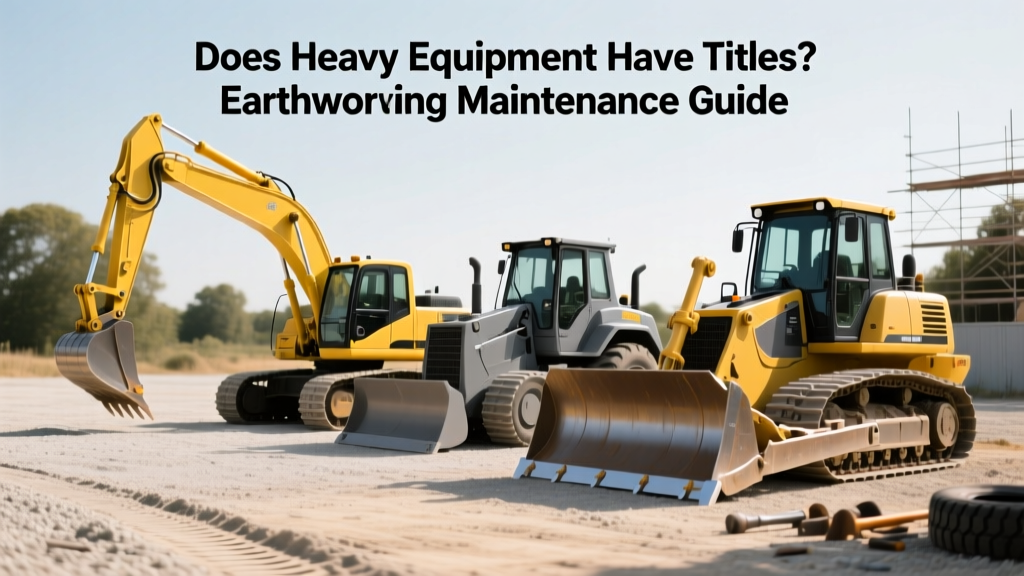
- Tracked Equipment (Crawler Dozers, Hydraulic Excavators): Tracked machines are almost universally classified as off-road implements. They do not receive state titles. Instead, ownership is proven via a Bill of Sale and the machine's PIN (often mistakenly called a VIN).
According to the National Equipment Register (NER), tracking the PIN is the industry standard for off-road machinery. For maintenance managers, this distinction is critical: OEM dealerships require the exact PIN to pull up the machine's build sheet, identify serial-number-break part changes, and validate Tier 4 Final or Stage V engine warranties. If you purchase an untitled, unregistered excavator without verifying the PIN history, you risk inheriting voided warranties and hidden lienholder claims that can disrupt your entire service schedule.
Earthmoving Machine Types: Titling Status & Maintenance Baselines
The table below maps common earthmoving equipment types to their typical titling requirements and baseline factory maintenance intervals. These baselines assume standard operating conditions; severe applications (rock quarrying, demolition, deep mud) require reducing fluid change intervals by 20% to 30%.
| Equipment Type & Model Example | Typical Titling Status | Primary Identifier | Baseline Engine Oil Interval | Critical High-Wear Service Point |
|---|---|---|---|---|
| Hydraulic Excavator (Komatsu PC210LC-11) | No Title (Bill of Sale) | PIN / Serial Plate | 500 Hours (15W-40 CK-4) | Swing Circle Grease (Every 250 Hrs) |
| Crawler Dozer (Caterpillar D6 XE) | No Title (Bill of Sale) | PIN / Serial Plate | 500 Hours (DEO-ULS 15W-40) | Final Drive Oil (Every 1,000 Hrs) |
| Wheel Loader (Volvo L120H) | Yes (in most states) | Title + PIN | 500 Hours (VDS-4.5 15W-40) | Axle Oil & Filters (Every 1,000 Hrs) |
| Motor Grader (John Deere 872GP) | Yes (in most states) | Title + PIN | 500 Hours (Plus-50 II 15W-40) | Circle & Drawbar Wear Pads (Inspect Weekly) |
Application-Specific Service Schedules & Failure Modes
Maintenance schedules must be tailored not just to the machine's engine, but to the specific earthmoving application. The administrative tracking of these services via a CMMS (Computerized Maintenance Management System) must be anchored to the machine's PIN or title number to ensure accurate historical logging.
Hydraulic Excavators: Trenching and Mass Earthmoving
Excavators like the Komatsu PC210LC-11 or Cat 336 operate under high cyclic shock loads. The most common maintenance failure is neglecting the swing bearing (slewing ring).
Actionable Maintenance Protocol:
Grease the swing circle every 250 hours using an NLGI Grade 2 Molybdenum Disulfide (Moly) EP grease. Standard lithium-complex grease will fail under the extreme shearing forces of the swing pinion. Additionally, track tension must be checked weekly; excessive tightness in muddy conditions accelerates idler and sprocket wear, potentially leading to a $15,000–$22,000 undercarriage replacement prematurely. Always log these services against the PIN in your CMMS to maintain resale value, as buyers will specifically request undercarriage wear percentage reports tied to the machine's identity.
Crawler Dozers: Grading and Push-Loading
Track-type tractors, such as the Caterpillar D6 XE (an electric drive model), face continuous abrasion. Because they lack a traditional torque converter and transmission, the maintenance focus shifts heavily to the undercarriage and final drives.
Actionable Maintenance Protocol:
Sample the final drive oil every 500 hours. Look for elevated iron and chromium levels in the oil analysis, which indicate internal gear spalling. The D6 XE's high-voltage electrical system also requires strict adherence to cooling system maintenance; flush the radiator cores every 2,000 hours to prevent inverter overheating. Since dozers do not have titles, the PIN plate (usually located on the right-hand front ROPS post or engine bay) is your sole legal identifier. Keep a clear, timestamped photo of the PIN plate in your maintenance file alongside your Bill of Sale.
Wheel Loaders: Load-and-Carry and Stockpiling
Wheel loaders like the Volvo L120H or John Deere 944L are highly mobile and frequently cross public roads, triggering the need for state titles and DOT compliance in many jurisdictions.
Actionable Maintenance Protocol:
Because they are titled and road-legal, maintenance schedules must include DOT-mandated lighting, braking, and reflector checks alongside standard mechanical services. Mechanically, the articulation joint pivot pins and Z-bar linkage require daily greasing if operating in abrasive environments like sand or fly ash. Change the wet-axle oil every 1,000 hours, and ensure the breathers are cleared of debris to prevent seal blowouts from internal pressure buildup.
When purchasing used wheeled earthmoving equipment that requires a title, never accept a "lost title" excuse without running a lien search. If a wheel loader has an active UCC-1 financing lien attached to its title, the lender can legally repossess the machine from your job site, regardless of your maintenance investments. Always cross-reference the PIN with the National Equipment Register to check for theft records before finalizing the Bill of Sale.
Integrating Ownership Documentation with CMMS
The modern approach to heavy equipment fleet management requires bridging the gap between legal ownership documents and daily wrench-turning. Guidelines from the Association of Equipment Management Professionals (AEMP) emphasize that accurate asset tracking is the foundation of reliable lifecycle cost analysis.
To achieve this, configure your CMMS (such as B2W Maintain, HCSS HeavyJob, or Fleetio) with the following data fields for every earthmoving asset:
- Legal Identifier: State Title Number (for wheeled) OR MCO/Bill of Sale Reference Number (for tracked).
- Technical Identifier: 17-character PIN (or legacy serial number for pre-1980s equipment).
- EPA Engine Family Number: Crucial for tracking DEF consumption and Tier 4 emissions compliance maintenance.
- Component Serial Numbers: Log the serial numbers of the engine, hydraulic pumps, and transmission separately. In the earthmoving industry, major components are frequently swapped; tracking these ensures you are ordering the correct seals and filters for the actual installed components, not just what the factory build sheet says.
"An earthmoving machine without a verifiable PIN or title history is a liability. Maintenance logs that cannot be definitively tied to a specific machine's legal identity hold zero weight during resale negotiations or OEM warranty disputes."
Summary: Aligning Admin and Wrenches
So, does heavy equipment have titles? Yes, for wheeled machines crossing public domains, and no, for tracked implements confined to the dirt. However, the administrative rigor required to track a PIN-based Bill of Sale must be identical to tracking a state-issued title. By anchoring your rigorous, application-specific maintenance schedules—whether it is 250-hour swing circle greasing on an excavator or 1,000-hour axle services on a wheel loader—to the machine's verified legal identity, you protect your capital investment, ensure OEM warranty compliance, and maximize your fleet's residual value at auction.