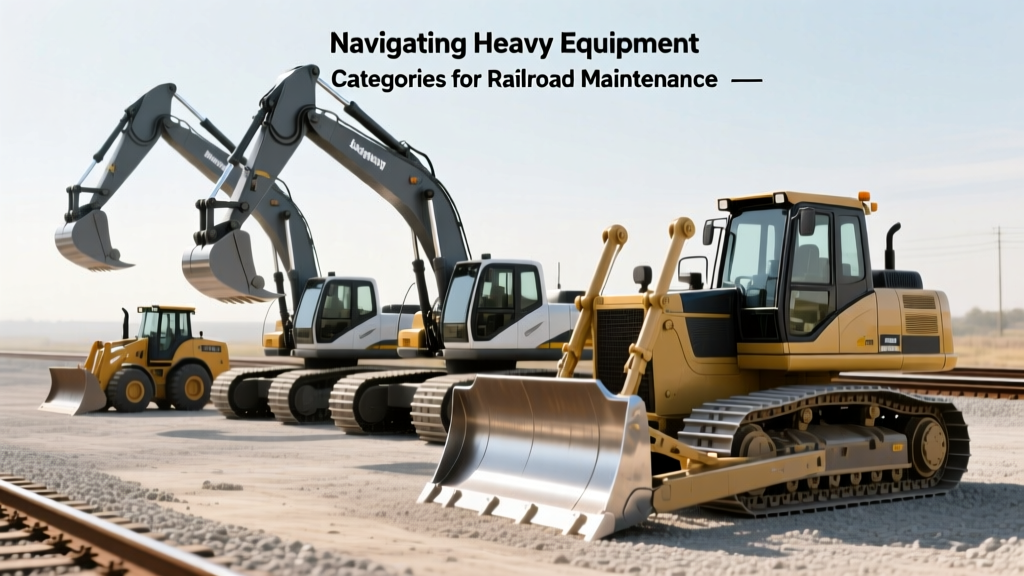
Navigating Heavy Equipment Categories for Railroad Maintenance
Explore specialized heavy equipment categories for railroad maintenance. Compare tampers, grinders, and regulators with 2026 pricing and buying frameworks.
The Unique Landscape of Maintenance of Way (MoW) Machinery
Railroad infrastructure demands precision that standard earthmoving machinery simply cannot provide. When fleet managers and rail contractors evaluate heavy equipment categories for track construction and upkeep, they must pivot away from conventional excavators and motor graders toward highly specialized Maintenance of Way (MoW) equipment. Unlike standard construction heavy equipment categories that focus on bulk material movement, MoW machinery is engineered to manipulate track geometry, manage ballast profiles, and correct rolling contact fatigue within millimeter tolerances.
MoW Equipment Definition: Maintenance of Way encompasses all activities and machinery required to preserve the physical infrastructure of a railway, including the track, roadbed, bridges, and signaling systems. MoW equipment is typically self-propelled, rail-bound, and integrates complex hydraulic and laser-guided alignment systems.Selecting the right machinery requires understanding the distinct heavy equipment categories unique to the rail sector. In 2026, with supply chain lead times for new rail-bound machinery stretching between 18 and 24 months, making the correct procurement decision upfront is critical for maintaining Class I and shortline network fluidity.
Core Heavy Equipment Categories in Railroad Maintenance
1. Track Surfacing and Tamping Equipment
Track geometry degrades continuously under dynamic axle loads. Tamping machines restore the track's longitudinal and lateral alignment by lifting the rails, lining them to precise coordinates, and vibrating steel tines into the ballast to pack the crushed stone tightly beneath the ties.
- Flagship Model: Plasser & Theurer 09-3X Dynamic (Tamping Express)
- Estimated CapEx (2026): $3.8M – $4.5M USD
- Key Specifications: Features a 3-sleeper tamping unit, continuous action, and an integrated dynamic track stabilizer. Capable of production speeds up to 2.5 km/h under optimal conditions.
- Buyer Insight: For high-density freight corridors, the 3-sleeper configuration offers a 40% productivity gain over traditional 2-sleeper units, justifying the premium capital expenditure through reduced track-occupancy time.
2. Rail Grinding and Milling Machinery
Steel rails develop surface defects like head checks, corrugations, and shelling due to rolling contact fatigue (RCF). Rail grinders use rotating abrasive stones to shave away microscopic layers of damaged steel, restoring the optimal railhead profile and extending rail life by up to 300%.
- Flagship Model: Loram C44 Series Rail Grinder
- Estimated CapEx (2026): $9.2M – $12.5M USD (depending on stone count and emission tier)
- Key Specifications: Configurable with up to 72 grinding stones, operating at speeds up to 15 km/h. Modern units feature automated pattern control using real-time laser profiling.
- Buyer Insight: Shortlines and regional carriers often opt for 32-stone configurations ($5.5M range) or contract the service, whereas Class I railroads require 60+ stone high-production grinders to maintain thousands of miles of mainline track.
3. Ballast Undercutters and Shoulder Cleaners
Over time, ballast becomes fouled with coal dust, mud, and degraded stone particles, destroying its drainage capabilities. Undercutters excavate the trackbed, pass the ballast through a series of vibrating screens to discard fines, and return clean stone to the trackbed while introducing new material.
- Flagship Model: Plasser & Theurer RM 90-750 Heavy-Duty Undercutter
- Estimated CapEx (2026): $5.1M – $6.8M USD
- Key Specifications: Cutting depths up to 500mm below the tie bottom; processing capacity of 750 cubic meters per hour.
Selection Matrix: Matching Equipment to Track Class
The Federal Railroad Administration (FRA) classifies tracks from Class 1 to Class 9 based on permissible speed and axle loads. Your procurement strategy across these heavy equipment categories must align with the FRA Track Safety Standards outlined in 49 CFR Part 213.
| FRA Track Class | Primary MoW Equipment Required | Intervention Frequency | Typical Buyer Profile |
|---|---|---|---|
| Class 1-3 (Shortlines, Branch) | Small mechanical tampers, shoulder ballasters | Reactive / 3-5 Years | Regional carriers, industrial spurs |
| Class 4-5 (Mainline Freight) | High-production tampers, 48-stone grinders | Preventative / 1-2 Years | Class I railroads, major contractors |
| Class 6-9 (High-Speed Passenger) | Continuous action tampers, rail milling trains | Predictive / 6-12 Months | Passenger transit authorities, HSR networks |
Procurement Framework: New vs. Rebuilt MoW Machinery
Given the extreme capital requirements of MoW fleets, buyers must weigh new manufacturing against comprehensive rebuilds. The American Railway Engineering and Maintenance-of-Way Association (AREMA) provides guidelines on structural fatigue and lifecycle management that heavily influence this decision.
The Rebuild Advantage
Companies like Holland Co. and Progress Rail offer certified rebuild programs. A complete teardown, frame stress-relieving, and modernization of a 15-year-old tamper can cost between $1.2M and $1.8M—roughly 40% of the cost of a new unit. Rebuilds typically carry a 6 to 9-month lead time, compared to 24 months for new builds from European manufacturers.
Warning on Tier 4 Emissions: When purchasing rebuilt equipment, ensure the powerplant is upgraded to EPA Tier 4 Final or EU Stage V standards. Many rail networks now mandate Tier 4 compliance for all motive power and MoW equipment operating in urban corridors or enclosed terminals to mitigate diesel particulate matter (DPM) exposure.Leasing and Contracting Alternatives
For shortlines and regional contractors, owning a $10M rail grinder is financially unviable. The industry standard is to contract grinding services on a per-mile basis (averaging $1,500 to $3,500 per mile depending on pass requirements). However, for tamping and lining, owning a mid-sized 2-sleeper tamper (e.g., Plasser 08-275 Unimat, approx. $1.8M) remains the most cost-effective strategy for networks exceeding 150 miles of track.
'The integration of automated track geometry measurement systems directly into tamping and regulating equipment has fundamentally shifted MoW from a reactive discipline to a predictive one. We are no longer just fixing track; we are executing algorithmic maintenance plans.'
— Director of Track Maintenance, Tier I North American Railroad (2025 MoW Symposium)
Logistics and Transport Considerations
Unlike standard heavy machinery that can be loaded onto lowboy trailers, rail-bound MoW equipment requires specialized logistics. Buyers must factor in the following during the selection process:
- Highway Clearances: Equipment like the RM 90 Undercutter exceeds standard highway width and height limits. Transport requires specialized Schnabel cars or temporary track installation to the maintenance facility.
- Hi-Rail Capabilities: Some lighter MoW equipment (regulators, spike pullers) can be fitted with hi-rail gear, allowing them to drive on rubber tires to the work site and drop onto the rails, eliminating the need for a dedicated locomotive to push the equipment to the site.
- Storage and Winterization: MoW machines contain complex hydraulic and pneumatic systems that require climate-controlled storage during winter months in northern territories to prevent seal degradation and valve freezing.
Frequently Asked Questions
How do MoW equipment categories differ from standard heavy earthmovers?
Standard earthmovers manipulate soil and rock in open environments. MoW equipment is constrained by the track gauge (typically 1,435mm standard gauge), overhead catenary clearances, and the strict requirement to leave the track structurally sound and compliant with FRA geometry standards immediately after the machine passes.
What is the typical lifespan of a high-production track tamper?
With rigorous preventative maintenance and a mid-life structural rebuild at the 15-year mark, a high-production tamper can remain in active service for 30 to 35 years. The primary frame is heavily reinforced, though hydraulic manifolds and electronic lining sensors require replacement every 7 to 10 years.
Where can I find verified technical specifications for MoW machinery?
Buyers should consult the Plasser & Theurer Machine Portfolio, Loram's technical data sheets, and the AREMA Manual for Railway Engineering, which outlines the performance and safety benchmarks all MoW equipment must meet on North American rail networks.