Earthmoving Types: Planning Your Heavy Equipment Sign Strategy
Explore how different earthmoving equipment types dictate heavy equipment sign placement and safety protocols in large-scale construction case studies.
Matching the right earthmoving machinery to a site’s soil and topographical conditions is only half the battle in large-scale infrastructure projects. The other half—often overlooked until an incident occurs—is designing a site-specific safety communication plan. The kinematic profile, blind spot radius, and operating speed of your selected fleet directly dictate the type, placement, and density of every heavy equipment sign on the job site. In 2026, with OSHA penalties for serious safety violations exceeding $16,000 per instance, treating site signage as an afterthought is a massive financial and operational liability.
This guide analyzes how specific earthmoving equipment types and applications require tailored signage strategies, drawing on data from recent highway expansion and urban transit mega-projects.
The Kinematic Profiles of Earthmoving Machines and Signage Requirements
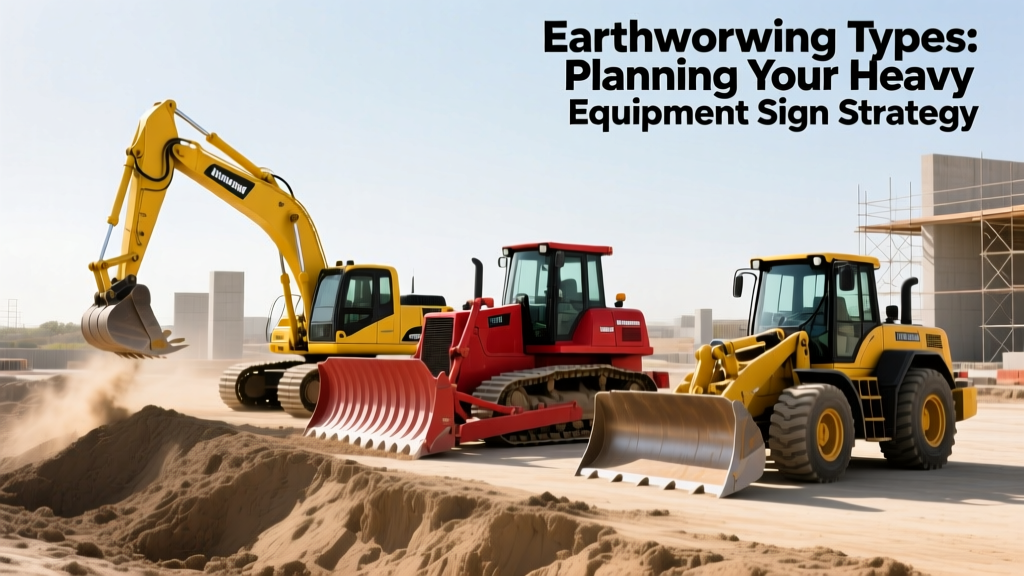
Different earthmoving machines interact with ground personnel and light vehicles in fundamentally different ways. A motor scraper traveling at 35 mph requires advanced warning signage placed hundreds of feet ahead of blind crests, whereas a hydraulic excavator requires localized, high-visibility barricade signage to mark its tail-swing radius. Below is a breakdown of primary earthmoving types and their corresponding signage mandates.
| Equipment Type | Common Model Example | Primary Hazard Profile | Required Heavy Equipment Sign Type |
|---|---|---|---|
| Motor Scraper | Caterpillar 657 | High-speed haulage, massive stopping distance | Warning (Orange): 'High-Speed Earthmoving Zone' |
| Track-Type Tractor (Dozer) | Caterpillar D11 | Severe rear/side blind spots, track-throwing debris | Danger (Red): 'Dozer Operating - Keep 50ft Clear' |
| Hydraulic Excavator | Komatsu PC8000-6 | Massive counterweight swing radius, overhead hazards | Danger (Red): 'Crush Hazard - Swing Radius' |
| Wheel Loader | Cat 994K | Wide turning radius, limited forward visibility when loaded | Caution (Yellow): 'Yield to Loading Equipment' |
Case Study 1: High-Speed Hauling in Highway Expansions
During the recent Texas SH-99 Grand Parkway expansion, earthmoving logistics relied heavily on a fleet of twin-engine motor scrapers and large wheel tractor-scrapers. These machines are designed for high-volume cut-and-fill operations, frequently traveling at speeds up to 34 mph (55 km/h) when loaded.
The Stopping Distance Problem
A fully loaded Cat 657 motor scraper can weigh over 120 tons. On a 5% downhill grade, the stopping distance can easily exceed 300 feet. Standard construction signs placed 50 feet from a hazard are entirely useless in this application. Site safety managers had to implement a specialized heavy equipment sign strategy based on kinematic stopping data.
Project Insight: Safety planners utilized GPS topographical mapping to identify every blind crest and curve on the haul road. They placed ANSI Z535.2-compliant 'Warning: High-Speed Scrapers' signs exactly 350 feet in advance of each blind spot, calculating the distance based on the 95th percentile scraper speed plus a 1.5-second driver reaction time buffer.Furthermore, because motor scrapers generate massive dust clouds in dry conditions, retroreflective sheeting (ASTM Type XI) was mandated for all signage to ensure visibility when airborne particulate matter reduced ambient light transmission by up to 60%.
Case Study 2: Confined Urban Excavation for Transit Hubs
Urban deep-excavation projects, such as the Los Angeles Purple Line Extension, present an entirely different set of constraints. Here, the primary earthmoving equipment consists of large hydraulic excavators and articulated dump trucks operating in tight, pedestrian-adjacent corridors.
Managing the Swing Radius
When deploying an 800-ton class machine like the Komatsu PC8000-6, the counterweight swing radius is a lethal hazard. The rear of the machine swings at high speeds, creating a crush zone that extends 15 to 20 feet beyond the tracks. In urban applications, physical barricades are not enough; they must be paired with explicit, standardized visual warnings.
According to OSHA Standard 1926.200 regarding accident prevention signs, the sign must feature the signal word 'DANGER' in white letters on a red background at the top. Site supervisors in the LA transit project erected continuous chain-link fencing around the excavator's maximum swing footprint, affixing a 'Danger: Heavy Equipment Swing Radius' sign every 10 linear feet.
Overhead and Subsurface Signage
Urban excavators also frequently operate near live power lines and shallow utilities. A specialized heavy equipment sign indicating maximum allowable boom height must be placed directly in the operator's line of sight, often mounted on the machine's cab or on a dedicated pole at the edge of the excavation pit. For subsurface utilities, ground-penetrating radar (GPR) data is translated into color-coded pavement markings and adjacent caution signs to prevent bucket strikes on high-pressure gas lines.
Regulatory Framework: OSHA, ANSI, and NIOSH Standards
Designing a compliant signage plan requires navigating a matrix of federal and industry standards. Relying on generic, off-the-shelf signs purchased from a hardware store will not pass a federal safety audit.
- OSHA 1926.200: Dictates the broad requirements for accident prevention signs and tags in construction, mandating that signs be visible, legible, and maintained.
- ANSI Z535 Series: The definitive standard for sign design. It governs the exact color codes (Red for Danger, Orange for Warning, Yellow for Caution), font sizes relative to viewing distance, and the required use of standardized pictograms to bridge language barriers among multilingual crews.
- NIOSH Blind Spot Data: The NIOSH Highway Work Zones Safety resources provide critical blind spot diagrams for specific heavy machinery models, which safety officers use to determine where ground personnel are completely invisible to operators, necessitating localized 'No-Go Zone' signage.
The Cost of Non-Compliance: In 2026, OSHA's maximum penalty for a 'Serious' violation is over $16,000 per instance. If an inspector finds that a haul road lacks appropriate advance warning signs for high-speed scrapers, they can cite the general contractor for every missing sign, compounding fines rapidly into the hundreds of thousands of dollars.
Integrating Digital Geofencing with Physical Signage
The most advanced earthmoving fleets in 2026 do not rely solely on static metal signs. The modern heavy equipment sign strategy integrates physical ANSI-compliant placards with machine-integrated telematics and digital site signage.
For example, when a wheel loader approaches a designated pedestrian crossing zone, geofencing triggers an automated alert on the operator's in-cab display. Simultaneously, digital LED message boards at the site perimeter automatically update to display 'Active Loading Zone - Pedestrians Detour'. This dynamic approach ensures that the safety communication scales with the actual movement and presence of the machinery, rather than relying on static signs that workers eventually become blind to due to habituation.
Site Manager's Implementation Checklist
To ensure your earthmoving application is properly supported by a compliant and effective signage strategy, execute the following steps before breaking ground:
- Audit the Fleet Roster: Pull the exact make, model, and year of every earthmoving machine scheduled for the site.
- Map Blind Spots: Download the specific NIOSH or OEM blind spot diagrams for each model and overlay them onto your site logistics plan.
- Calculate Stopping/Swing Distances: Determine the maximum travel speed of haulers and the maximum tail-swing radius of excavators.
- Specify ANSI Z535 Compliance: Ensure your procurement team orders signs with the correct signal word (Danger/Warning/Caution), color code, and ASTM-compliant retroreflective sheeting.
- Establish a Maintenance Schedule: Earthmoving sites are dusty and muddy. Assign a laborer to inspect and wipe down every heavy equipment sign weekly, replacing any that are faded, bent, or obscured by vegetation or dirt berms.
By treating site signage as an engineered extension of your earthmoving fleet's operational parameters, you protect your workforce, maintain regulatory compliance, and keep your mega-projects on schedule without costly safety stand-downs.