SEO for Heavy Equipment: Demolition Attachment Repair Guides
Master demolition attachment troubleshooting for hydraulic breakers, shears, and pulverizers, optimized for heavy equipment SEO and repair lead generation.
Demolition Attachment Diagnostics and Digital Visibility
Capturing high-intent B2B search traffic requires more than basic keyword placement; it demands deep technical authority. When executing an SEO for heavy equipment strategy, repair shops, dealers, and rental fleets must anchor their content in exact diagnostic procedures, precise hydraulic specifications, and real-world failure modes. Search engines reward content that solves complex mechanical problems, and site operators searching for repair solutions represent the highest-converting segment of the demolition market.
This guide provides the exact troubleshooting data for primary demolition attachments—hydraulic breakers, concrete pulverizers, and scrap shears. By structuring this technical data correctly, equipment service centers can dominate search results while providing actionable repair frameworks for fleet managers.
⚠️ HIGH-PRESSURE SAFETY WARNING: Hydraulic demolition attachments operate at extreme pressures (up to 5,000 psi) and utilize high-pressure nitrogen accumulators. Never crack a hydraulic line or remove an accumulator charging valve without verifying zero-pressure states using calibrated gauges. Stored hydraulic or pneumatic energy can cause catastrophic injury.Hydraulic Breaker Diagnostics: Nitrogen and Valve Failures
Hydraulic breakers (hammers) like the Epiroc HB 3600 and Rammer E66 rely on a precise combination of hydraulic flow and nitrogen gas to drive the piston. The most common field complaint is 'short-stroking' or a complete loss of impact force.
Symptom: Piston Short-Stroking or No Impact
When a breaker cycles rapidly but delivers weak blows, or fails to fire entirely, the issue typically originates in the nitrogen accumulator or the main control valve.
- Nitrogen Accumulator Bleed-Down: The diaphragm separating the hydraulic oil and nitrogen gas can rupture, or the Schrader valve may leak. For a Rammer E66, the accumulator must be charged to exactly 600 psi (41 bar) at 68°F (20°C). If pressure drops below 450 psi, the piston lacks the return energy to complete its stroke.
- Control Valve Spool Scoring: Contaminated hydraulic oil causes microscopic scoring on the main spool valve. This leads to internal bypassing, starving the piston chamber of the required 2,400 psi operating pressure.
Diagnostic Procedure & Repair Costs (2026)
- Install a calibrated nitrogen charging kit to the accumulator valve.
- Bleed the hydraulic pressure from the circuit by cycling the auxiliary pedal with the engine off.
- Read the static nitrogen pressure. If it reads below spec, recharge to 600 psi. Cost: $150–$250 for mobile nitrogen recharge.
- If pressure drops again within 24 hours, the internal diaphragm is ruptured. Cost: $800–$1,200 for an OEM diaphragm kit and labor.
Concrete Pulverizer & Scrap Shear Force Loss
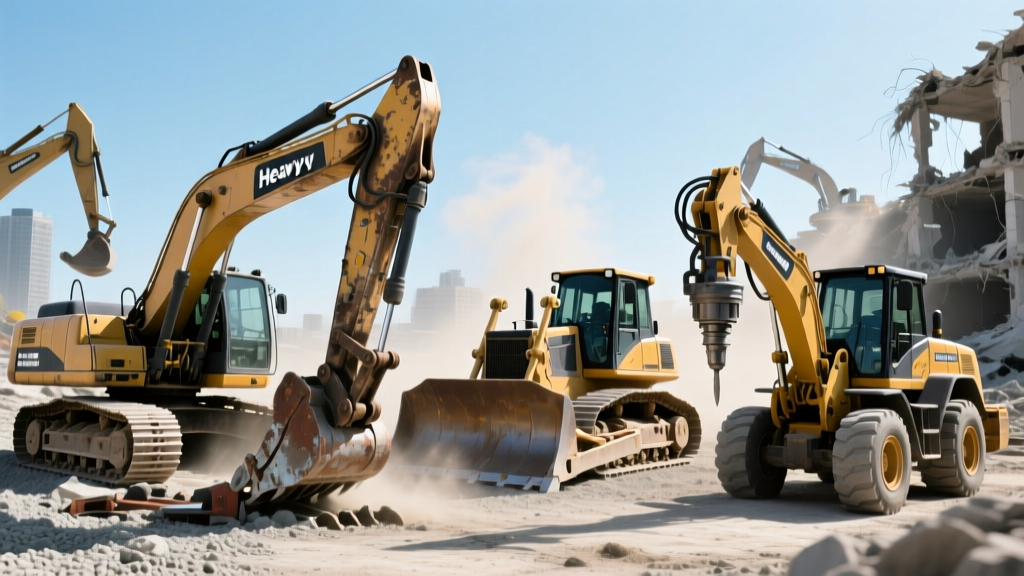
Secondary demolition tools, such as the Cat P318 Pulverizer and Genesis GXP 365 Scrap Shear, utilize massive hydraulic cylinders to generate crushing and shearing forces. Loss of crushing power or cylinder drift are the primary failure modes that sideline these attachments.
Symptom: Weak Crushing Force and Cylinder Drift
When a pulverizer fails to fracture high-psi concrete, or a shear blade drifts open under load, the hydraulic circuit is bypassing fluid internally or mechanically binding.
Key Diagnostic Metric: A Cat P318 pulverizer requires a main relief valve setting of 4,800 psi to achieve its rated 410-ton crushing force. A 10% drop in relief pressure (down to 4,320 psi) results in a disproportionate 25% loss in actual jaw crushing efficiency due to the hydraulic leverage curve.Troubleshooting the Relief Valve and Pivot Pins
- Relief Valve Degradation: Metal shavings from normal jaw wear often lodge in the main relief valve seat, preventing it from closing fully. This causes premature pressure bypass. Fix: Remove the valve cartridge, clean with solvent, and lap the seat. Replace the spring if the pressure cannot be adjusted back to 4,800 psi. Cost: $350 for a new valve cartridge.
- Pivot Pin and Bushing Wear: If the lower jaw drifts or the attachment 'chatters' during crushing, inspect the main pivot pin. Measure the pin diameter and the bushing inner diameter. If the clearance exceeds 0.5mm (0.020 inches), the mechanical geometry is compromised, transferring destructive lateral loads to the cylinder rod. Fix: Press out the pin and replace the bushing kit. Cost: $2,800–$3,500 for OEM pin/bushing sets.
The Demolition Troubleshooting Matrix
Use this matrix to quickly identify root causes and estimate repair budgets for common demolition attachment failures.
| Attachment Type | Primary Symptom | Diagnostic Test | Target Spec | Avg. 2026 Repair Cost |
|---|---|---|---|---|
| Hydraulic Breaker | Rapid cycling, weak impact | Accumulator static pressure test | 600 psi (41 bar) | $250 (Recharge) / $1,100 (Diaphragm) |
| Hydraulic Breaker | Oil leak at lower tool bushing | Visual inspection of tool seal | Zero weepage | $450 (Seal Kit & Labor) |
| Concrete Pulverizer | Fails to crush 4,000 psi concrete | Deadhead cylinder, read flow meter | 4,800 psi relief setting | $350 (Relief Cartridge) |
| Scrap Shear | Blade chipping, lateral chatter | Micrometer measurement of pivot pin | < 0.5mm clearance | $3,200 (Pin & Bushing Kit) |
| Scrap Shear | Cylinder drifts open under load | Hold-load test (5 min at 3,000 psi) | < 2mm drift / 5 min | $850 (Cylinder Seal Kit) |
Structuring Technical Data for SEO for Heavy Equipment
Creating highly technical repair guides is only half the battle. To capture leads from fleet managers and owner-operators searching for solutions, your content architecture must align with modern search engine algorithms. Implementing a robust SEO for heavy equipment strategy requires translating these mechanical specs into structured data.
Implementing HowTo and FAQ Schema Markup
Search engines prioritize content that provides immediate, structured answers. When publishing the diagnostic procedures outlined above, wrap the step-by-step troubleshooting sequences in HowTo JSON-LD schema. This allows search engines to display your repair steps directly in rich snippets, drastically increasing click-through rates from equipment operators in the field.
Additionally, map common field questions to FAQPage schema. For example:
- Why is my hydraulic breaker short-stroking?
- What is the correct relief valve pressure for a Cat P318 pulverizer?
- How often should I grease a demolition shear pivot pin?
According to industry analyses published by For Construction Pros, equipment dealers that integrate structured schema into their service pages see a significant increase in qualified service leads, as the content directly answers high-intent, long-tail queries.
"In the heavy equipment sector, search intent is highly specific. A user searching for 'Rammer E66 accumulator pressure specs' is not browsing; they are standing next to a broken machine with a wrench in their hand. If your content provides the exact spec and the part number to fix it, you win the service contract." — Digital Strategy Director, Heavy Machinery Dealership Network
Preventative Maintenance Schedules for Demolition Fleets
Troubleshooting is reactive; maintenance is proactive. Publishing maintenance intervals alongside repair guides establishes comprehensive topical authority. Recommend the following 2026 standard intervals to your clients:
Demolition Attachment Maintenance Baseline
- Hydraulic Breakers: Apply molybdenum disulfide (MoS2) based tool grease every 2 hours of continuous operation. Inspect the lower tool bushing for ovality every 250 hours.
- Pulverizers & Shears: Grease all pivot points daily (every 8-10 hours). Perform hydraulic oil particle count analysis (ISO 4406 standard) every 500 hours to detect internal cylinder wear before catastrophic failure occurs.
- Cutting Edges & Teeth: Rotate shear blades and pulverizer teeth at 50% wear to double the lifespan of the ground engaging tools (GET).
By combining exact mechanical tolerances, current repair pricing, and structured digital architecture, heavy equipment businesses can transform their service departments into powerful digital assets. True authority in this niche is proven not by broad overviews, but by the precise, actionable data that keeps demolition fleets operating at peak capacity.