Preventing Heavy Equipment Tattoos: Road Construction Operator Guide
Master road construction equipment classification and operator best practices to prevent heavy equipment tattoos (track scarring) on fresh asphalt.
The Reality of "Heavy Equipment Tattoos" in Road Construction
In the road construction and paving industry, the term heavy equipment tattoos does not refer to operator ink. Instead, it is the colloquial term for the permanent, unsightly scarring, gouging, and torsional tearing left on finished asphalt or concrete surfaces by steel-tracked machinery. When a 45,000-pound dozer with steel grousers pivots on freshly laid Hot Mix Asphalt (HMA), the resulting "tattoo" can compromise the structural integrity of the pavement and trigger severe Department of Transportation (DOT) penalties.
Effective operator training in 2026 requires a deep understanding of road construction equipment classification, undercarriage physics, and strict travel protocols. This guide breaks down the machinery involved, the physics of surface scarring, and the exact best practices operators must follow to protect finished roadways.
⚠️ DOT Penalty Alert: State highway authorities routinely issue fines ranging from $5,000 to $15,000 per incident for surface scarring on municipal contracts. Furthermore, the contractor bears the cost of emergency milling and overlay, which averages $45 to $65 per square foot in 2026.Road Construction Equipment Classification & Undercarriage Profiles
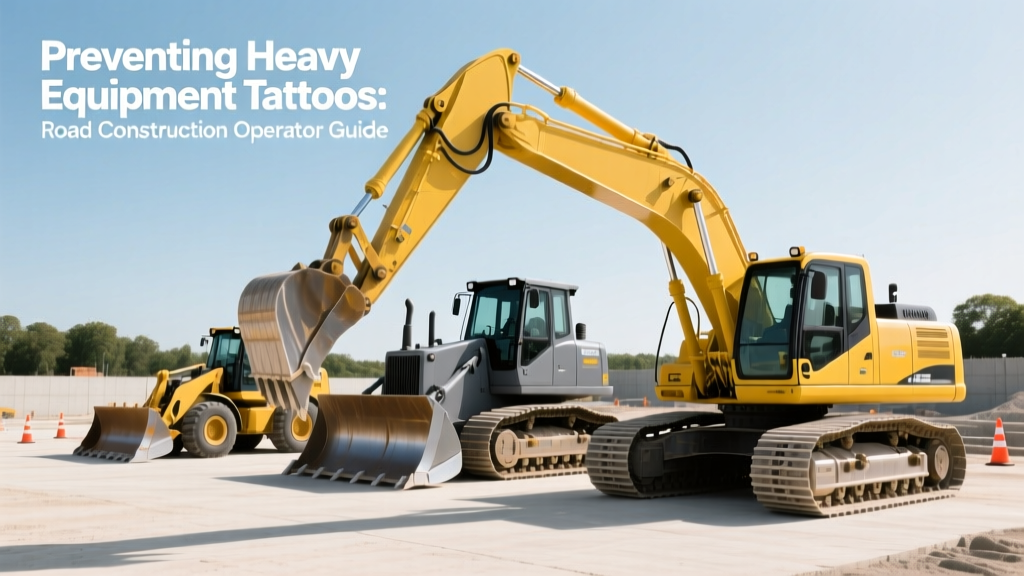
To prevent surface damage, operators must first classify their machinery by function and undercarriage type. Road construction equipment generally falls into three primary categories, each presenting unique "tattoo" risks:
1. Earthmoving and Subgrade Preparation
- Primary Machines: Crawler dozers (e.g., Caterpillar D6 XE), excavators (e.g., Volvo CE EC250), and motor graders.
- Track Profile: Primarily steel grousers with single, double, or triple teeth designed for aggressive soil penetration.
- Tattoo Risk Level: Extreme. Steel grousers exert point-load pressures exceeding 25 PSI, easily crushing hot asphalt or spalling curing concrete.
2. Paving and Material Distribution
- Primary Machines: Tracked asphalt pavers (e.g., Volvo CE ABG8820), material transfer vehicles (MTVs).
- Track Profile: Heavy-duty rubber tracks or steel tracks fitted with continuous rubber belts.
- Tattoo Risk Level: Low to Moderate. While rubber protects the surface, improper track tensioning or debris trapped between the belt and the mat can cause linear scraping.
3. Compaction and Finishing
- Primary Machines: Vibratory soil compactors, pneumatic-tired rollers, and double-drum asphalt rollers (e.g., Bomag BW 226 DH-5).
- Track Profile: Steel drums or rubber tires.
- Tattoo Risk Level: Moderate. Steel drums can scar if the operator engages high-amplitude vibration while stationary or turns too sharply on hot, unstable mix.
The Physics of Asphalt Scarring: Why Temperature Matters
According to guidelines published by the National Asphalt Pavement Association (NAPA), HMA is placed at temperatures between 275°F and 300°F. At these temperatures, the asphalt binder is highly viscous and lacks structural shear strength.
Operators are trained to monitor the core temperature of the asphalt, not just the surface temperature. Steel tracks can permanently tattoo the mat if the core temperature is above 120°F. Below 120°F, the binder stiffens enough to support distributed loads, but concentrated point loads (like a dozer's track link edge) can still cause micro-fractures.
| Undercarriage Type | Average Point Load (PSI) | Safe Core Temp for Travel | Scarring Mechanism |
|---|---|---|---|
| Bare Steel Grousers | 25 - 40 PSI | Never on finished HMA | Deep gouging, aggregate displacement |
| Bolt-On Rubber Pads | 8 - 12 PSI | < 140°F | Surface depression (rebound) |
| Chain-On Rubber Pads | 5 - 8 PSI | < 160°F | Minimal (if turning is avoided) |
| Wide Flat Street Pads | 3 - 5 PSI | < 180°F | None under linear travel |
Operator Best Practices: Preventing the Tattoo
Preventing heavy equipment tattoos requires a combination of route planning, undercarriage outfitting, and precise machine control. The Federal Highway Administration (FHWA) mandates strict surface tolerances, making operator discipline non-negotiable.
Step 1: Mandate the "No Counter-Rotation" Rule
The most severe tattoos occur when operators perform a "neutral turn" or "counter-rotation" (spinning one track forward and the other in reverse) on hot asphalt. This creates massive torsional shear forces that rip the top layer of aggregate from the binder matrix. Best Practice: Operators must execute wide, gradual turns using single-track steering. If a machine must change direction sharply, it must be driven off the finished mat onto the compacted aggregate base first.
Step 2: Implement Track Matting Protocols
When steel-tracked equipment (like an excavator digging utility trenches across a newly paved intersection) must cross finished surfaces, operators must deploy protective matting.
- Crane Mats (Timber): 8x8 oak timbers bolted together. Excellent for distributing load but can leave temporary wood-grain impressions on very hot asphalt.
- Steel Trench Plates: Minimum 1-inch thick steel plates. Must be swept completely clean of gravel and debris before placement; a single trapped rock under a steel plate will act as a chisel, carving a deep tattoo into the asphalt when the dozer drives over it.
- Geotextile-Rubber Composite Mats: The 2026 industry standard for high-visibility municipal projects. These provide grip without abrasion.
Step 3: Daily Undercarriage Walk-Arounds
Operators must inspect rubber grouser pads during the morning walk-around. A missing rubber pad exposes the bare steel shoe beneath. If a machine with a missing pad is driven onto a finished road, it will carve a continuous, rhythmic tattoo every 6 to 8 inches. Rule: If more than two consecutive rubber pads are missing or torn, the machine is grounded from paved-surface travel until replaced.
💡 Pro-Tip: Track Tensioning for Paved TravelStandard track tension (sag) for dirt work is typically 1.5 to 2.5 inches. However, when traveling long distances across paved surfaces, operators should slightly loosen the track tension (increasing sag to 2.5 - 3.0 inches) to reduce the internal friction and heat buildup in the undercarriage, which prevents premature rubber pad delamination.
Managing Concrete Surface Tattoos
While asphalt scarring is heat-dependent, concrete tattoos are moisture- and cure-dependent. When equipment must travel on freshly poured concrete (e.g., for slip-form paving or curb-and-gutter work), the concrete is highly susceptible to surface spalling.
Operators must adhere to the following timeline based on standard Portland cement curing rates at 70°F:
- 0 to 24 Hours: Zero equipment traffic. The surface will bruise and permanently deform under any load.
- 24 to 48 Hours: Light rubber-tired traffic only. Steel tracks will cause micro-cracking and surface scaling.
- 7 Days (Minimum 3,500 PSI compressive strength): Tracked equipment with bolt-on rubber pads may cross, provided no counter-rotation is performed.
Safety and site logistics must also comply with OSHA construction standards regarding material handling and site traffic control, ensuring that protective matting does not create tripping hazards for ground personnel.
Frequently Asked Questions (Operator Troubleshooting)
What should an operator do if a rubber pad rips off mid-crossing on hot asphalt?
Stop immediately. Do not attempt to "limp" the machine to the other side, as the exposed steel shoe will gouge the mat with every track revolution. Call for a lowboy loader to transport the machine off the mat, or deploy steel trench plates over the remaining crossing distance to bridge the gap.
Can water be used to cool the asphalt before equipment crosses?
No. Spraying water on hot HMA to cool it down causes rapid thermal contraction, leading to surface checking (micro-cracks) and stripping the binder from the aggregate. It creates a different type of permanent damage. Rely on ambient cooling and temperature guns to verify the core temp is below 120°F.
Are tracked pavers exempt from tattoo rules since they lay the mat?
Tracked pavers operate directly on the hot mat, but they use specialized, wide, flat rubber belts designed to distribute the machine's weight evenly. However, if the paver operator abruptly stops the travel mechanism while the screed is still down and vibrating, the machine will settle and create a "paver stutter" tattoo—a transverse ridge in the asphalt that will require diamond grinding to fix.
Summary: Protecting the Pavement Profile
Heavy equipment tattoos are entirely preventable through rigorous operator training, strict adherence to temperature thresholds, and meticulous undercarriage maintenance. By classifying equipment correctly, selecting the appropriate rubber pad durometer, and enforcing a strict "no counter-rotation" policy on finished surfaces, construction fleets can eliminate surface scarring, avoid crippling DOT fines, and deliver the smooth, high-tolerance roadways that modern infrastructure demands.