1Up Equip D vs Heavy Duty Pipeline Tractors: Utility ROW Analysis
Compare the 1Up Equip D vs heavy duty pipeline tractors for utility ROW construction. Analyze lifting capacity, transport costs, and TCO.
The Shift in Utility and Pipeline Right-of-Way (ROW) Construction
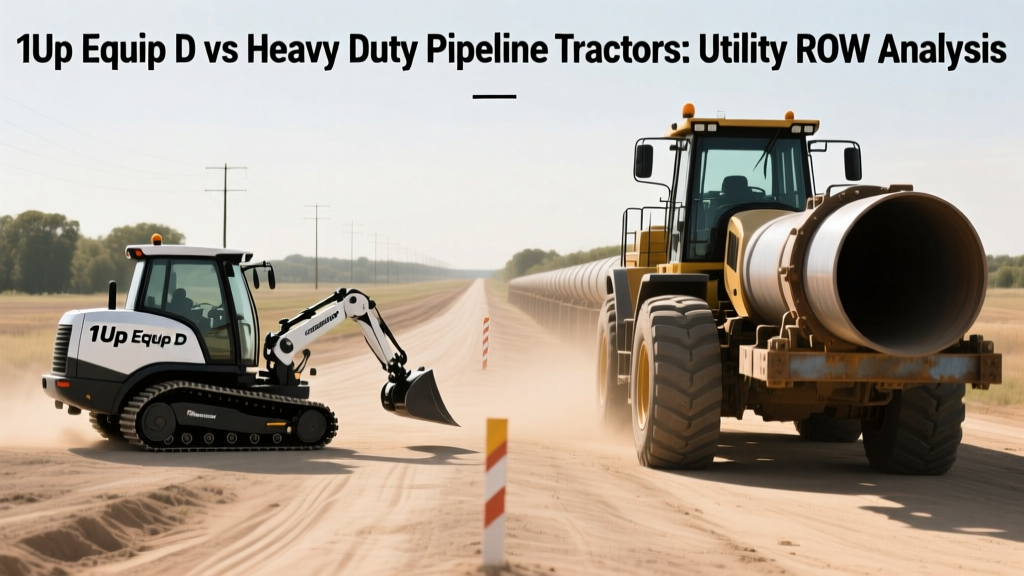
Pipeline and utility construction in 2026 demands unprecedented precision. With Right-of-Way (ROW) corridors becoming narrower, environmental regulations tightening around wetland disruption, and urban congestion increasing, the traditional approach of deploying massive, high-horsepower iron to every job site is no longer economically viable. Project managers and fleet coordinators are increasingly evaluating specialized, mid-size utility tractors against traditional heavy machinery. Specifically, the operational comparison of the 1Up Equip D vs heavy duty pipeline tractors (such as the Caterpillar 583 sidebooms or D7-class dozers) has become a critical decision point for distribution line and utility corridor projects.
While heavy-duty equipment remains the undisputed king of cross-country, large-diameter transmission pipelines, the 1Up Equip Model D has emerged as a highly agile, cost-effective alternative for 4-inch to 24-inch utility lines, fiber optic trenching, and municipal gas line replacements. This analysis breaks down the technical specifications, total cost of ownership (TCO), and logistical realities of both equipment classes to help fleet managers make data-driven deployment decisions.
Quick Spec Snapshot: 1Up Equip D vs. Traditional Heavy Duty
- Operating Weight: 1Up Equip D (~28,500 lbs) vs. Heavy Duty D7-Class (~75,000+ lbs)
- Pipe Lifting Capacity: 1Up Equip D (18,000 lbs at full reach) vs. Heavy Duty Sideboom (80,000+ lbs)
- Ground Pressure (LGP Config): 1Up Equip D (4.2 psi) vs. Heavy Duty Standard (8.5 - 11.0 psi)
- Transport Requirement: 1Up Equip D (Standard 48ft flatbed) vs. Heavy Duty (3-axle RGN lowboy + escorts)
The Heavy Duty Standard: Cat 583 and D7-Class Dominance
For decades, heavy-duty pipeline tractors and sidebooms have been the backbone of energy infrastructure. Machines in the 300+ horsepower category, such as the Cat 583/587 sidebooms and D7 LGP dozers, are engineered for brute force. They excel in deep ripping, clearing heavily timbered ROWs, and stringing 36-inch to 48-inch steel transmission pipe across rugged, mountainous terrain.
Where Heavy Duty Excels
The primary advantage of heavy-duty pipeline equipment is sheer hydraulic and tractive effort. A standard heavy-duty sideboom can hoist over 80,000 pounds, allowing operators to lift and lower massive sections of coated steel pipe into deep trenches without dual-lift coordination. Furthermore, the massive flywheel torque and heavy undercarriage provide unmatched traction in steep, muddy inclines where smaller machines would lose grip or spin their tracks.
The Hidden Costs of Heavy Iron
However, deploying heavy-duty equipment for standard utility distribution lines introduces severe logistical and financial penalties. Transporting a 75,000-pound sideboom requires a Removable Gooseneck (RGN) lowboy trailer, a specialized heavy-haul CDL driver, and oversize/overweight permits. In 2026, multi-state oversize permit fees and required escort vehicles can add $1,500 to $3,000 to a single mobilization event. Additionally, the high ground pressure of standard heavy-duty tracks (often exceeding 9 psi) frequently violates PHMSA (Pipeline and Hazardous Materials Safety Administration) and local environmental compliance standards when working near agricultural topsoil or protected wetlands, necessitating expensive timber mats or swamp pads.
The 1Up Equip Model D: The Agile Utility Alternative
The 1Up Equip Model D was engineered specifically to bridge the gap between compact skid steers and massive heavy-duty dozers. Designed for the utility and mid-stream pipeline sector, it prioritizes maneuverability, low ground pressure, and multi-functional hydraulic integration over raw, unrefined horsepower.
Technical Advantages in Constrained ROWs
Operating at approximately 140 horsepower and weighing in at 28,500 pounds, the 1Up Equip D utilizes a hydrostatic drive system paired with a 30-inch wide Low Ground Pressure (LGP) track shoe configuration. This results in an exceptional ground pressure rating of just 4.2 psi. This specification is critical for utility contractors working in spring thaw conditions or sensitive ecological zones, as it minimizes soil compaction and rutting, drastically reducing final ROW remediation costs.
Hydraulically, the 1Up Equip D delivers 48 GPM (gallons per minute) of auxiliary flow at 4,500 psi. While this falls short of the 70+ GPM required to run massive heavy-duty trenching chains, it is perfectly calibrated to operate 36-inch utility trenchers, horizontal directional drilling (HDD) mud pumps, and integrated knuckle-boom pipe grapples. The machine can easily handle the stringing and lowering of 24-inch HDPE or standard steel distribution pipe, which covers roughly 75% of municipal water, gas, and sewer projects.
Head-to-Head Comparison Matrix
| Operational Metric | 1Up Equip Model D | Traditional Heavy Duty (e.g., Cat D7/583) |
|---|---|---|
| Primary Use Case | 4" to 24" distribution lines, urban utility, fiber | 30"+ cross-country transmission, heavy clearing |
| Mobilization Cost (Avg) | $350 - $600 (Standard flatbed, no permits) | $1,500 - $3,500 (RGN lowboy, escorts, permits) |
| Fuel Consumption | 4.5 - 6.2 Gallons/Hour | 12.0 - 18.5 Gallons/Hour |
| Operator Visibility | Excellent (Low-profile engine enclosure, rear cameras) | Restricted (High engine profile, requires spotters) |
| Undercarriage Wear Rate | Moderate (Lighter weight reduces pin/bushing stress) | High (Massive weight accelerates track component wear) |
| Tier 4/5 Emissions | Standard DEF system, easily serviced in-field | Complex aftertreatment, requires specialized techs |
Total Cost of Ownership (TCO) and Transport Logistics
When analyzing the 1Up Equip D vs heavy duty alternatives, purchase price is only a fraction of the equation. The logistics of moving the equipment between dispersed utility job sites often dictates profitability.
A standard heavy-duty pipeline tractor requires a dedicated heavy-haul truck and trailer combination. If a contractor is running three simultaneous municipal water line projects across a single state, they must either purchase multiple heavy-haul rigs or pay premium third-party hauling rates (often $6 to $9 per loaded mile). Conversely, the 1Up Equip D can be loaded onto a standard 48-foot flatbed or a 40-foot equipment trailer pulled by a standard Class 8 day-cab tractor. This allows general freight carriers or standard company flatbeds to handle mobilization, cutting transport costs by up to 70%.
Fleet Manager Insight: "We used to mobilize D7s for 12-inch gas line replacements. Between the lowboy permits, the escort cars, and the fuel burn just getting to the site, our margins were wiped out before the first trench was dug. Switching to mid-size utility tractors like the 1Up Equip D for distribution work cut our mobilization overhead by 65% and eliminated our oversize permit delays." — Director of Fleet Operations, Mid-Atlantic Utility Contractors (2025)
Safety and Trenching Compliance
Utility pipeline construction is inherently hazardous, particularly regarding trench collapse and pipe handling. The OSHA Excavation and Trenching standards mandate strict protocols for soil stability and heavy equipment operation near trench edges. The lighter footprint of the 1Up Equip D significantly reduces the risk of trench wall collapse caused by the vibration and static load of heavy machinery operating too close to the spoil pile. Furthermore, the 1Up Equip D features a low-profile engine deck and integrated 360-degree camera systems, mitigating the blind-spot hazards that frequently plague operators of high-profile heavy-duty dozers in congested urban ROWs.
Decision Framework: Which Equipment Class to Deploy?
Do not view this as a binary replacement scenario. The most profitable utility contractors in 2026 utilize a mixed fleet, deploying machinery based on specific project parameters. Use the following framework to assign equipment to your upcoming bids:
Deploy the 1Up Equip Model D When:
- Pipe Diameter: The project involves 4-inch to 24-inch HDPE, PVC, or steel distribution pipe.
- Environment: The ROW crosses sensitive wetlands, agricultural land, or highly compacted urban zones where ground pressure must remain below 5 psi.
- Logistics: The job requires frequent demobilization and remobilization across multiple short-distance sites (e.g., municipal block-by-block water main replacements).
- Attachments: The primary hydraulic needs are pipe grapples, 36-inch trenchers, or vibratory plows.
Deploy Heavy Duty Pipeline Tractors When:
- Pipe Diameter: The project involves 30-inch to 48-inch+ steel transmission lines requiring dual-lift or massive single-lift sideboom capacities.
- Environment: The ROW requires heavy timber clearing, deep rock ripping, or traversing extreme mountainous grades where maximum flywheel torque and tractive effort are non-negotiable.
- Logistics: The project is a continuous, multi-mile cross-country spread where the machine will be mobilized once and remain on-site for months.
Final Verdict for Utility Contractors
The utility and pipeline construction sector has evolved past the era of using oversized, heavy-duty transmission equipment for standard distribution work. While heavy-duty sidebooms and dozers will always hold their place in large-scale energy transmission, the 1Up Equip D provides a mathematically superior alternative for the vast majority of municipal, water, and mid-stream utility projects. By drastically reducing transport logistics, lowering fuel consumption, and minimizing ROW remediation costs through superior ground pressure metrics, mid-size utility tractors offer a faster return on investment and higher margin protection for modern utility contractors.