Demolition Attachments: Pictures of Heavy Equipment for Construction
Compare demolition attachments and carriers. Learn to identify rigs from pictures of heavy equipment for construction and match hydraulic specs.
Visual Identification vs. Hydraulic Reality
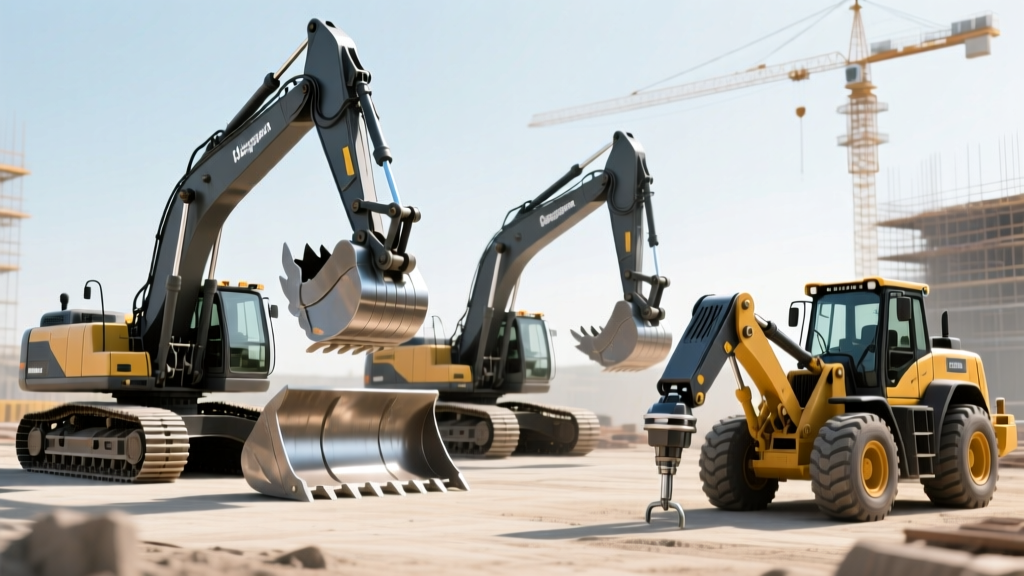
While reviewing pictures of heavy equipment for construction to verify fleet deployment, project managers often assume that any large excavator can handle structural teardowns. This is a costly misconception. Visual identification only scratches the surface of machine capability. A standard 30-ton earthmoving excavator and a dedicated demolition carrier may look similar in silhouette, but their internal hydraulic architecture, structural reinforcement, and attachment compatibility are vastly different.
Demolition requires extreme precision, massive breakout forces, and continuous high-flow hydraulics to power specialized attachments. Misidentifying a machine based purely on visual cues leads to catastrophic hydraulic cavitation, premature pin wear, and severe safety violations. Below, we break down the technical realities of demolition carriers and their attachments, moving beyond superficial aesthetics into the engineering specs that dictate job site success.
The Visual Matrix: Standard Earthmovers vs. Demolition Carriers
When analyzing pictures of heavy equipment for construction sites, you can spot a dedicated demolition rig by looking for specific structural modifications. The following matrix highlights the critical physical differences that separate a standard digging excavator from a purpose-built demolition carrier.
| Component | Standard Earthmoving Excavator | Dedicated Demolition Carrier |
|---|---|---|
| Cab Guarding | Standard glass, minimal overhead protection. | FOPS (Falling Object Protective Structures) Level 2, heavy-duty steel mesh, polycarbonate lower windows. |
| Boom Geometry | Standard reach (e.g., 10-12 meters), optimized for digging depth and dump height. | Multi-piece modular booms (up to 28+ meters), straight-line geometry for vertical reach, hydraulic pin-locking for quick teardown. |
| Undercarriage | Standard track width, optimized for traction and transport. | Variable-gauge or extra-wide tracks (e.g., 3.5m+ width) to lower the center of gravity and prevent tipping during high-reach pulls. |
| Counterweight | Fixed, integrated into the rear swing frame. | Modular, hydraulically removable counterweights to balance extreme forward moments when the boom is fully extended. |
Primary Carriers: High-Reach vs. Standard Excavators
Choosing the right base machine is the first critical decision in a demolition fleet. The market is currently dominated by two primary configurations: Ultra-High Demolition (UHD) rigs and heavily modified standard excavators.
Ultra-High Demolition (UHD) Rigs (e.g., Cat 340 UHD)
Best for: Top-down teardowns of multi-story commercial buildings, chimney stack removal, and industrial silo dismantling.
- Reach: Up to 28 meters (91 feet) vertically.
- Weight Class: 90+ tons operating weight.
- Cost: $850,000 - $1.2 million (new, 2026 pricing).
- Pros: Unmatched vertical reach, integrated tilt mechanisms for the boom, advanced load-moment indicator (LMI) systems that automatically restrict swing if the center of gravity shifts dangerously.
- Cons: Massive transport footprint (requires 4+ lowboy trailers to move), high hourly fuel burn (12-15 gallons/hour), overkill for low-rise residential demo.
Modified Standard Excavators (e.g., Volvo EC380E with demo boom)
Best for: Low-rise structural demo (1-3 stories), interior strip-outs, and heavy concrete slab processing.
- Reach: 14 - 18 meters.
- Weight Class: 38 - 45 tons.
- Cost: $380,000 - $450,000 (base machine + demo boom package).
- Pros: Versatile (can swap back to a standard digging boom for site prep), easier to transport, lower operating costs.
- Cons: Limited vertical reach, requires manual boom configuration changes which take 2-4 hours with a crane.
The Attachment Arsenal: Shears, Pulverizers, and Hammers
The carrier is only as effective as the tool on the end of its stick. Demolition attachments are highly specialized, and selecting the wrong tool for the material matrix will destroy cycle times and inflate maintenance costs.
1. Mobile Shears (e.g., LaBounty MSD 7500)
Mobile shears are the primary tools for processing structural steel. The LaBounty MSD 7500 is an industry benchmark, capable of shearing 14-inch I-beams and 2-inch thick solid steel plates.
- Hydraulic Requirement: 130 - 160 GPM (Gallons Per Minute) at 5,000 PSI. This requires a carrier with a dual-pump merge system; a standard 30-ton excavator pushing 75 GPM will stall the shear mid-cut.
- Rotation: Requires a continuous 360-degree hydraulic rotator (e.g., Epiroc HAT 1500) to manipulate steel beams without repositioning the carrier.
- Market Price: $115,000 - $135,000 (attachment only).
2. Concrete Pulverizers (e.g., Trevi Benne P30)
Pulverizers are designed to crush concrete and separate the embedded rebar in a single pass. Unlike shears, they rely on massive crushing force rather than cutting edge geometry.
- Hydraulic Requirement: 90 - 110 GPM at 4,500 PSI. Less flow-intensive than shears, making them compatible with mid-sized (30-40 ton) carriers.
- Jaw Design: Features an asymmetrical jaw with a specialized "rebar cutter" notch at the throat. Attempting to cut rebar with the tips of the jaw will crack the casting.
- Market Price: $55,000 - $75,000.
3. Hydraulic Hammers (e.g., Epiroc HB 3000)
Used for trench rock breaking, thick foundation slab reduction, and secondary breaking of oversized concrete chunks.
- Hydraulic Requirement: 45 - 60 GPM. Hammers are highly sensitive to flow spikes; exceeding the recommended GPM will cause piston over-travel and catastrophic cylinder scoring.
- Auto-Stop Technology: Modern 2026 models feature auto-stop sensors that halt the hammer the millisecond the tool loses contact with the material, preventing "blank firing" which destroys the tie-rod tensioning.
- Market Price: $38,000 - $45,000.
The most common cause of catastrophic attachment failure in demolition is auxiliary hydraulic flow mismatch. Never assume a carrier's "high-flow" package is sufficient for a heavy shear. Always verify the exact GPM at the attachment coupling, not just at the pump outlet. Pressure drops across 20 feet of boom hoses and a quick-coupler can reduce effective flow by 15-20%. Always install inline flow meters during commissioning to verify actual delivery.
Quick Couplers: The Hidden Bottleneck
In demolition, operators frequently swap between a shear, a pulverizer, and a grapple within a single shift. Manual pin-knockers are a relic of the past and a massive safety hazard under OSHA Demolition Safety Standards. Modern fleets rely on fully automatic quick couplers.
The OilQuick OQ70/55 is the dominant standard for 30-50 ton carriers. It features a fully enclosed locking mechanism that prevents dirt and concrete slurry from jamming the locking pins—a common failure point in open-face couplers. However, the OilQuick system requires the carrier to have a dedicated 4th auxiliary circuit to operate the locking mechanism independently of the attachment's working circuit. If your carrier only has a 2-circuit auxiliary setup, you will be forced to use a manual wedge-lock coupler, which increases attachment swap times from 30 seconds to 15 minutes.
Decision Framework: Specifying Your Demolition Fleet
Use this step-by-step framework to specify the correct carrier and attachment combination for your next teardown project, ensuring compliance with UK Health and Safety Executive (HSE) Demolition Guidelines and equivalent global safety standards.
- Define the Maximum Reach & Weight: Calculate the height of the structure and the weight of the heaviest single piece of material (e.g., a steel roof truss). Select a carrier whose load-moment chart safely supports the attachment weight at that maximum radius.
- Audit the Carrier Hydraulics: Request the carrier's auxiliary hydraulic flow chart. Ensure the GPM at 5,000 PSI meets the attachment manufacturer's minimum requirement. If it falls short, install a hydraulic booster pack or upgrade the carrier.
- Specify the Coupler & Rotator: Mandate a fully automatic, enclosed quick coupler and a continuous-rotation tiltrotator. This eliminates the need for operators to leave the cab in the drop zone to manually secure pins.
- Verify Cab Protection: Ensure the carrier is fitted with FOPS Level 2 overhead guarding and 1-inch thick polycarbonate lower front windows to protect against high-velocity concrete spalling and snapping rebar.
By prioritizing hydraulic architecture and structural reinforcement over superficial visual identification, fleet managers can eliminate equipment bottlenecks, prevent catastrophic attachment failures, and maintain rigorous job site safety standards.