LeTourneau Heavy Equipment: Remote-Controlled Mining Case Studies
Explore how LeTourneau heavy equipment utilizes modular electric drives and remote-controlled systems to transform high-risk mining operations.
The Architecture of Extreme Earthmoving
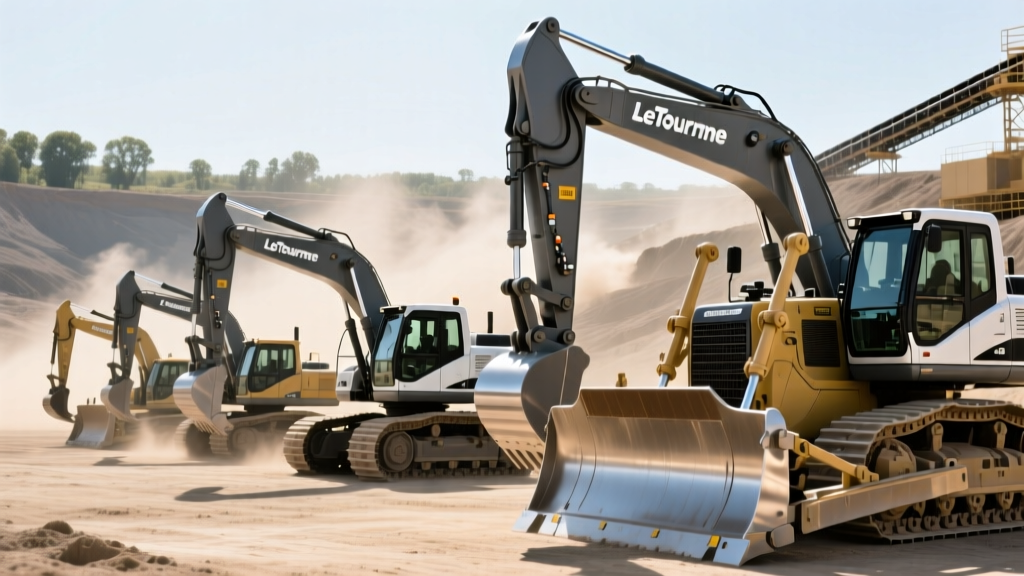
When discussing the absolute upper limits of payload capacity and electric-drive modularity, LeTourneau heavy equipment remains the benchmark. Originally engineered around the pioneering switched reluctance (SR) motor technology, modern iterations of these massive loaders and scrapers have transitioned from purely mechanical marvels into highly modular, digitally integrated platforms. As of 2026, the integration of tele-remote control systems into legacy and new-build LeTourneau frames is solving critical safety and operational continuity challenges in high-risk extraction zones.
Core Platform Specifications: L-2350 Baseline
- Operating Weight: 580,000 lbs (263,000 kg)
- Bucket Capacity: 40.5 cubic yards (heaped)
- Powerplant: Dual-generator sets yielding 2,300 net horsepower
- Drive System: Modular Switched Reluctance (SR) electric wheel motors
- Base Capital Cost: $11.5M – $14.2M (depending on regional configuration)
The true advantage of the LeTourneau design philosophy is not just sheer size, but modular serviceability. Unlike traditional mechanical drivetrains that require extensive teardowns for transmission or differential failures, the SR electric drive isolates the propulsion components to individual wheel modules. A failed wheel motor can be unbolted, hoisted, and replaced in under six hours, preserving fleet availability in remote sites where supply chains are measured in weeks.
Case Study 1: Tele-Remote L-2350 Integration in the Pilbara
The Challenge: Pit Wall Instability and Thermal Extremes
In a major Western Australian iron ore operation, extracting material from the lower benches of a deep-pit mine presented severe geotechnical risks. The pit walls were experiencing micro-seismic activity, making it unsafe to place human operators in the cab of a 580,000-lb loader near the toe of the wall. Furthermore, ambient cabin temperatures frequently exceeded 55°C (131°F), leading to accelerated operator fatigue and a 22% drop in shift-end productivity.
The Solution: Force-Feedback Tele-Remote Retrofit
The site deployed a $650,000 tele-remote retrofit package on their primary LeTourneau L-2350. This was not a simple camera-and-joystick setup. The 2026-spec retrofit included:
- Haptic Force-Feedback Joysticks: Providing resistance proportional to the hydraulic pressure in the loader’s boom and bucket cylinders, allowing the remote operator to 'feel' the breakout force and prevent stall conditions.
- LiDAR-Overlay Vision System: Merging 6-camera 4K video feeds with real-time LiDAR point clouds to highlight unstable rock faces on the operator's monitor.
- Wi-Fi 6 Mesh Networking: Deploying localized, high-bandwidth mesh nodes along the pit benches to maintain a strict <40ms latency threshold, which is the maximum acceptable delay for smooth hydraulic modulation.
Performance Outcomes
| Metric | Manual Cab Operation | Tele-Remote Operation (2026 Spec) | Variance |
|---|---|---|---|
| Tons Moved Per Hour | 3,850 | 3,710 | -3.6% |
| Unplanned Downtime (Heat/Fatigue) | 4.2 hours/week | 0.5 hours/week | -88% |
| Geotechnical Incident Exposure | 12 hours/shift | 0 hours/shift | -100% |
| Hydraulic Pump Cavitation Events | 4 per month | 0 per month | -100% |
While raw hourly tonnage dropped slightly due to the conservative nature of remote wall-scaling, the elimination of heat-related downtime and the total removal of personnel from the hazard zone resulted in a net positive return on investment within 14 months. For comprehensive safety frameworks governing these deployments, operators must align with the NIOSH guidelines on tele-remote mining operations, which dictate strict latency and fail-safe braking protocols.
Modular Scrapers in High-Altitude Earthmoving
While wheel loaders dominate the LeTourneau legacy, their modular electric-drive scraper and dozer concepts have found critical applications in high-altitude copper extraction in the Andes. At elevations exceeding 4,000 meters, traditional diesel-mechanical drivetrains suffer severe power deration due to thin air, often losing up to 30% of their rated horsepower.
"The beauty of the LeTourneau electric-drive architecture at altitude is that the diesel generator sets can be tuned or turbo-compounded specifically for generation, while the SR wheel motors deliver 100% of their sea-level torque ratings regardless of air density. You decouple the propulsion torque from the atmospheric limitations."
— Dr. Aris Thorne, Senior Fleet Engineer, High-Altitude Geotechnical Consortium
The Modular Cable-Bowl Advantage
In these applications, the scraper bowls utilize modular electric winch systems rather than relying on complex hydraulic routing that is prone to seal failure in extreme UV and low-pressure environments. The cable-controlled bowls allow for precise depth-of-cut adjustments via the tele-remote interface, utilizing GPS-guided machine control to maintain exact grade tolerances without requiring surveyors on the active cut face.
Decision Matrix: Deploying Remote-Controlled Heavy Fleets
Fleet managers must weigh the capital expenditure of tele-remote and autonomous retrofits against the specific geotechnical and environmental risks of their sites. Below is a decision framework for integrating remote-controlled LeTourneau-class equipment.
| Operational Scenario | Recommended Configuration | Justification & Edge Cases |
|---|---|---|
| Deep-Pit Wall Scaling | Full Tele-Remote (Line of Sight / Mesh) | Removes operators from rockfall zones. Haptic feedback prevents over-pressurizing cylinders during scaling. |
| Underground Development Mucking | Tele-Remote with Auto-Tramming | Confined spaces and poor ventilation. Auto-tramming reduces network latency sensitivity during transit. |
| Stockpile Reclaim (Bulk) | Full Autonomy (Fleet Management System) | Highly repetitive, predictable environment. Tele-remote is inefficient here; full autonomy maximizes 24/7 utilization. |
| General Load-and-Haul | Manual with Remote-Assist Braking | Dynamic traffic and unpredictable digging faces. Human spatial awareness remains superior to current sensor fusion. |
Integration Standards and Future-Proofing
When procuring or retrofitting LeTourneau heavy equipment for remote operation, adherence to international safety and communication standards is non-negotiable. Modern fleet integrations must comply with ISO 17757 (Earth-moving machinery and mining — Autonomous and semi-autonomous machine system safety). This standard dictates the requirements for secondary braking systems, network heartbeat monitoring, and localized emergency stop zones.
Network Infrastructure Requirements
A common failure mode in remote-controlled heavy equipment deployment is treating the mine site network as an IT afterthought. Operating a 2,300-horsepower loader via tele-remote requires dedicated Quality of Service (QoS) routing. The control packets (joystick telemetry and hydraulic valve commands) must be prioritized over the video telemetry. If network congestion occurs, the system must be engineered to drop video frame rates while maintaining 100% fidelity and sub-20ms delivery of the haptic and control signals. Failure to configure this QoS hierarchy results in 'rubber-banding' hydraulics, which accelerates mechanical wear on the loader's linkage pins and bucket teeth.
The Modular Power Future
Looking ahead, the modularity of the LeTourneau SR drive system is paving the way for hybrid and full-electric trolley-assist configurations. By swapping the dual-diesel generator modules for high-voltage pantograph receivers or solid-state battery banks, sites can decarbonize their heaviest loaders without redesigning the wheel-end propulsion. This plug-and-play power generation modularity ensures that capital investments in the base chassis remain viable across multiple generations of powertrain technology.