Heavy Equipment Pan Scraper vs Dozers for Pipeline Construction
Compare heavy equipment pan scraper performance against dozers and graders for pipeline ROW grading, trench backfill, and utility site prep.
Pipeline ROW Earthmoving: The Scraper vs. Dozer Dilemma
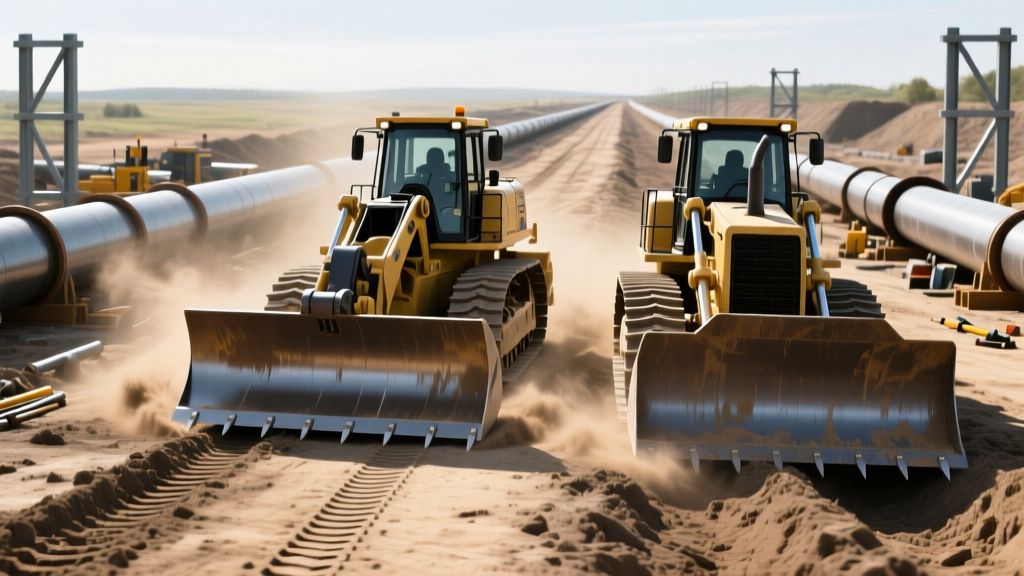
Preparing a 100-to-120-foot wide Right-of-Way (ROW) for cross-country pipeline construction requires moving millions of bank cubic yards (BCY) of topsoil and subgrade material. Fleet managers must continuously evaluate the most cost-effective earthmoving methodology. While track-type tractors (dozers) dominate short-distance pushing and trench backfilling, the heavy equipment pan scraper remains the undisputed leader for mid-range cut-and-fill operations, topsoil segregation, and ROW leveling. Choosing between self-propelled elevating scrapers, pull-type pans, and alternative haulers dictates both the project timeline and the cost-per-yard baseline.
Baseline Cycle Economics (2026 Estimates):For haul distances between 400 and 2,500 feet in loose loam, a single heavy equipment pan scraper (e.g., Cat 627G) operates at $0.45 to $0.68 per BCY. By contrast, a Cat D8 dozer pushing soil beyond 300 feet sees costs spike to $1.15+ per BCY due to exponential cycle time degradation.
Topsoil Segregation and the Double-Ditch Method
Environmental compliance and PHMSA safety regulations mandate strict topsoil preservation during pipeline installation. The industry standard 'double-ditch' method requires stripping 6 to 12 inches of topsoil and stockpiling it on the outer edges of the ROW, keeping it separate from the rocky subsoil excavated from the trench.
This is where the heavy equipment pan scraper outperforms all alternatives. An elevating scraper can precisely cut a uniform 8-inch layer of topsoil, load it in under 45 seconds, and transport it 1,500 feet to the ROW boundary without spilling. Attempting this with a semi-U blade dozer results in excessive topsoil mixing, windrowing inefficiencies, and severe reclamation penalties during final ROW restoration.
Direct Comparison Matrix: Scrapers vs. Track-Type Tractors
When planning utility corridor grading, superintendents must match the equipment to the haul distance and soil plasticity. Below is a direct operational comparison for a standard 10-mile pipeline segment.
| Operational Metric | Elevating Pan Scraper (Cat 627G) | Track-Type Tractor (Cat D8T) | Pull-Type Pan (Ashland 412 + D7) |
|---|---|---|---|
| Optimal Haul Distance | 400 ft – 3,000 ft | 50 ft – 300 ft | 300 ft – 1,500 ft |
| Stripping Precision | High (uniform 2-12 inch cuts) | Low (requires skilled operator) | Medium |
| Load Time (Loam) | 35 – 45 seconds | N/A (continuous push) | 60 – 90 seconds |
| Rock Fragmentation Tolerance | Low (boulders jam elevators) | High (blades push rock easily) | Medium (shear pin protection) |
| Ground Pressure (PSI) | 45 – 60 PSI (tires) | 8 – 12 PSI (tracks) | 30 – 40 PSI (tires) |
| Primary Pipeline Application | Topsoil stripping, ROW cut/fill | Trench backfill, pad building | Mid-range utility pad grading |
Alternative Earthmovers for Utility Trench Backfill
A common and costly mistake in pipeline construction is attempting to use a heavy equipment pan scraper for direct trench backfilling over the pipe. Scrapers lack the precision to spread fill in 12-inch lifts over a 48-inch pipeline without risking impact damage to the pipe's anti-corrosion coating. Furthermore, the high ground pressure of scraper tires can cause localized subsidence over uncompensated trenches.
The Correct Backfill Fleet Alternative
- Sideboom Tractors: Used for lowering the pipe and initial padding (screened soil) directly over the structure.
- Excavators (e.g., Cat 336): Utilized for precise lift placement and initial compaction immediately adjacent to the pipe.
- Articulated Dump Trucks (ADTs): Deployed to haul imported select backfill from borrow pits to the trench line when native soil is unsuitable.
- Motor Graders (e.g., Cat 14M): Brought in post-backfill to spread the remaining subgrade material and blend it with the preserved topsoil piles prior to final seeding.
'The scraper builds the road and clears the path, but the excavator and sideboom protect the asset. Mixing their roles is the fastest way to fail a hydrostatic test or trigger an environmental reclamation audit.'
— Pipeline ROW Earthmoving Superintendent, ASCE Pipeline Division Guidelines
Decision Framework: Deploying the Pan Scraper
Use this operational logic tree to determine if a heavy equipment pan scraper belongs in your pipeline fleet mix:
IF Haul Distance is > 400 feet AND < 3,000 feet:
THEN deploy self-propelled elevating scrapers. The rolling resistance of rubber tires on compacted subgrade yields a 30% fuel advantage over tracked alternatives.
IF Soil is Expansive Clay (High Plasticity Index):
THEN avoid pull-type pans. Sticky clays will pack into the bowl and refuse to eject via the apron. Elevating scrapers with forced ejection mechanisms are mandatory here.
IF Subgrade Contains > 15% Cobble/Rock Fragmentation:
THEN pull the scrapers off the ROW. Rocks larger than 8 inches will shear the elevator chains or wedge in the cutting edge. Switch to D8 dozers with semi-U blades and rippers.
Acquisition Costs and 2026 Fleet Pricing
Capital allocation for pipeline earthmoving requires precise forecasting. As of early 2026, the heavy equipment pan scraper market reflects stabilized supply chains but elevated baseline manufacturing costs.
- New Self-Propelled Elevating Scraper (e.g., Cat 627G equivalent): $580,000 – $640,000. Best for mega-projects exceeding 2 million BCY.
- Used Market (2019-2022 models, 8,000-12,000 hours): $185,000 – $275,000. The sweet spot for mid-sized utility contractors.
- New Pull-Type Scraper Pan (e.g., Ashland or Reynolds 12-14 yd³ capacity): $65,000 – $85,000. Requires an existing fleet of high-horsepower dozers (D7/D8 class) to tow.
Operational Edge Cases: Moisture and Compaction Limits
Pipeline specifications dictate strict moisture control for backfill and ROW subgrade compaction. According to American Society of Civil Engineers (ASCE) pipeline standards, soil must be within 2% to 4% of its Optimum Moisture Content (OMC) to achieve the required 90% to 95% Standard Proctor density.
Scrapers inherently aerate soil during the loading and ejection phases. If native soils are 3% above OMC due to heavy rainfall, running a heavy equipment pan scraper in 'spread' mode (ejecting thin 2-inch layers while driving at 15 mph) acts as a mechanical disc, accelerating evaporation and bringing the soil back to compaction-ready parameters. Conversely, if the soil is too dry, water trucks must run in tandem with the scraper fleet; operating a scraper in bone-dry clay will result in severe dust generation, violating EPA fugitive dust regulations and blinding equipment operators.
Tire Flotation and Wet-Weather ROW Access
When unexpected rain hits a pipeline ROW, track-type dozers can continue operating due to their low ground pressure (under 12 PSI). A loaded 627G scraper exerting 55 PSI will rut deeply into wet clay, destroying the subgrade and requiring costly re-grading. Fleet managers must mandate a strict 'stand-down' protocol for rubber-tired scrapers when soil moisture exceeds the OMC threshold, relying on dozers to maintain the haul roads until the sun bakes the corridor back to spec.
For comprehensive specifications on scraper bowl capacities, cutting edge widths, and elevator horsepower requirements, consult the Caterpillar Scraper Performance Handbooks to match your specific pipeline corridor's unified soil classification.