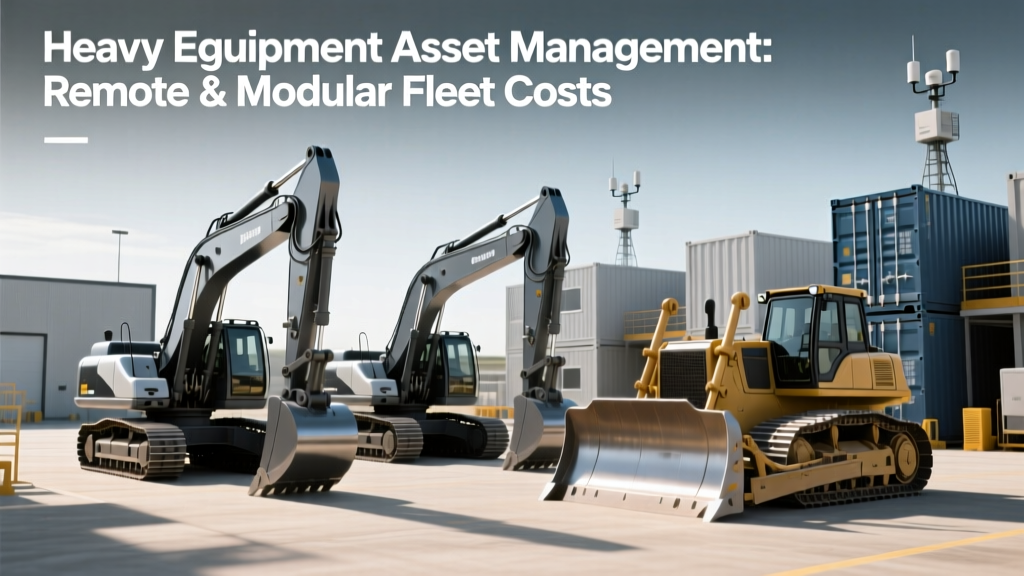
Heavy Equipment Asset Management: Remote & Modular Fleet Costs
Analyze the CAPEX and OPEX of remote-controlled and modular heavy equipment. Learn budget frameworks for heavy equipment asset management.
The Financial Reality of Unmanned and Modular Fleets
Transitioning to remote-controlled and modular heavy equipment fundamentally alters the unit economics of earthmoving, mining, and demolition. For fleet managers and CFOs, the shift from traditional manned cabs to teleoperated and modular architectures requires a complete recalibration of capital expenditure (CAPEX) and operational expenditure (OPEX) models. Modern heavy equipment asset management is no longer just about tracking engine hours and scheduling oil changes; it is about managing high-frequency telemetry, private network infrastructure, and modular component lifecycles.
As of 2026, the integration of autonomous and remote-controlled nodes into mixed fleets has moved from pilot programs to standardized deployment. However, the financial friction lies in the hidden costs of integration. According to McKinsey & Company's analysis on construction disruption, technology-driven fleet optimization can yield up to a 15% reduction in overall project costs, but only if the underlying asset management software and network infrastructure are budgeted correctly from day one.
CAPEX Allocation: OEM Native vs. Aftermarket Modular Retrofits
When budgeting for remote capabilities, procurement teams face a bifurcated market: purchasing OEM-native remote-controlled machines or applying aftermarket electro-hydraulic modular retrofit kits to existing iron. Both approaches carry vastly different depreciation schedules and upfront capital requirements.
OEM-native systems, such as Caterpillar's Command platform for surface and underground mining, offer seamless integration with the machine's primary CAN bus architecture. A new Cat 745 Articulated Truck equipped with native Command remote capabilities commands a premium of $320,000 to $450,000 over the base manned model. This CAPEX is typically depreciated over a 7-to-10-year lifecycle, bundled into the primary asset loan.
Conversely, aftermarket modular retrofits—like the Built Robotics RT100 system for excavators or Teleo's teleoperation kits for wheel loaders—allow fleets to upgrade mid-life assets. These modular kits bolt onto the hydraulic pilot lines and joystick linkages without voiding the base engine warranty.
| Investment Category | OEM Native Remote (e.g., Cat Command) | Aftermarket Modular Retrofit (e.g., Built Robotics) |
|---|---|---|
| Upfront CAPEX | $320,000 - $450,000 (Premium over base) | $165,000 - $225,000 (Kit + Installation) |
| Depreciation Schedule | Tied to base machine (7-10 years) | Accelerated (3-5 years as modular tech asset) |
| Installation Downtime | Zero (Factory integrated) | 4 to 7 days per unit for calibration |
| Hardware Lifecycle | Machine lifespan | Modular swap at 10,000 operating hours |
| Best Fleet Application | Greenfield mining / Mega-projects | Brownfield sites / Mixed-age rental fleets |
OPEX & Heavy Equipment Asset Management Software Integration
Remote-controlled equipment generates up to 400% more telemetry data than standard manned machines. High-definition video feeds, LiDAR point clouds, and millisecond-latency hydraulic feedback loops require robust enterprise software. Standard telematics are insufficient; operators must invest in specialized heavy equipment asset management platforms capable of processing edge-computed data.
Budgeting for this software tier typically ranges from $85 to $140 per asset, per month, for enterprise-grade platforms that integrate predictive maintenance algorithms. These platforms monitor the thermal degradation of remote-control actuators and the wear rates of modular quick-attach couplers, triggering automated parts ordering before catastrophic failure occurs.
Warning: The Private Network TaxThe most frequently underestimated OPEX line item in remote fleet budgeting is on-site network infrastructure. Teleoperated heavy equipment requires ultra-low latency (under 50ms) to prevent hydraulic oscillation and operator motion sickness. Relying on public cellular networks is a critical failure point. Budget $85,000 to $150,000 for a private LTE/5G micro-cell deployment per major site, plus $4,500 to $8,000 monthly for dedicated backhaul maintenance and spectrum licensing.
Labor Reallocation: From Operators to Technicians
While remote fleets reduce the need for on-site machine operators, they drastically increase the demand for on-site mechatronics and network technicians. A traditional fleet budget allocates roughly $45 to $65 per hour for heavy equipment operators. A remote fleet must budget $75 to $110 per hour for specialized technicians capable of troubleshooting modular electro-hydraulic valves and private 5G router arrays. The net labor savings typically manifest not in hourly wage reduction, but in a 20% to 30% reduction in total headcount and the elimination of remote site camp/lodging costs.
Modular Component Economics: Batteries and Quick-Attach Systems
Modularity in heavy equipment extends beyond remote-control retrofits; it is the defining feature of the 2026 electric and hybrid machinery landscape. The traditional asset management model assumes a machine is replaced when its primary powertrain or structural chassis reaches end-of-life. Modular design inverts this paradigm.
Consider the deployment of electric wheel loaders utilizing modular battery interfaces. Instead of a single, integrated battery pack that degrades and forces the scrapping of the chassis, modern architectures use swappable, standardized battery modules (e.g., 40kWh to 60kWh blocks). When a module drops below 80% state-of-health (SOH), it is swapped out in 15 minutes using a standard forklift, and the degraded module is repurposed for stationary site power storage.
"Modularity decouples the lifecycle of the power source from the structural iron. We are seeing fleets extend the useful life of electric loader chassis by an additional 8 to 12 years simply by rotating modular battery packs and upgrading the software-defined hydraulic controllers."
— Director of Fleet Electrification, Global Mining Consortium (2025 Industry Report)
From a budgeting perspective, this shifts a massive, unpredictable CAPEX event (a $65,000 battery replacement) into a predictable, amortized OPEX line item. Fleet managers can lease modular battery packs on a per-kWh basis, aligning energy costs directly with project revenue.
Strategic Budgeting Framework for Fleet Upgrades
To secure capital approval for remote and modular fleet integrations, asset managers must present a comprehensive ROI model that accounts for both direct and indirect financial impacts. Utilize this four-step framework when building your annual budget:
- Calculate the Safety and Insurance Dividend: Remote-controlled equipment operating in hazardous environments (trenching, demolition, underground mining) routinely yields a 12% to 18% reduction in fleet insurance premiums. Factor these hard savings directly against the private network CAPEX.
- Model the Utilization Uplift: Manned machines average 6 to 8 hours of productive work per shift due to breaks, shift changes, and fatigue. Remote-controlled machines, managed via centralized control rooms, routinely achieve 14 to 18 hours of utilization. Budget for increased wear-part consumption (filters, teeth, cutting edges) to match this doubled throughput.
- Amortize Modular Retrofits Separately: Do not bundle aftermarket remote-control kits into the base machine's depreciation schedule. Treat them as distinct IT/hardware assets with a 36-month accelerated depreciation cycle, reflecting the rapid iteration of sensor and LiDAR technology.
- Audit Edge-Computing Requirements: Ensure your heavy equipment asset management software budget includes edge-computing hardware (ruggedized on-site servers). Processing LiDAR and video telemetry locally reduces cloud egress fees by up to 60%, a critical OPEX saving for large-scale earthmoving projects.
According to Deloitte's ongoing analysis of mining and heavy industry trends, companies that successfully integrate modular and remote technologies are those that treat their iron not as isolated mechanical assets, but as nodes in a broader, software-defined enterprise network. Accurate budgeting for these nodes requires looking past the sticker price of the steel and deeply analyzing the data, network, and modular ecosystems that keep it moving.