Is a Forklift Considered Heavy Equipment in Modern Forestry Tech?
Explore whether a forklift is considered heavy equipment and dive into 2026 forestry logging machinery tech, from AI harvesters to log stackers.
The Classification Divide: Material Handling vs. Heavy Extraction
When procurement managers, site safety officers, and heavy machinery operators ask, is a forklift considered heavy equipment, the answer depends entirely on the operational environment, payload capacity, and the specific regulatory framework in play. In the context of modern forestry and logging operations, the line between material handling equipment (MHE) and true heavy extraction machinery is defined by severe terrain capabilities, hydraulic complexity, and gross vehicle weight.
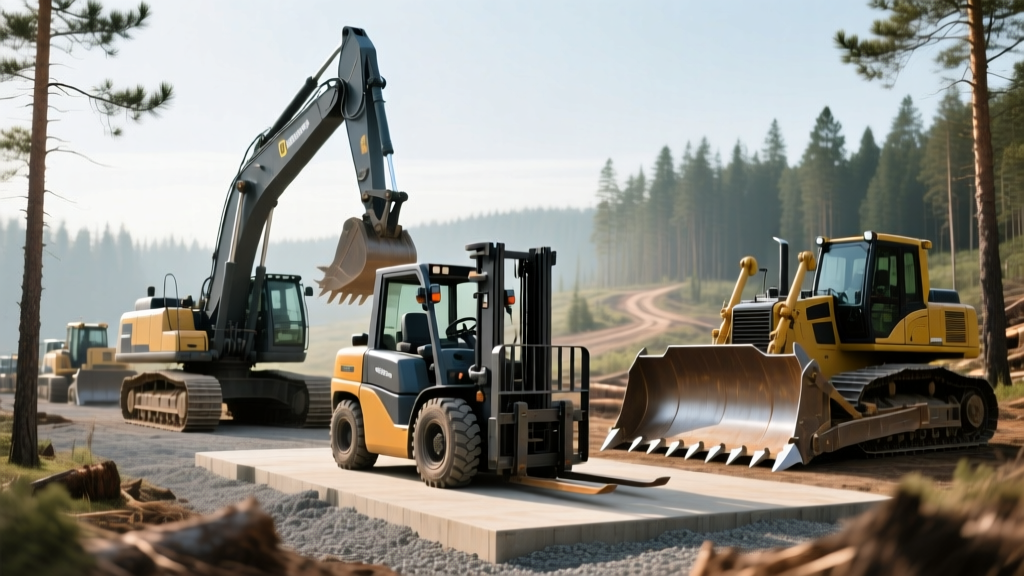
A standard 5,000 lb capacity internal combustion warehouse forklift is universally classified as MHE. However, when operations move from the sawmill floor to the deep woods or the primary log yard, the machinery scales up dramatically. A 30,000 lb capacity articulated log stacker—often colloquially referred to by yard crews as a 'heavy-duty log forklift'—crosses the threshold into heavy equipment. Understanding this distinction is critical for compliance, insurance underwriting, and deploying the right technology for 2026's high-yield timber extraction.
Regulatory Insight: OSHA and ANSI Definitions
Under OSHA Standard 1910.266 (Logging Operations), heavy equipment in forestry encompasses machines designed for felling, processing, and extracting timber on uneven, unimproved terrain. Standard forklifts lack the oscillating axles, high-clearance undercarriages, and load-sensing hydraulic systems required for these environments. Conversely, specialized forestry wheel loaders equipped with log forks and weighing over 20 metric tons are strictly regulated as heavy earthmoving and forestry equipment.
2026 Forestry Heavyweights: Beyond the Log Yard
While log yard stackers handle the sorting, the true heavy equipment of the forestry sector operates under the canopy. The modern timber harvesting sector has shifted away from manual chainsaw felling toward highly automated, sensor-laden heavy machinery. The integration of telematics, hybrid hydraulic drives, and LiDAR mapping has transformed harvesters and forwarders into mobile data centers.
To understand the current landscape of logging heavy equipment, we must look at the flagship models dominating the 2026 market. These machines feature advanced load-sensing axial piston pumps that adjust hydraulic flow dynamically, reducing fuel consumption by up to 18% compared to older open-center systems.
| Model | Classification | Engine Power | Boom Reach / Capacity | Est. Base Price (2026) |
|---|---|---|---|---|
| Ponsse Scorpion King | 8-Wheel Harvester | 210 kW (Mercedes-Benz) | 11.0 m reach | $720,000 - $780,000 |
| John Deere 1510E | Forwarder | 200 kW (FT4) | 20-ton payload | $580,000 - $630,000 |
| Tigercat H725 | Harvester Head | N/A (Attachment) | 700mm max diameter | $110,000 - $135,000 |
| Sennebogen 835 M | Log Yard Handler | 261 kW | 35-ton lift capacity | $850,000 - $920,000 |
Technological Innovations Reshaping the Canopy
The question of whether a machine qualifies as heavy equipment is no longer just about weight; it is about computational mass. Modern forestry harvesters utilize edge computing to process spatial data in real-time, fundamentally changing how timber is extracted.
Intelligent Boom Control (IBC) and AI Automation
Operators historically required thousands of hours to master the dual-joystick hydraulic controls of a harvester boom. Today, AI-driven systems like John Deere's Intelligent Boom Control (IBC) allow the operator to simply point the grapple at a target stem using a single joystick. The machine's onboard PLC (Programmable Logic Controller) calculates the kinematic trajectory, automatically adjusting the main boom, dipper stick, and rotator to achieve the smoothest, most fuel-efficient path. This reduces hydraulic shock loads on the pins and bushings, extending the service life of the boom by an estimated 22%.
LiDAR Integration and Stem Mapping
In 2026, the integration of drone-mapped LiDAR data with harvester onboard computers is standard practice for high-yield forestry operations. Before a Ponsse Scorpion enters a stand, a UAV maps the terrain and individual tree stems. This point-cloud data is uploaded to the harvester's Opti4G software, allowing the machine to automatically calculate the optimal bucking sequences (cutting the log into specific lengths for maximum market value) before the felling head even touches the bark.
'The transition from mechanical extraction to digital forestry means our heavy equipment is now judged by its teraflops and sensor fusion capabilities just as much as its drawbar pull and hydraulic flow rates.'
— Lead Operations Engineer, Pacific Northwest Timber Cooperative
Log Yard Stackers: Where Forklifts Meet Heavy Machinery
Returning to the initial classification question: the log yard is where the forklift concept evolves into undisputed heavy equipment. Standard warehouse forklifts rely on rigid masts and rear-wheel steering, rendering them useless on the muddy, uneven terrain of a logging sorting yard.
Instead, operations deploy heavy-duty material handlers and specialized wheel loaders. Machines like the Sennebogen 835 M or customized Caterpillar 966M wheel loaders equipped with log forks feature:
- Oscillating Rear Axles: Allowing up to 12 degrees of articulation to keep all four wheels grounded on uneven log piles.
- Rotating Cabs: Providing 360-degree visibility without the operator needing to twist their spine, crucial for spotting ground personnel in high-traffic sorting yards.
- High-Pressure Hydraulics: Operating at 350+ bar to clamp and rotate multi-ton bundles of raw timber with millimeter precision.
Decision Framework: Specifying Your 2026 Logging Fleet
When outfitting a logging operation, matching the machine to the silvicultural requirements prevents catastrophic capital waste. Use this framework to determine your heavy equipment needs:
- Assess the Terrain Gradient: If your extraction routes exceed a 35% grade, standard wheeled forwarders will suffer from excessive tire slip and soil disturbance. You must spec a tracked harvester or a winch-assisted tethered system (like the Haas tethering winch integrated with a Ponsse Buffalo) to anchor the heavy equipment to the canopy.
- Calculate the Average DBH (Diameter at Breast Height): For stands averaging under 200mm DBH, a lightweight, multi-tree harvester head is required to maintain cycle times. For old-growth or heavy plantation pine exceeding 500mm DBH, you need a heavy carrier with a high-flow hydraulic pump (minimum 400 L/min) to power the feed rollers of a heavy-duty head like the Tigercat H725.
- Evaluate the Log Yard Interface: Do not attempt to use modified agricultural tractors or standard MHE forklifts for log yard sorting. Invest in a purpose-built log stacker with a reinforced undercarriage and specialized grapple attachments to meet heavy machinery safety and productivity standards.
Summary: The Verdict on Forestry Equipment Classification
So, is a forklift considered heavy equipment? In the strict taxonomy of industrial machinery, a standard counterbalance forklift is material handling equipment. But in the forestry sector, the 'forklift' evolves into the 35-ton log stacker, and the 'tractor' evolves into the 20-ton forwarder. These machines are unequivocally heavy equipment, governed by stringent OSHA logging standards and characterized by immense hydraulic power, complex kinematics, and advanced AI integration. Recognizing this distinction ensures that logging operations invest in the correct, legally compliant, and technologically capable machinery required for modern timber extraction.