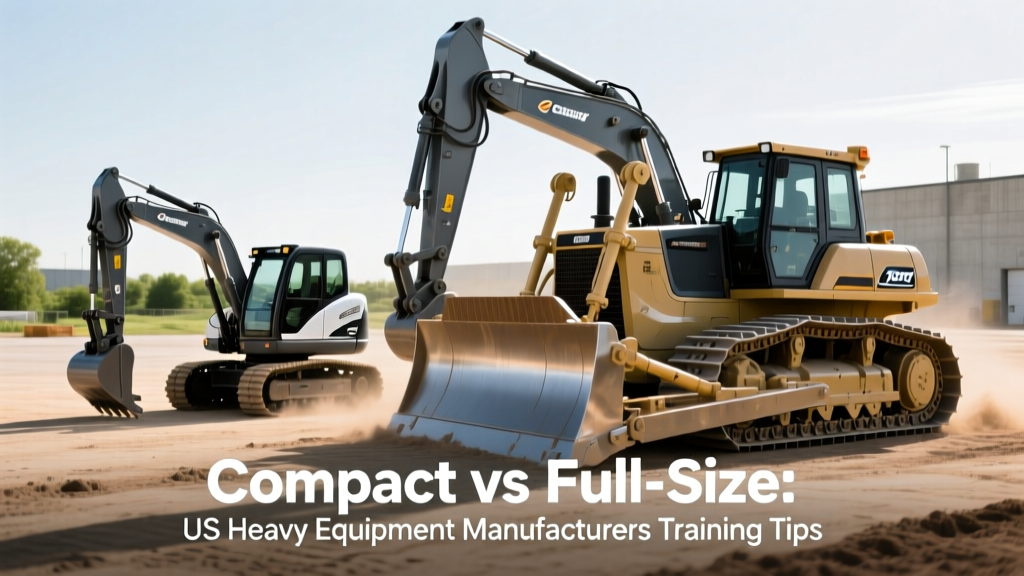
Compact vs Full-Size: US Heavy Equipment Manufacturers Training Tips
Master operator training for compact vs full-size machinery. Compare specs, safety protocols, and selection tips from top US heavy equipment manufacturers.
The Training Gap: Why Machine Size Dictates the Curriculum
Fleet managers and site superintendents frequently make a costly assumption: an operator who excels in a 5-ton mini excavator can seamlessly transition to a 36-ton hydraulic excavator. This 'step-up' fallacy is responsible for a significant percentage of job site incidents, utility strikes, and machine tip-overs. When evaluating compact vs full-size construction equipment selection, the decision is not merely about digging depth or lifting capacity; it is fundamentally about matching the machine's operational physics to the operator's verified training level.
Top US heavy equipment manufacturers like Caterpillar, John Deere, and Case have radically diverged their cab ergonomics, telematics, and hydraulic response profiles between their compact and full-size lineups. A 2026 Cat 305 CR (compact radius) operates with an entirely different center of gravity and hydraulic feedback loop than a Cat 336. Training protocols must reflect these engineering realities.
⚠️ CRITICAL WARNING: The 'Step-Up' FallacyDo not allow operators to transition from compact to full-size machinery based solely on seat time. According to OSHA excavation and heavy equipment standards, operators must be evaluated on the specific class and capacity of the machine they are assigned to. A 40-hour compact certification does not legally or practically qualify an operator for a 30-ton+ full-size machine, especially when lifting operations are involved.
Machine Selection & Training Matrix: Compact vs. Full-Size Parameters
Before assigning operators, fleet managers must understand the baseline technical deltas between the two categories. The following matrix outlines the core specifications from leading US heavy equipment manufacturers and the corresponding training adjustments required.
| Parameter | Compact (e.g., Cat 305 CR / Deere 60G) | Full-Size (e.g., Cat 336 / Deere 350G LC) | Training Delta & Focus Area |
|---|---|---|---|
| Operating Weight | ~11,000 - 14,000 lbs | ~75,000 - 85,000 lbs | Ground bearing pressure calculations and matting protocols. |
| Tail Swing | Zero or Compact Radius (ZTS) | Conventional (Overhang by 4-6 ft) | Swing radius barricading and blind-spot management. |
| Hydraulic Flow | 15 - 25 GPM (Standard/Aux) | 130 - 160+ GPM (Main Pumps) | Muscle memory recalibration for boom/arm speed and multifunctioning. |
| Cab Tech & Grade Control | 2D Laser Receivers, Basic Telematics | 3D GNSS/SmartGrade, 360° Cameras | Digital interface navigation, calibration, and sensor troubleshooting. |
| Required Supervised Hours | 40 - 60 Hours | 120 - 200+ Hours | Formal evaluation and potential NCCCO certification for lifting. |
Core Competencies for Compact Machinery Operators
Compact equipment, such as the Case CX57B or Bobcat E60, is typically deployed in confined urban environments, residential backyards, or interior demolition sites. The training focus here is heavily skewed toward spatial awareness and attachment management.
Zero Tail Swing (ZTS) Pinch Point Awareness
While ZTS machines keep the counterweight within the track width, they create severe pinch points between the rear of the cab and stationary objects (walls, fences, utility poles). Operators must be trained to maintain a minimum 18-inch clearance buffer. Training exercises should involve placing physical barriers (like foam blocks) at the exact pivot radius of the specific machine model to force the operator to develop spatial muscle memory without relying solely on mirrors.
High-Flow Attachment Management
Modern compact machines from US heavy equipment manufacturers frequently feature high-flow auxiliary hydraulics (up to 40 GPM) to run tiltrotators and hydraulic breakers. Operators must be trained on the thermal limitations of these systems. Running a hydraulic breaker on a 5-ton machine for more than 20 continuous minutes without checking hydraulic fluid temperatures can lead to pump cavitation and seal blowouts. Best practice dictates a strict 15-minutes-on, 5-minutes-off cycle during heavy breaking operations.
💡 Pro Tip: Joystick Pattern VerificationMost US heavy equipment manufacturers default to ISO patterns, but rental fleets often feature machines switched to SAE (backhoe) patterns. Before an operator turns the key, they must perform a 'dry cycle'—lifting the bucket 6 inches off the ground and testing all four primary directional movements to verify the joystick configuration matches their certification.
Full-Size Equipment: Advanced Training Protocols
Transitioning to full-size machinery like the John Deere 350G LC or Caterpillar 336 introduces complex physics, massive blind spots, and advanced digital ecosystems. The financial risk is exponentially higher; a 2026 Cat 336 can exceed $550,000, and a single utility strike can result in millions in damages.
Blind Spot Mapping and Swing Radius Barricading
Full-size excavators possess massive right-rear blind spots that mirrors and standard cameras cannot fully eliminate. Training must include a physical 'blind spot walk-around.' Have the operator sit in the cab while a spotter walks the perimeter holding a 4-foot safety cone. The operator must mark the exact locations on a site map where the cone disappears from view. Furthermore, OSHA mandates that the swing radius of full-size equipment must be physically barricaded with caution tape or fencing, not just marked with paint.
Telematics and 3D Grade Control Integration
US heavy equipment manufacturers now integrate factory-calibrated 3D grade control (e.g., Cat Grade with 3D, Deere SmartGrade) directly into the cab displays. Operators must be trained not just to dig, but to manage the digital ecosystem. This includes:
- GNSS Calibration: Performing daily base station checks and verifying satellite lock (minimum 12 satellites for sub-inch accuracy).
- Over-dig Prevention: Understanding how the boom and bucket cylinders automatically restrict downward force when the bucket edge hits the digital design surface.
- Sensor Troubleshooting: Identifying when inertial measurement units (IMUs) on the boom require recalibration due to heavy vibration or thermal drift.
Step-by-Step Transition Framework: Moving Operators Up
When promoting an operator from compact to full-size equipment, implement this strict 4-phase transition framework to ensure safety and equipment longevity.
- Phase 1: Shadowing and Cab Familiarization (20 Hours)
The operator rides in the cab with a senior mentor. Focus is strictly on daily maintenance routines (DEF fluid levels, track tensioning, greasing the swing circle) and navigating the digital telematics displays without engaging the hydraulics. - Phase 2: Empty Bucket Manipulation (40 Hours)
The operator runs the machine in an open, barricaded lot. The goal is to recalibrate muscle memory for the heavier boom and arm speeds. They must practice trenching, backfilling, and track-tramming without moving any dirt, focusing purely on hydraulic multifunctioning smoothness. - Phase 3: Load-Bearing and Production (60 Hours)
Under direct supervision, the operator begins actual production digging. The mentor monitors hydraulic pressure gauges and engine load percentages via the telematics dashboard to ensure the operator is not stalling the engine or over-pressurizing the relief valves. - Phase 4: Lifting and Rigging Evaluation (Variable)
If the full-size machine will be used for pipe laying or material handling, the operator must undergo specific rigging training and pursue NCCCO Excavator Certification. This includes calculating load charts, understanding dynamic loading, and managing taglines.
The Cost of Inadequate Training: 2026 Incident Realities
Cutting corners on transition training is a false economy. Industry data indicates that the average cost of a subterranean utility strike by a full-size excavator now exceeds $125,000 when factoring in repair costs, OSHA fines, and project downtime. Furthermore, improper operation of full-size track drives—such as high-speed tramming over uneven debris—can snap track chains or destroy final drive motors, resulting in $15,000 to $25,000 in immediate repair bills.
By aligning your compact vs full-size construction equipment selection with a rigorous, model-specific training curriculum, you protect your capital assets, ensure regulatory compliance, and build a workforce capable of leveraging the advanced technology integrated into modern machinery by US heavy equipment manufacturers.