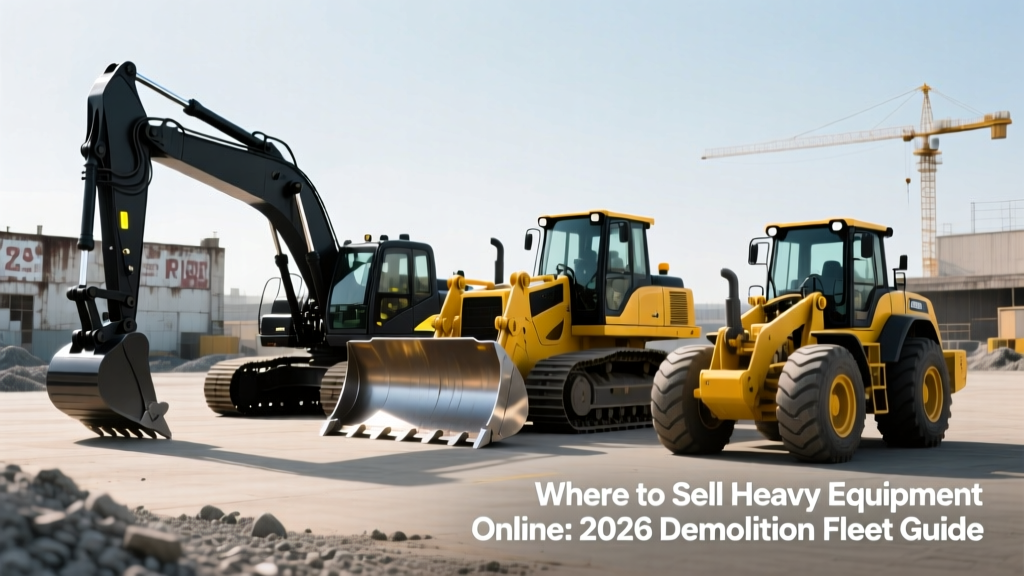
Where to Sell Heavy Equipment Online: 2026 Demolition Fleet Guide
Maximize ROI on demolition excavators and attachments. Learn where to sell heavy equipment online and plan your 2026 fleet budget with exact resale data.
The 2026 Demolition Fleet Depreciation Matrix
Fleet managers in the demolition sector face a unique capital recovery challenge. Unlike standard earthmoving assets, demolition equipment operates in high-impact, high-abrasion environments that accelerate wear on structural components and hydraulic systems. Accurately forecasting residual value is the first step in budget planning before deciding where to liquidate aging assets.
The table below outlines current 2026 capital outlays and projected 36-month resale targets for core demolition machinery, factoring in standard MACRS 5-year depreciation schedules and current secondary market demand.
| Asset Category | Example Model | Avg. New Capital Outlay | 36-Month Resale Target | Primary Depreciation Driver |
|---|---|---|---|---|
| Heavy Demolition Excavator | Cat 352 (50-ton class) | $685,000 - $720,000 | $410,000 - $445,000 | Undercarriage wear, boom cracking |
| Hydraulic Breaker | Epiroc HB 4700 | $82,000 - $88,000 | $45,000 - $52,000 | Nitrogen chamber fatigue, tool wear |
| Hydraulic Shear | LaBounty MSD7500 | $115,000 - $125,000 | $70,000 - $85,000 | Blade edge degradation, pivot pin elongation |
| Concrete Pulverizer | NPK H20Xb | $55,000 - $62,000 | $32,000 - $38,000 | Jaw tooth abrasion, cylinder scoring |
Evaluating Attachment Residual Value: The Hidden Costs of Wear
When budgeting for fleet turnover, contractors often overvalue the base machine and undervalue the attachments. In demolition, the attachment is the primary revenue-generating tool. A Cat 352 excavator with a compromised hydraulic flow rate cannot efficiently run an Epiroc HB 4700 breaker, which requires a minimum of 100 to 130 gallons per minute (GPM) at 2,500 to 3,000 PSI to maintain optimal blow frequency.
Before listing assets, conduct a physical audit of the attachment mounting interfaces. Pin and bushing tolerances on shear jaws that exceed 0.030 inches of radial play will trigger immediate price deductions from savvy buyers. Rebuilding a LaBounty shear jaw with hardened AR400 steel plate and replacing the pivot pins typically costs between $4,500 and $7,000 at a certified fabrication shop, but can yield a $15,000+ increase in final auction hammer price.
Warning: Undercarriage Contamination in Demolition EnvironmentsDemolition sites are littered with rebar, pulverized concrete, and abrasive dust. Standard sealed-and-lubricated (SALT) track chains frequently fail prematurely when fine concrete dust infiltrates the idler seals. When appraising your fleet for resale, measure the track chain stretch. A chain stretched beyond 3% of its original pitch length requires a $25,000 to $35,000 undercarriage replacement. If your machine is at 2.8% stretch, liquidate immediately before the failure threshold is crossed, as buyers will discount the machine by the full cost of a new undercarriage plus a 20% risk premium.
Where to Sell Heavy Equipment Online: Platform ROI Comparison
Determining exactly where to sell heavy equipment online requires matching your specific demolition assets to the platform with the highest concentration of specialized buyers. Generalist marketplaces often yield lower hammer prices for niche demolition attachments because the algorithmic reach does not target specialized scrap and recycling contractors.
Unreserved Auctions vs. Classified Marketplaces
- Ritchie Bros. / IronPlanet (Unreserved Auctions): Best for complete fleet liquidations and high-hour base machines (8,000+ hours). The unreserved format guarantees a sale date, which is critical for strict capital recovery timelines. Expect to pay a 3% to 5% seller fee, but the global reach to scrap yard operators drives competitive bidding on shears and grapples.
- MachineryTrader (Classifieds): Ideal for low-hour, specialized attachments (under 500 hours) and mid-size excavators (Cat 330 to 336 class). You retain price control, but assets may sit for 60 to 120 days. Listing fees range from $150 to $300 per month per asset. This platform is optimal when your budget allows for delayed capital injection.
- Equipment Trader: Strong regional reach for mid-market demolition gear. Excellent for selling skid-steer mounted demolition grapples and mini-excavator breakers to residential demolition contractors. Commission structures are typically tiered, capping around 8% for lower-priced items.
Expert Insight: "When selling hydraulic shears and pulverizers online, always include a video of the attachment cycling under load on a live machine. Buyers of demolition attachments are highly skeptical of 'shelf-pulled' tools. Demonstrating that the cylinder holds pressure without drifting and that the rotator motor maintains continuous 360-degree rotation under a 2-ton load will increase your inquiry rate by over 40%." — Fleet Appraisal Guidelines, Association of Equipment Manufacturers (AEM).
Budgeting for Fleet Turnover: A Step-by-Step Capital Recovery Plan
Integrating your resale strategy with your tax and procurement budget ensures that capital is deployed efficiently for 2026 upgrades. Follow this framework to align your secondary market sales with new equipment acquisitions.
- Align Sales with MACRS Depreciation Schedules: According to the IRS Publication 946, heavy construction equipment falls under the 5-year MACRS property class. If you sell a demolition excavator in year 4 of the schedule, your adjusted basis will be roughly 28.88% of the original purchase price. If your projected resale value exceeds this adjusted basis, you will trigger a taxable gain. Time your sales for late Q4 to offset annual tax liabilities or utilize Section 179 expensing on the replacement asset.
- Calculate the Repair-vs-Sell Threshold: Track your maintenance cost per operating hour. For a 50-ton demolition excavator, once the rolling 12-month maintenance cost exceeds $18.50 per hour (excluding fuel and DEF), the asset has crossed the economic break-even point. Initiate the online listing process immediately.
- Factor in Logistics and Rigging: Selling a 12,000 lb LaBounty shear online requires specialized flatbed transport. Budget $3.50 to $5.00 per loaded mile for heavy-haul rigging. If you are selling the attachment detached from the host machine, ensure you factor the cost of custom crating and hydraulic line capping into your minimum acceptable bid.
- Reinvest in Quick-Coupler Systems: Use the recovered capital to upgrade your new fleet with universal hydraulic quick-couplers (e.g., Worktools International or Case Pin Grabber). This allows a single base machine to run multiple demolition attachments, reducing the need to purchase dedicated carrier machines and lowering your overall fleet capital expenditure by up to 22%.
Market Trends: The Shift Toward Electrified Demolition Tools
As urban demolition projects face stricter emissions and noise ordinances in 2026, the secondary market is seeing a shift in buyer preferences. Electric and battery-hydraulic hybrid demolition robots (such as the Brokk 500E series) are commanding a 15% to 20% premium over their diesel counterparts on online marketplaces. If your fleet includes older diesel-powered remote-controlled demolition machines, prioritize selling them to international buyers via unreserved auctions, as domestic urban contractors are aggressively pivoting to zero-emission alternatives. For comprehensive industry forecasting and equipment standards, refer to the latest market reports published by Construction Equipment Magazine and the Association of Equipment Manufacturers.
Strategic budget planning in the demolition sector requires treating your attachments and base machines as distinct financial assets. By auditing hydraulic tolerances, timing your sales against MACRS depreciation curves, and selecting the precise online marketplace for your specific asset class, you can maximize capital recovery and fund your next fleet upgrade without relying on high-interest equipment financing.