Heavy Equipment Technician Guide to Renewable Energy Construction
Master renewable energy construction as a heavy equipment technician. Learn turbine crane calibration, solar pile driver maintenance, and safety protocols.
The Shift from Traditional Earthmoving to Renewable Megaprojects
The transition from traditional civil earthmoving to renewable energy megaprojects demands a highly specialized skill set from the modern heavy equipment technician. Wind turbine erection and utility-scale solar deployment utilize machinery that blends extreme mechanical loads with high-precision GNSS telematics and high-voltage proximity risks. Unlike standard excavation, where mechanical wear is the primary concern, renewable construction equipment requires technicians to master software-hardware integration, hydraulic accumulator tuning, and strict electrical safety protocols.
In 2026, the average onshore wind turbine capacity exceeds 4.5 MW, requiring nacelle lifts of over 120 tons at hub heights approaching 120 meters. Simultaneously, utility-scale solar farms span thousands of acres, demanding the driving of millions of steel foundation piles through highly variable geological strata. This guide details the exact maintenance, calibration, and troubleshooting frameworks required for technicians servicing this specialized fleet.
Technician vs. Operator Crossover: While operators drive the machinery, the heavy equipment technician is responsible for the pre-shift calibration of Load Moment Limiters (LML), GNSS base station verification, and hydraulic pressure staging. In remote renewable sites, technicians frequently cross-train as certified riggers and signalpersons to maintain workflow continuity.Wind Farm Construction: Calibrating Super-Cranes
Erecting modern wind turbines relies heavily on 1,000-ton to 1,500-ton class crawler cranes, such as the Liebherr LR 11300 or the Demag CC 8800-1. These machines are not just mechanical levers; they are heavily sensor-dependent platforms governed by complex CAN-bus networks.
LICCON2 Control System and LML Diagnostics
The Liebherr LICCON2 crane control system relies on a network of angle, length, and load sensors to calculate the Load Moment Limiter (LML) threshold. A frequent failure mode on windy ridgelines is the boom-tip anemometer sending erratic wind-speed data due to icing or bearing seizure, triggering an LML lockout that halts all lifts.
- Diagnostic Step 1: Connect the OEM diagnostic laptop (e.g., Liebherr DAT) to the main cabin CAN-bus port to read the raw sensor voltage.
- Diagnostic Step 2: If the voltage fluctuates outside the 0.5V–4.5V operating range, bypass the digital anemometer temporarily using the OEM software to allow the crane to slew to a safe stow position.
- Diagnostic Step 3: Physically test the anemometer with a calibrated handheld vane meter (e.g., Kestrel 5500) before resetting the LML threshold to the OEM-mandated 22 mph (9.8 m/s) cutoff.
Technicians must also monitor the slew ring grease distribution. For 1,000-ton class cranes operating in sub-zero wind farm environments, standard lithium-complex greases fail to pump through automatic lubrication lines. Switching to a synthetic, cold-weather formulated grease like Mobilgrease XHP 320 Mine prevents slew ring gear scoring during winter nacelle lifts.
Solar Array Deployment: Servicing GPS-Guided Pile Drivers
Utility-scale solar relies on hydraulic pile drivers, such as the Vermeer PD10 or MacLean SR-15, to sink W-beam or H-beam foundations. These machines must drive piles to exact depths while maintaining plumbness within a 2-degree tolerance, often across uneven, rocky terrain.
Hydraulic Hammer Accumulator Tuning for Variable Strata
When driving piles into glacial till or fractured shale, standard hydraulic pressures (typically 3,500 psi) cause pile 'mushrooming'—the severe deformation of the steel cap where the hammer strikes. This compromises the structural integrity of the foundation and ruins the hammer's drive cap.
| Soil Strata Type | Nitrogen Pre-Charge Pressure | Hydraulic Flow Rate | Technician Action |
|---|---|---|---|
| Soft Clay / Topsoil | 1,800 psi | 45 GPM | Standard high-frequency, low-impact blows. |
| Dense Sand / Gravel | 1,500 psi | 35 GPM | Mid-stroke adjustment to prevent rebound. |
| Fractured Shale / Bedrock | 1,200 psi | 25 GPM | High-stroke, high-energy blows to prevent mushrooming. |
Actionable Best Practice: To adjust for bedrock, the technician must drop the nitrogen accumulator pre-charge from 1,800 psi to 1,200 psi. This increases the blow stroke while reducing peak impact force, preserving the pile integrity without sacrificing driving speed. Always use a calibrated nitrogen charging kit with a bleed-down valve; guessing the pressure via the hydraulic gauge will result in blown hammer seals.
GNSS Base Station and Rover Calibration
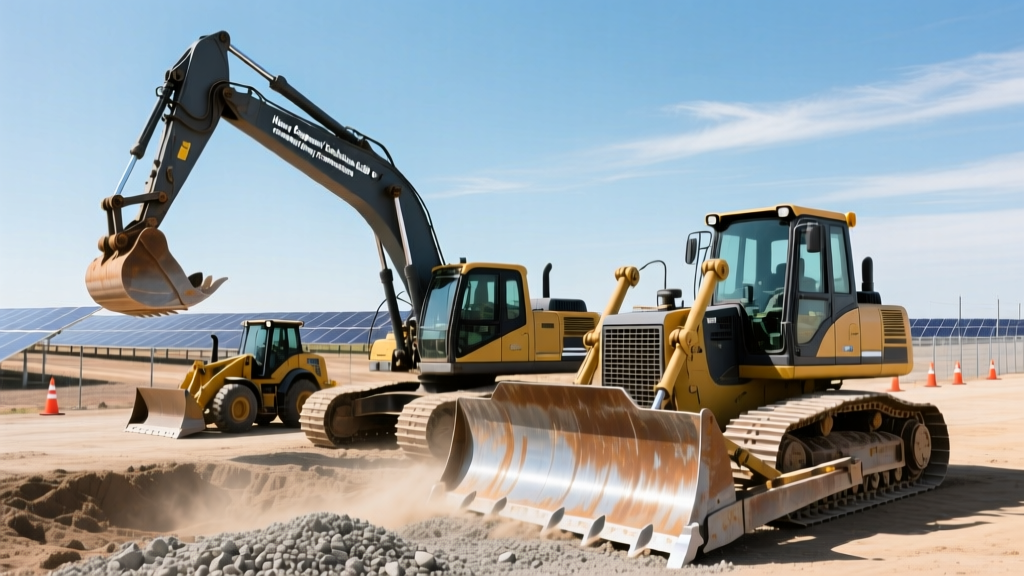
Solar grading and pile driving rely on RTK (Real-Time Kinematic) GNSS networks. A heavy equipment technician must verify the base station's coordinate accuracy daily. If the Cat D6 XE dozer's blade control system shows a 'drift' of more than 15mm, the technician must check the base station's physical plumbness, verify the satellite constellation PDOP (Position Dilution of Precision) is below 2.0, and ensure the UHF radio antenna cable has not suffered micro-fractures from machine vibration.
High-Voltage Proximity and Lockout/Tagout (LOTO)
Renewable sites are essentially massive, un-energized power plants. Once the substation is commissioned, 34.5kV collector lines run directly beneath the paths of cranes and pile drivers. According to OSHA 1926 Subpart CC, operating heavy machinery near energized power lines requires strict adherence to minimum clearance distances and dedicated spotter protocols.
Warning: Arc Flash and Induced VoltageEven when de-energized, long runs of solar collector cabling can hold lethal induced voltages from adjacent live lines or static buildup. Technicians performing maintenance on solar pile drivers or changing tracks on excavators near trenching operations must use a certified hot stick to verify zero energy state and apply personal grounding cables before touching the machine's undercarriage.
Furthermore, technicians working inside solar inverter pads or substation enclosures to repair auxiliary equipment must wear NFPA 70E Category 3 arc flash PPE, including a 40 cal/cm² suit and insulated Class 2 gloves. Standard heavy-duty leather mechanic gloves offer zero protection against medium-voltage arc flashes.
Certification Pathways and 2026 Salary Expectations
The specialized nature of renewable energy equipment has driven up the market value for cross-trained technicians. General diesel mechanics are no longer sufficient for modern wind and solar sites. Employers and unions now demand specific credentialing.
- NCCER Heavy Equipment & Renewable Certifications: The National Center for Construction Education and Research (NCCER) offers specialized modules for renewable energy site safety and advanced hydraulics, which are heavily favored by EPC (Engineering, Procurement, and Construction) contractors.
- OEM Telematics Certifications: Completing proprietary diagnostic training for Liebherr, Caterpillar, and Vermeer is mandatory. Technicians must be certified to interpret proprietary CAN-bus fault codes rather than just swapping physical parts.
- NCCCO Rigger/Signalperson: Because technicians frequently assist in complex turbine lifts, holding a National Commission for the Certification of Crane Operators (NCCCO) rigger certification is increasingly a prerequisite for site access.
As of 2026, a certified heavy equipment technician specializing in renewable megaprojects can expect a base salary ranging from $95,000 to $125,000, excluding per diem, overtime, and remote site bonuses. The American Clean Power Association continues to report a severe shortage of technicians capable of bridging the gap between traditional heavy iron repair and modern digital/hydraulic calibration, making this one of the most lucrative and secure niches in the heavy equipment sector.
Summary Checklist for the Renewable Site Technician
- Verify LML sensor calibration and anemometer functionality before every major turbine lift.
- Adjust hydraulic accumulator nitrogen pre-charge based on daily geological core samples to prevent pile mushrooming.
- Test RTK GNSS base station PDOP and rover drift before releasing GPS-guided dozers for solar grading.
- Enforce strict NFPA 70E PPE and personal grounding protocols when servicing equipment near 34.5kV collector trenches.