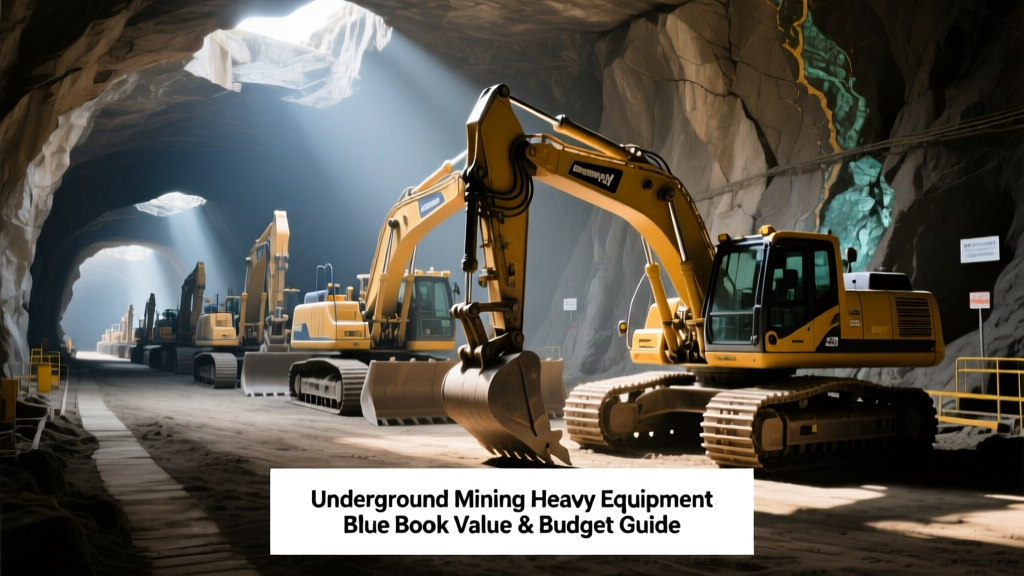
Underground Mining Heavy Equipment Blue Book Value & Budget Guide
Master heavy equipment blue book value calculations for underground mining fleets. Compare LHDs, drill jumbos, and haulers for accurate budget planning.
The Subterranean Depreciation Reality
Valuing surface-level earthmoving fleets is a straightforward exercise in tracking engine hours and undercarriage wear. Underground mining equipment, however, operates in a fundamentally hostile environment that aggressively accelerates asset degradation. When financial controllers and fleet managers attempt to establish the heavy equipment blue book value for subterranean assets, standard agricultural or construction appraisal models routinely fail. The combination of highly corrosive saline groundwater, abrasive muck, confined spatial stresses, and severe ventilation constraints creates a depreciation curve that is uniquely punishing.
For 2026 capital expenditure planning, relying on generic equipment guides without applying subterranean wear multipliers will result in severe balance sheet inaccuracies. Underground fleets do not merely lose value through mechanical fatigue; they lose value through structural contamination and dimensional obsolescence. A machine designed for a 5-meter-wide drift cannot be easily resold to a mine operating 3-meter narrow-vein stopes, artificially suppressing its secondary market demand and, consequently, its residual valuation.
Core Underground Fleet Valuations
To build an accurate budget, procurement teams must segment the fleet by primary function, as depreciation drivers vary wildly between mucking, drilling, and hauling assets.
Load Haul Dumpers (LHDs)
LHDs are the workhorses of the underground environment, subjected to continuous high-impact loading and severe articulation stress. Take the Caterpillar R1700 or the Sandvik LH518i. A new R1700 typically commands a base capital cost between $720,000 and $780,000 depending on automation packages. However, the heavy equipment blue book value for an LHD drops precipitously in the first 24 months. Unlike surface wheel loaders, LHDs suffer from 'tramming wear'—the continuous scraping of the belly plate and bucket edges against unblasted floor rock. By the 10,000-hour mark (roughly 3.5 to 4 years of double-shift operation), structural cracking in the rear frame and articulation points often necessitates a $120,000+ rebuild, dragging the blue book retention down to roughly 38% of the original purchase price.
Underground Drill Jumbos
Development drill jumbos, such as the Epiroc Boomer S2 or Sandvik DD422iE, represent a different financial profile. Priced between $750,000 and $950,000 new, their depreciation is driven less by structural wear and more by hydraulic and technological obsolescence. The rock drills (e.g., COP 1838 or RD525) require complete overhauls every 2,500 to 3,000 impact hours. If maintenance logs show deferred percussion rebuilds, appraisers will deduct upwards of $45,000 per boom from the blue book baseline. Conversely, jumbos equipped with verified 2025/2026 autonomous drilling software packages retain a 12% to 15% premium on the secondary market compared to manual counterparts.
Battery-Electric Underground Haulers
The transition to Battery Electric Vehicles (BEVs) has disrupted traditional valuation models. A 40-tonne BEV haul truck like the Sandvik Artisan Z40 or Epiroc Minetruck MT42 carries a massive upfront premium—often exceeding $1.3 million. The heavy equipment blue book value for these units is currently highly volatile. The traction motors and drivetrain suffer far less mechanical wear than diesel equivalents, but the lithium-ion battery packs represent a ticking depreciation clock. Appraisers currently apply a 20% to 25% battery degradation penalty at the 5-year mark, regardless of actual cycle counts, until long-term battery health diagnostics become standardized across the secondary market.
Valuation Matrix: 5-Year Blue Book Retention
The following matrix illustrates the expected residual heavy equipment blue book value percentages for standard underground assets operating on a 2-shift, 5-day weekly schedule in hard-rock metalliferous mining.
| Equipment Category | Representative Model | Avg. New Capital Cost | 3-Year Retention % | 5-Year Retention % | Primary Depreciation Driver |
|---|---|---|---|---|---|
| Load Haul Dumper (Diesel) | Cat R1700 | $745,000 | 58% | 36% | Articulation frame stress, belly wear |
| Development Drill Jumbo | Epiroc Boomer S2 | $810,000 | 65% | 44% | Hydraulic percussion fatigue, tech obsolescence |
| Underground Haul Truck (Diesel) | Sandvik TH545i | $1,150,000 | 52% | 31% | Powertrain thermal degradation, hoist cylinder wear |
| BEV Haul Truck (40-tonne) | Artisan Z40 | $1,350,000 | 60% | 41%* | Battery cycle degradation, high-voltage system aging |
| Scaling Rig | Sandvik DS312 | $680,000 | 55% | 39% | Boom shock absorption failure, cabin glass pitting |
*Note: BEV 5-year retention assumes the battery pack has not required a full replacement cycle. A mandated pack swap will reset the asset value but severely impact net present value calculations.
Warning: The 'Hour Meter' Trap in Underground AppraisalsNever rely solely on engine hours to determine the heavy equipment blue book value of underground gear. A diesel LHD idling in a ventilation-controlled stope burns hours without accumulating wear, while an LHD tramming up a 1-in-7 decline with a full payload inflicts exponential drivetrain damage. Appraisers must cross-reference engine hours with payload telemetry data and decline tramming logs to calculate 'effective working hours.'
Adjusting Standard Blue Book Metrics for Severe Duty
When utilizing platforms like EquipmentWatch or Kelley Blue Book Commercial, the baseline values assume 'average' operating conditions. Underground mining inherently qualifies as 'severe duty.' To arrive at an actionable budget figure, financial teams must apply the following deduction framework to the published baseline:
- Corrosion Deduction (8% - 12%): Apply if the mine utilizes saline groundwater or operates in high-sulfide ore bodies (e.g., volcanogenic massive sulfide deposits) that accelerate chassis and electrical harness corrosion.
- Abrasive Environment Deduction (5% - 9%): Apply for operations handling highly abrasive materials like quartzite or taconite, which decimate bucket lips, dump bed liners, and hydraulic cylinder rods.
- Dimensional Obsolescence Penalty (10% - 15%): If the equipment is physically sized for a specific, non-standard mine profile (e.g., ultra-low-profile machines for narrow-vein platinum reefs), deduct this amount due to the severely restricted secondary buyer pool.
- Regulatory Emissions Discount (Up to 20%): For aging Tier 3 or older diesel equipment. As global mining jurisdictions tighten underground particulate and NOx regulations, non-compliant diesel assets are becoming stranded assets, heavily suppressing their blue book value.
Capital Allocation: Buy vs. Lease Framework
Understanding the heavy equipment blue book value is the foundational input for the buy-versus-lease decision matrix. In underground mining, the steep early-stage depreciation curve often favors operational leasing for high-wear assets, while ownership makes sense for specialized, long-life infrastructure equipment.
'If an asset's 5-year blue book retention falls below 40%, and the cost of a mid-life powertrain rebuild exceeds 25% of the residual value, the asset is a prime candidate for a full-maintenance operating lease. You transfer the catastrophic failure risk to the OEM or lessor.' — Fleet Financial Analysis Guidelines, Mining Equipment Lessors Association.
For LHDs and Haul Trucks, where 5-year retention hovers around 31% to 36%, leasing protects the mine operator from the massive $150,000+ mid-life overhaul costs. Conversely, for Drill Jumbos and Bolting Rigs, which retain 44%+ of their value and suffer less catastrophic structural failure, purchasing and executing a rigorous in-house preventative maintenance program yields a superior Net Present Value (NPV) over a 7-year horizon.
Frequently Asked Questions
How do MACRS tax schedules interact with underground blue book values?
In the United States, the Modified Accelerated Cost Recovery System (MACRS) typically classifies underground mining machinery under the 7-year property class. However, the tax depreciation schedule rarely aligns with the actual heavy equipment blue book value. While MACRS allows for aggressive front-loaded tax deductions (accelerating write-offs in years 1 and 2), the actual market resale value of an LHD or haul truck drops even faster than the IRS schedule assumes. Financial controllers must maintain dual ledgers: one for tax optimization and one for true market residual tracking to avoid balance sheet shocks when liquidating fleets.
Does retrofitting older diesel equipment with emission scrubbers improve residual value?
Retrofitting Tier 3 underground haul trucks with Diesel Particulate Filters (DPFs) or catalytic scrubbers is often mandatory to meet modern mine ventilation standards. However, this capital expenditure (typically $40,000 to $65,000 per unit) rarely yields a 1:1 return in the heavy equipment blue book value. The secondary market views emission retrofits as a baseline requirement for legality, not a value-adding upgrade. Expect to recover only 30% to 40% of the retrofit cost upon resale.
Where can I verify current secondary market pricing for niche underground gear?
While standard commercial guides provide baselines, true market clearing prices for specialized underground equipment are best tracked via direct auction results from specialized liquidators like Mining Magazine industry reports, or by consulting OEM-certified used equipment divisions, such as Caterpillar Mining and Sandvik's Rebuild programs, which publish verified transaction data for certified pre-owned subterranean fleets.