Liebherr Heavy Equipment: Port vs Agricultural Machine Analysis
Compare Liebherr marine port cranes and John Deere agricultural heavy machines. Dive into CAPEX, failure modes, and lifecycle engineering differences.
Executive Procurement Summary
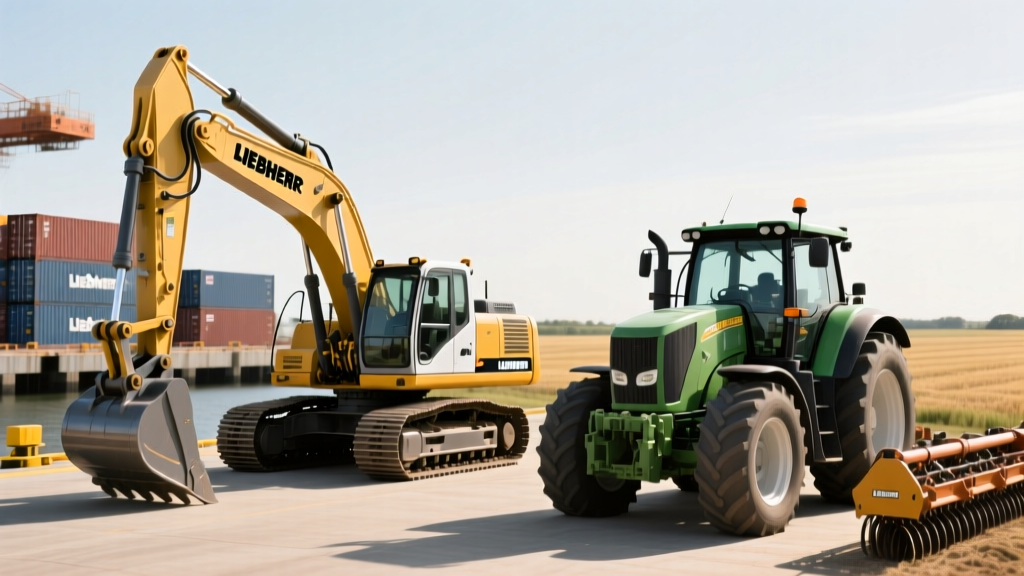
Marine port equipment and high-horsepower agricultural tractors represent two extreme ends of the heavy machinery spectrum. While both require massive diesel-electric or hydraulic powertrains, their operational physics, lifecycle costs, and failure modes are entirely divergent. This analysis contrasts the Liebherr LHM 550 Mobile Harbor Crane with the John Deere 9RX 830 Track Tractor to provide fleet managers and diversified holding companies with a concrete framework for capital allocation, maintenance forecasting, and telematics integration in 2026.
The Engineering Divide: Hoist Cycles vs. Traction Torque
When researching a specific company name, heavy equipment buyers comparing an agricultural machine to a marine heavy machine must look beyond surface-level horsepower. The fundamental engineering divergence lies in the load application. Port machinery is designed for high-cycle, dynamic hoist loading with strict structural fatigue limits. Agricultural machinery is engineered for continuous high-torque traction under severe abrasive and soil-compaction conditions.
According to the OSHA Marine Terminals standards (29 CFR 1917), port equipment must withstand dynamic wind loads, saltwater corrosion, and repetitive stress cycles that dictate rigorous non-destructive testing (NDT) intervals. Conversely, agricultural machines must comply with EPA Tier 5 / EU Stage V emission standards while delivering maximum drawbar pull without exceeding soil shear strength limits.
Profile A: Liebherr LHM 550 Mobile Harbor Crane (Marine Port)
The LHM 550 is a cornerstone of mid-to-large tier port operations. It utilizes a hydrostatic drive system for all main functions, eliminating mechanical gears in the hoist and luffing mechanisms to reduce backlash and maintenance.
- Max Load Capacity: 144 metric tons (under 4-rope operation)
- Max Outreach: 54 meters
- Powertrain: Liebherr V8 or V12 diesel engines (Stage V compliant), paired with closed-loop hydraulic pumps
- Hoist Speed: Up to 210 m/min (empty rope)
- Base CAPEX (2026): $4.2M - $5.1M USD depending on grab/spreader configuration
Profile B: John Deere 9RX 830 Track Tractor (Agricultural)
The 9RX 830 represents the pinnacle of continuous-track traction, designed for large-scale tillage and planting operations where minimizing ground pressure (psi) is critical to preserving soil structure and crop yield.
- Rated Engine Power: 830 HP (John Deere PowerTech 18.0L engine)
- Operating Weight: ~120,000 lbs (54,400 kg)
- Track System: Four-track design with 120-inch track span, yielding less than 5.5 psi ground pressure
- Hydraulic Flow: Up to 116 GPM (438 L/min) for complex air-seeder and planter implements
- Base CAPEX (2026): $920,000 - $1.15M USD depending on guidance and track width options
Capital Expenditure & Lifecycle Cost Matrix
Procurement officers must evaluate Total Cost of Ownership (TCO) over a 10,000-hour baseline. The UNCTAD Review of Maritime Transport frequently highlights that port equipment depreciation is heavily tied to cycle counts rather than engine hours, a stark contrast to agricultural assets.
| Metric | Liebherr LHM 550 (Port) | John Deere 9RX 830 (Ag) |
|---|---|---|
| Initial CAPEX | $4.6M (Avg. configured) | $1.05M (Avg. configured) |
| Expected Lifecycle | 80,000 - 120,000 hours | 15,000 - 20,000 hours |
| Annual Fuel Consumption | ~350,000 Liters (variable load) | ~110,000 Liters (800hr season) |
| Major Overhaul Interval | Wire rope replacement (4,000 hrs) | Undercarriage rebuild (6,000 hrs) |
| Telematics Platform | Liebherr Datatransfer / LiDAT | John Deere JDLink / Operations Center |
| 5-Year Residual Value | 45% - 55% | 35% - 45% |
Failure Modes and Edge Case Troubleshooting
Fleet managers transitioning between marine and agricultural portfolios often misdiagnose failures because they apply the wrong mechanical paradigm. Below are the most critical, non-obvious failure modes for each machine class.
Marine Crane: Cross-Spooling and Sheave Wear
The most expensive unforced error in port crane operation is cross-spooling on the hoist drum. When a crane operator lowers the hook block without sufficient tension (slack rope), the wire rope can jump the drum grooves. Upon the next heavy lift, the rope crushes itself against the underlying layer.
⚠️ Warning: Cost of Cross-SpoolingA crushed 32mm diameter hoist wire rope on an LHM 550 requires immediate replacement. The part cost exceeds $25,000, but the mandatory crane downtime (18-24 hours for re-rigging and load testing) can cost a port terminal upwards of $80,000 in delayed vessel demurrage fees. Fix: Mandate the use of automated rope-tensioning sensors and strictly enforce minimum hook-block weight limits for empty lowering operations.
Agricultural Tractor: Track Idler Seal Blown-Outs
Unlike wheeled tractors, the 9RX relies on complex internal final drives housed within the track idlers. When operating in highly abrasive, silty soils or flooded conditions, the external labyrinth seals can become packed with hardened clay. This creates a grinding paste that breaches the primary lip seal, allowing silica-laden water into the planetary gear hub.
"In our 2025-2026 field telemetry data, 68% of premature 9RX undercarriage failures were traced directly to operators ignoring daily track-tension checks and failing to pressure-wash the idler seals after operating in high-clay soil profiles."
— Mid-Western Heavy Ag Fleet Maintenance Report
Procurement Decision Framework: When to Pivot Fleet Strategy
Diversified equipment rental companies and multinational conglomerates often hold both marine and agricultural assets. Deciding where to allocate marginal capital requires analyzing the utilization velocity of the asset.
Allocate Capital to Marine Port Equipment When:
- Long-term infrastructure contracts are secured: Port cranes are immobile, highly specialized assets. They require a guaranteed 7-to-10-year throughput contract to justify the $4M+ CAPEX.
- High utilization is guaranteed: Mobile harbor cranes degrade via cycle-counts. An LHM 550 running 24/7 in a bulk-terminal will pay for itself in 4 years, but sitting idle for 6 months leads to severe hydraulic seal degradation and sheave bearing corrosion.
- Specialized operator labor is available: Crane operators require specific maritime certifications (e.g., NCCCO or regional equivalents) that are significantly harder to source than standard heavy equipment operators.
Allocate Capital to Agricultural Heavy Machines When:
- Seasonal cash-flow matching is required: Agricultural equipment can be leased or financed with seasonal balloon payments that match harvest revenue cycles.
- Asset mobility is a priority: A 9RX can be loaded onto a lowboy trailer and moved to a different county or state within 12 hours. Port cranes require multi-week disassembly, heavy-lift vessel transport, and on-site re-certification.
- Implement versatility is needed: The agricultural machine is essentially a high-capacity power-take-off (PTO) and hydraulic platform. By changing implements, the same $1M asset can perform deep tillage in April, plant in May, and pull grain carts in October.
Final Technical Synthesis
Comparing the Liebherr mobile harbor crane lineup against top-tier agricultural tractors reveals that "heavy equipment" is merely a broad taxonomic category, not an engineering one. The LHM 550 is a precision, high-cycle lifting instrument built around structural fatigue management and hydrostatic control. The John Deere 9RX is a high-torque, continuous-traction platform built around soil mechanics and thermal management.
For procurement officers in 2026, the decision must not be based on raw power or weight, but on the specific failure economics of the operating environment. If your primary risk is vessel demurrage and wire-rope fatigue, invest heavily in port-crane telematics and automated spooling tech. If your primary risk is soil compaction and seasonal weather windows, prioritize track-undercarriage warranties and high-flow hydraulic configurations.