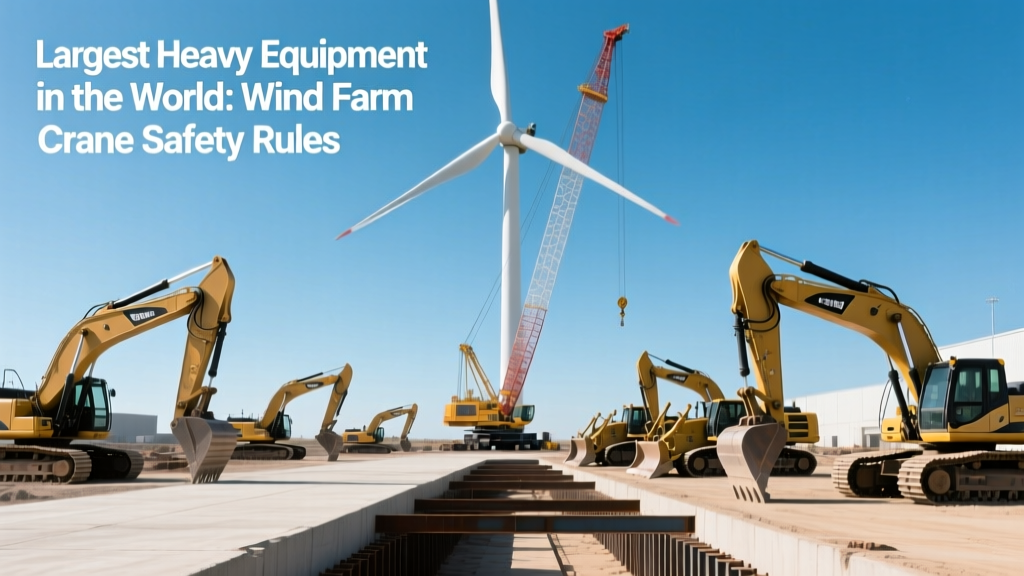
Largest Heavy Equipment in the World: Wind Farm Crane Safety Rules
Explore safety standards and compliance frameworks for operating the largest heavy equipment in the world during renewable energy and wind farm construction.
The global transition to 15MW+ onshore and offshore wind turbines has fundamentally altered the heavy lifting industry. Hoisting a 650-ton nacelle to a 160-meter hub height requires deploying the largest heavy equipment in the world. These mega-crawlers and specialized transporters operate at the absolute limits of mechanical engineering, meaning standard construction safety margins are insufficient. In renewable energy construction, a single compliance failure can result in catastrophic structural collapse, multi-million-dollar asset losses, and severe fatalities.
Operating these mega-machines demands strict adherence to specialized compliance frameworks that integrate geotechnical engineering, advanced meteorology, and dynamic load monitoring. This guide details the precise safety standards, engineering controls, and regulatory compliance requirements for deploying the world's largest cranes and transporters in wind farm construction.
The Scale of Renewable Mega-Equipment
Modern wind turbine components have scaled beyond the capabilities of standard 500-ton crawler cranes. The current generation of 8MW to 15MW turbines requires ultra-class crawler cranes capable of lifting 1,000+ metric tons at extreme radii. According to the U.S. Department of Energy WINDExchange, the physical footprint and mass of these turbines dictate the mobilization of specialized heavy lift fleets.
| Model | Max Capacity | Max Boom Length | Counterweight Requirement | Primary Safety Control System |
|---|---|---|---|---|
| Liebherr LR 17000-1.0 | 1,700 MT | 198m (Main Boom) | Up to 750 MT (V-Tray) | LICCON 3 with Wind Speed Monitoring |
| Demag CC 8800-1 | 1,600 MT | 156m (Main Boom) | Up to 680 MT | IC-1 Plus Touch Control |
| XCMG XGC28000 | 2,800 MT | 144m (Main Boom) | Up to 1,200 MT | Intelligent Black-Box Telematics |
Ground Bearing Pressure (GDP) & Matting Compliance
The most frequent cause of mega-crane failure in wind farm construction is not mechanical; it is geotechnical. A fully rigged 1,700-ton crawler crane with a suspended load can exert immense ground bearing pressure. Compliance with OSHA 1926 Subpart CC (Cranes and Derricks in Construction) mandates that ground conditions must be firm, drained, and graded to support the equipment.
Engineering the Lift Pad
Wind farms are frequently located on agricultural land, coastal ridges, or reclaimed soil, which rarely possesses the native bearing capacity to support a 3,500-ton combined machine-and-load footprint. Site preparation requires strict compliance with engineered lift pad specifications:
- Soil Testing: Geotechnical boring logs must be taken at the exact crane pad location to a depth of 20 feet to identify shear planes or high water tables.
- GDP Limits: Most engineered lift pads for mega-cranes are designed to limit ground bearing pressure to 2,500 - 4,000 pounds per square foot (psf).
- Matting Systems: Standard timber mats are insufficient. Compliance requires engineered crane pads, such as 12-inch thick laminated hardwood mats, or specialized composite systems like Dura-Base heavy-duty mats, overlaid on a compacted aggregate sub-base.
- PE Certification: The lift pad design must be stamped by a licensed Professional Engineer (PE) who verifies the soil compaction reports prior to crane assembly.
When lifting a 115-meter wind turbine blade, the surface area acts as a massive sail. A sudden 15 mph gust can generate lateral dynamic loads exceeding the crane's side-load capacity, leading to a boom buckling failure. Compliance requires active yaw control of the nacelle and the use of motorized taglines to keep ground workers out of the drop zone while maintaining rotational control of the blade.
Wind Speed Thresholds and Anemometer Compliance
Standard mobile crane operations often permit lifting in winds up to 20 mph. However, the Global Wind Organisation (GWO) and heavy lift engineering guidelines enforce much stricter thresholds for turbine component installation due to the extreme height and aerodynamic profile of the loads.
Multi-Point Wind Monitoring
Wind velocity at the hub height (often 140m to 170m above ground) can be 30% to 50% higher than wind speeds measured at the operator's cab. Compliance requires the installation of redundant, calibrated anemometers at three distinct points:
- Base Level: To monitor ground-level gusts affecting the rigging crew and tagline handlers.
- Boom Tip: To measure the exact wind load acting on the upper boom section and the suspended load block.
- Hub Height (Nacelle Mount): To measure the environmental conditions exactly where the component will be bolted.
For nacelle lifts, operations must typically cease if sustained winds exceed 9.8 m/s (22 mph). For blade lifts, the threshold is often reduced to 7.5 m/s (16.7 mph) due to the aerodynamic instability of the fiberglass/carbon-fiber airfoil.
Transporting the Giants: SPMT and Route Compliance
Deploying the largest heavy equipment in the world requires moving 100+ meter turbine blades and 150-ton nacelles from port facilities to remote turbine pads. This is accomplished using Self-Propelled Modular Transporters (SPMTs) from manufacturers like Goldhofer or Scheuerle.
DOT and Axle Load Distribution
SPMT compliance revolves around axle load distribution and route surveying. A single 115-meter blade transported on a blade lifter and SPMT configuration can span over 80 meters in length. Route surveys must account for:
- Bridge Load Capacities: SPMTs distribute weight across dozens of axles, but culverts and rural bridges must be structurally analyzed by a civil engineer prior to crossing.
- Turning Radii: Blade lifters utilize hydraulic steering to navigate tight mountain or forest roads, but the swept path of the blade tip must be modeled in 3D CAD to ensure it does not strike topography or overhead power lines.
- Hydraulic Line Integrity: SPMTs rely on high-pressure hydraulic hoses for steering and suspension leveling. Daily compliance checklists mandate pressure-testing these lines to 4,500 PSI to prevent a catastrophic hose burst that could drop a multi-million-dollar nacelle onto the roadway.
Critical Lift Plan Documentation
Under OSHA regulations, any lift exceeding 75% of the crane's rated capacity at the operational radius, or involving multiple cranes (tandem lifts), is classified as a Critical Lift. In wind energy, virtually every major component hoist falls into this category.
A compliant Critical Lift Plan for a 15MW turbine installation must include:
- 3D Lift Simulation: CAD-generated clash detection showing the boom deflection and load swing radius, ensuring clearance from adjacent installed turbines.
- Center of Gravity (CoG) Verification: Manufacturer-provided CoG data for the nacelle, verified by load-cell readings during the initial test pick.
- Rigging Gear Certifications: Color-coded and documented inspection logs for all synthetic slings, wire rope grommets, and heavy-duty shackles (e.g., Crosby or Gunnebo Industries hardware rated for 200+ tons).
- Emergency Lowering Procedures: Documented protocols for safely lowering a suspended load in the event of a sudden engine failure or hydraulic pump loss, utilizing auxiliary power units (APUs) and manual bleed valves.
2026 Telematics and Immutable Compliance Logs
The era of paper-based crane logs is over. Modern ultra-class cranes are equipped with advanced telematics systems, such as Liebherr's LICCON 3 or Manitowoc's Crane-TRAK, which serve as immutable black boxes for safety compliance. These systems continuously record boom angle, load weight, wind speed, ground pressure via track strain gauges, and operator inputs at 100-millisecond intervals.
In the event of an incident, or during routine corporate safety audits, site managers can extract these digital logs to prove that the crane was never operated outside its ASME B30.5 load chart parameters. Furthermore, these systems feature hard-coded safety interlocks; if the boom-tip anemometer registers winds above the programmed safety threshold for the specific attached load, the system will physically lock out the hoist-up and boom-down functions, enforcing compliance at the hardware level.
Summary of Actionable Compliance Steps
Operating the largest heavy equipment in the world for renewable energy projects leaves zero margin for error. Site managers and lift directors must enforce the following non-negotiable protocols:
- Mandate PE-stamped geotechnical lift pad designs verified by soil boring logs.
- Install multi-point anemometers and enforce strict, component-specific wind speed thresholds.
- Utilize motorized taglines to eliminate worker presence in the suspended load drop zone.
- Require 3D CAD clash-detection simulations for all critical lift plans.
- Leverage OEM telematics data for post-lift compliance auditing and operator performance review.