Remote vs Traditional Heavy Duty Tree Cutting Equipment Compared
Compare remote-controlled modular carriers vs cab-operated feller bunchers. Find the best heavy duty tree cutting equipment for steep terrain and ROI.
The operational landscape of steep-slope logging, right-of-way clearing, and utility line maintenance has fundamentally shifted. Fleet managers evaluating heavy duty tree cutting equipment are no longer restricted to traditional cab-operated feller bunchers. The rise of modular, remote-controlled slope carriers presents a viable, highly adaptable alternative to fixed-purpose forestry machines. This analysis breaks down the technical specifications, terrain limitations, and total cost of ownership (TCO) between remote-controlled modular systems and traditional cab-operated alternatives to help you allocate capital efficiently in 2026.
The Core Contenders: Remote Modular Carriers vs. Cab-Operated Feller Bunchers
Remote-Controlled Modular Carriers
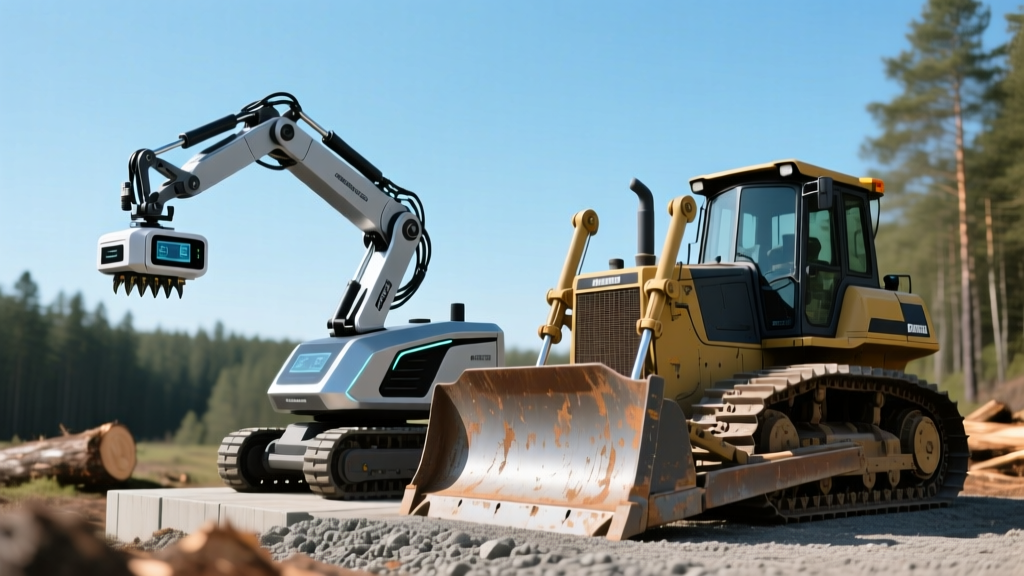
Remote-controlled carriers, such as the Green Climber LV 500 Pro or the Prinoth Raptor 300, are compact, low-center-of-gravity tracked platforms operated via line-of-sight radio telemetry. Their defining feature is modularity. Utilizing hydraulic quick-attach couplers (like the OilQuick OQ70 or Lehnhoff SQ70), a single base unit can swap between a heavy duty tree shear, a drum mulcher, a stump grinder, or a grapple saw in under 15 minutes. These machines typically operate in the 150 to 300 horsepower range and are engineered specifically for extreme inclines and confined urban-forest interfaces.
Traditional Cab-Operated Feller Bunchers
Conventional heavy duty tree cutting equipment, exemplified by the Tigercat 822E or John Deere 903M, features an integrated, enclosed operator cab and a dedicated boom-mounted cutting head (disk saw or shear). These machines excel in high-volume, production-level clearcutting on flat to moderate terrain. They offer superior hydraulic flow for continuous cutting cycles and massive fuel capacities for 12-hour shifts, but they lack attachment modularity and face severe safety restrictions on steep gradients.
Head-to-Head Specification & Cost Matrix
| Feature | Remote Modular Carrier (e.g., Green Climber LV 500) | Cab-Operated Feller Buncher (e.g., Tigercat 822E) |
|---|---|---|
| Base Unit Price (2026) | $165,000 - $190,000 | $550,000 - $680,000 |
| Attachment Cost | $35,000 - $65,000 per head | Integrated (Replacement heads: $25,000+) |
| Max Safe Operating Slope | 55 degrees (140% grade) | 35 degrees (without tethered winch-assist) |
| Hydraulic Flow (Aux) | 120 - 160 L/min | 400+ L/min (Dedicated pump systems) |
| Attachment Swap Time | 12 - 15 minutes | N/A (Fixed boom configuration) |
| Operator Safety Profile | Zero crush/strike risk (Remote operated) | High risk on slopes; requires ROPS/FOPS |
The Modularity Advantage: Quick-Attach Economics
The primary financial argument for remote-controlled systems lies in attachment versatility. A traditional feller buncher is a single-purpose asset. If a utility clearing contract requires felling trees, mulching the slash, and grinding stumps, a traditional fleet requires three separate dedicated machines.
With a modular remote carrier, the base power unit remains constant. Consider the hydraulic economics: modern remote carriers utilize load-sensing electro-hydraulic pumps that dynamically adjust flow to the attached implement. When swapping from a Nisula 425E tree shear (requiring 80 L/min for the rotator and tilt) to a Fecon FGT500 drum mulcher (requiring 150 L/min at high pressure), the carrier's onboard ECU automatically recalibrates the hydraulic relief valves and flow dividers via the remote control interface.
Fleet Utilization Insight: A single $180,000 remote carrier paired with three $45,000 attachments ($315,000 total capital expenditure) can execute the same multi-phase right-of-way clearing scope as a traditional fleet consisting of a feller buncher, a dedicated mulching tractor, and a stump grinder (often exceeding $1.2 million in combined capital costs). The trade-off is lower continuous production volume per hour.Terrain Limits and Safety Directives
When selecting heavy duty tree cutting equipment, terrain topography dictates the viable alternatives. According to safety directives published by the National Institute for Occupational Safety and Health (NIOSH), logging remains one of the most hazardous occupations, with machine rollovers on steep slopes accounting for a significant percentage of fatal incidents.
Traditional tracked feller bunchers rely on a high center of gravity to accommodate the operator cab, engine bay, and massive counterweights. Operating a standard cab-operated buncher beyond a 35-degree slope drastically increases the risk of lateral track slip and catastrophic rollover. While tethered winch-assist systems (like the EcoLog or TFW systems) can extend a cab machine's safe operating limit to 45 degrees, these systems add $120,000 to $150,000 to the machine's price and require a secondary anchor machine or massive ground anchors at the top of the slope.
Conversely, remote-controlled modular carriers are engineered with the engine and hydraulic pumps mounted millimeters from the ground. This ultra-low center of gravity, combined with an oscillating undercarriage that keeps the tracks flat on uneven bedrock, allows safe, untethered operation on slopes up to 55 degrees. Because the operator is standing safely at the top of the ridge or in a designated safe zone, the Occupational Safety and Health Administration (OSHA) strike-by and crush-by hazard parameters are virtually eliminated, fundamentally altering the site safety plan.
5-Year Total Cost of Ownership (TCO) Breakdown
Capital expenditure is only the entry point. Evaluating the 5-year TCO reveals distinct operational differences between the two equipment types.
- Insurance Premiums: Due to the elimination of the operator-in-cab risk, heavy equipment insurers typically offer a 15% to 22% reduction in liability and workers' compensation premiums for remote-operated forestry fleets compared to manual felling or cab-operated steep-slope logging.
- Fuel Consumption: A 300 HP cab-operated feller buncher idling and cutting typically burns 8 to 12 gallons of diesel per hour. A 200 HP remote modular carrier, utilizing auto-idle and load-sensing hydraulics, averages 4 to 6 gallons per hour. Over a 2,000-hour annual operating schedule, this yields a fuel savings of approximately $35,000 to $45,000 per year at current off-road diesel prices.
- Undercarriage Wear: Remote carriers operate with much lower ground pressure (often under 5 PSI). However, because they are frequently deployed on extreme, rocky inclines where cab machines cannot go, track and idler wear can be 20% higher. Budget an additional $8,000 annually for rubber track or steel pad replacements on remote units.
- Telemetry and Signal Loss: Remote equipment requires line-of-sight for radio telemetry. In dense, old-growth canopies or deep ravines, signal degradation can cause machine shutdowns. Investing in high-gain repeater antennas ($2,500) is a mandatory operational cost for remote fleets.
Fleet Allocation Decision Framework
Choosing between modular remote-controlled carriers and traditional heavy duty tree cutting equipment requires matching the machine to the specific contract profile. Use the following framework to guide your procurement strategy:
Deploy Remote-Controlled Modular Carriers When:
- Slope Exceeds 35 Degrees: The contract involves steep ravines, embankments, or mountainous right-of-way clearing where tethered winch systems are logistically impossible to anchor.
- Multi-Phase Scope: The project requires felling, mulching, and stump removal in sequential phases, and you want to minimize the mobilization costs of moving three separate machines to remote sites.
- Confined Urban-Wildland Interface: Working near high-voltage transmission lines, pipelines, or residential zones where operator proximity to falling timber or swinging booms presents unacceptable liability.
Deploy Cab-Operated Feller Bunchers When:
- High-Volume Production Clearcutting: The terrain is flat to moderate (under 30 degrees) and the primary metric of success is tons-per-hour or stems-per-hour. The continuous, high-flow hydraulic systems of a Tigercat or John Deere will out-produce a remote carrier by a factor of 3-to-1 in pure felling speed.
- Large Diameter Timber: The target biomass consists of mature hardwoods exceeding 24 inches in diameter. Remote carriers generally max out at 12-to-16 inch shearing capacity, whereas cab-operated disk saws can process 30+ inch trunks in a single cycle.
- Operator Retention is Not an Issue: You have access to highly skilled, veteran operators who prefer the tactile feedback and climate-controlled environment of a modern forestry cab over standing in the elements with a remote control harness.