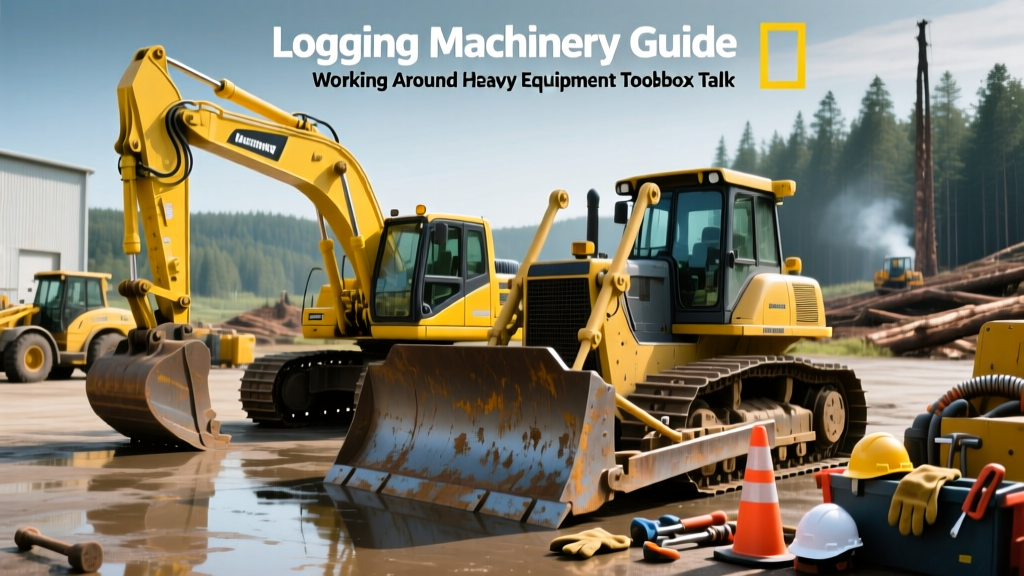
Logging Machinery Guide: Working Around Heavy Equipment Toolbox Talk
Procure forestry heavy machinery safely. This guide pairs logging equipment selection with a working around heavy equipment toolbox talk framework.
The Intersection of Fleet Procurement and Ground-Level Safety
Procuring forestry and logging heavy machinery requires evaluating more than just payload capacity, hydraulic flow, and horsepower. When investing upwards of $500,000 in a single feller buncher or track skidder, the return on investment is immediately negated if ground workers are injured due to poor fleet integration. In 2026, equipment selection must be directly tied to site safety protocols. This guide bridges the gap between buying forestry heavy machinery and executing a rigorous working around heavy equipment toolbox talk to ensure your new fleet operates without incident.
⚠️ Critical Safety Data: According to the OSHA 29 CFR 1910.266 Logging Operations Standard, struck-by and caught-in-between hazards account for the majority of severe ground-worker injuries in mechanized logging. Blind spots on modern 30-ton forwarders and high-speed dangle heads on feller bunchers demand strict spatial management.Core Forestry Fleet: Procurement Specs & Hazard Profiles
Before you can conduct an effective safety briefing, you must understand the specific mechanical hazards introduced by the equipment you are purchasing. Below is a breakdown of the primary logging machines, their 2026 market pricing, and their unique ground-level hazards.
1. Feller Bunchers (e.g., Tigercat 845D, John Deere 843M)
Feller bunchers are the apex predators of the logging site. Equipped with high-speed dangle heads or disc saws, they can process a tree in seconds. However, the tail swing of the upper carriage and the unpredictable trajectory of snapped branches (barber chairs) create massive danger zones. When specifying a new buncher, mandate factory-installed rear-view camera systems and polycarbonate mesh guarding on all cab windows to protect the operator, which in turn keeps their focus on ground workers.
2. Track Skidders (e.g., Caterpillar 525D, Tigercat 724G)
Skidders pull felled timber to the landing. The primary hazard for ground workers is the main winch cable. A snapped cable under 40,000 lbs of tension creates a lethal whip effect. When buying a skidder, opt for models with enclosed winch guards and synthetic winch lines where applicable, which drastically reduce the kinetic energy released during a failure.
3. Forwarders (e.g., Komatsu 931.1, Ponsse BuffaloKing)
Forwarders carry logs off the mountain. Their massive grapples and articulating chassis create severe pinch points. Ground workers assisting with load securement are frequently caught in the articulation joint when the machine reverses or turns. Purchasing forwarders with proximity radar (such as Orlaco RadarEye™ 77 GHz systems) is no longer optional for high-production crews.
| Equipment Type | 2026 Avg. Price Range | Primary Ground Hazard | Mandatory Safety Tech to Specify |
|---|---|---|---|
| Feller Buncher | $420,000 - $580,000 | Tail swing, flying debris | Brigade Backeye®360 cameras |
| Track Skidder | $310,000 - $450,000 | Cable snapback, blind spots | Enclosed winch drums, synthetic rope |
| Forwarder | $380,000 - $520,000 | Articulation crush zones | 77 GHz Proximity Radar, auto-braking |
Conducting the 'Working Around Heavy Equipment Toolbox Talk'
Once the iron is on the site, the procurement team must hand off the operational safety framework to the site supervisor. The working around heavy equipment toolbox talk should be conducted every morning before the first engine turns over. Use the following structured framework to ensure total crew comprehension.
Step 1: Delineate the 'Red Zone' and 'Drop Zone'
OSHA mandates specific safety distances, but site-specific talks must translate these into visual markers.
- The Red Zone (50 Feet): No ground worker may enter a 50-foot radius of any operating feller buncher, skidder, or forwarder without establishing positive communication.
- The Drop Zone (2 Tree Lengths / ~200 Feet): Per the OSHA Logging Operations eTool, manual fellers and ground workers must remain at least two tree lengths away from mechanized harvesting. If a 90-foot tree is being processed, the exclusion zone is 180 feet.
Step 2: Establish Positive Visual Contact (PVC)
Shouting over a 300-horsepower diesel engine is useless. The toolbox talk must enforce the PVC protocol:
- The ground worker approaches the Red Zone boundary and stops.
- The worker makes direct eye contact with the operator and raises both arms.
- The operator acknowledges by sounding the horn (one short blast) and physically placing the machine's controls in neutral/parking brake.
- Only after the machine is fully static does the ground worker cross into the zone.
Step 3: Review Machine-Specific Pinch Points
Do not give generic safety advice. Point directly to the machines on the site. For the forwarder, physically point out the articulation joint and the grapple rotation gear. For the skidder, identify the fairlead and the main drum. Remind the crew that hydraulic booms can drop instantly if a hose fails, meaning no one should ever walk under a suspended grapple, even if it appears empty.
💡 Pro-Tip for Supervisors: End the toolbox talk by having a junior crew member physically demonstrate the PVC protocol and identify the blind spots on the newest piece of equipment. Passive listening does not build muscle memory; active demonstration does.Mandating Safety Tech in Your 2026 Purchase Orders
When negotiating with dealers for John Deere, Tigercat, or Ponsse machinery, safety technology should be written into the purchase agreement as non-negotiable line items. Relying on aftermarket installations for critical safety systems often leads to wiring faults and voided warranties.
- FOPS and ROPS Certification: Ensure all cabs meet ISO 3471 (Roll-Over Protective Structures) and ISO 3449 (Falling Object Protective Structures) Level II standards. In steep-terrain logging, a Level II FOPS is required to withstand the impact of a 2,200 lb object dropped from 16 feet.
- Proximity Radar vs. Ultrasonic Sensors: Do not accept standard ultrasonic backup sensors for forestry equipment. Mud, snow, and heavy rain will cause false alarms, leading operators to mute the system. Specify 77 GHz radar systems (like Orlaco or Brigade) which penetrate environmental debris and accurately detect human heat/mass signatures.
- Auto-Idle and Boom Lockouts: Specify machines with seat-switch-activated boom lockouts. If the operator leaves the seat to clear a jam, the hydraulic boom must instantly lose travel function to prevent accidental crushing of ground workers.
Real-World Edge Cases & Failure Modes
Standard safety manuals rarely cover the catastrophic edge cases that occur in actual logging environments. Address these specific failure modes during your equipment selection and daily briefings.
High-Pressure Hydraulic Injection Injuries
Modern forestry equipment operates hydraulic systems at 4,000 to 5,500 PSI to power dangle heads and grapples. A pinhole leak in a hydraulic hose is invisible to the naked eye but acts like a high-pressure needle. If a ground worker uses their bare hand to check for a leak, the fluid will inject through the skin, causing severe tissue necrosis and potential amputation. Actionable rule: Ground workers must only ever use a piece of cardboard or wood to trace hydraulic lines for leaks. Never use hands.
Track Tension Blowouts on Steep Grades
When operating track skidders or harvesters on inclines exceeding 30%, the grease tensioners on the undercarriage are under immense stress. If a tensioner seal fails or a track link snaps, the track can violently unspool, whipping toward ground workers standing downhill. Actionable rule: Ground workers must never stand directly downhill of a tracked machine operating on a slope. Always approach from the uphill side or the lateral flanks, maintaining a 45-degree angle from the track path.
Finalizing the Fleet Integration Strategy
Buying heavy forestry equipment is a massive capital expenditure that demands a parallel investment in human safety infrastructure. By selecting machines equipped with modern radar, 360-degree vision, and certified protective structures, you eliminate the engineering hazards at the source. Pairing these procurement decisions with a strict, daily working around heavy equipment toolbox talk ensures that the crew understands the specific mechanical realities of the iron they are working alongside. Safety in the woods is not achieved through generic posters; it is achieved through precise machine knowledge, enforced spatial boundaries, and uncompromising communication protocols.