Underground Mining Types & Major Construction Equipment Manufacturers
Explore underground mining equipment maintenance schedules dictated by major construction equipment manufacturers, featuring LHD and haul truck service data.
The Crossover: Surface Engineering Meets Sub-Level Stoping
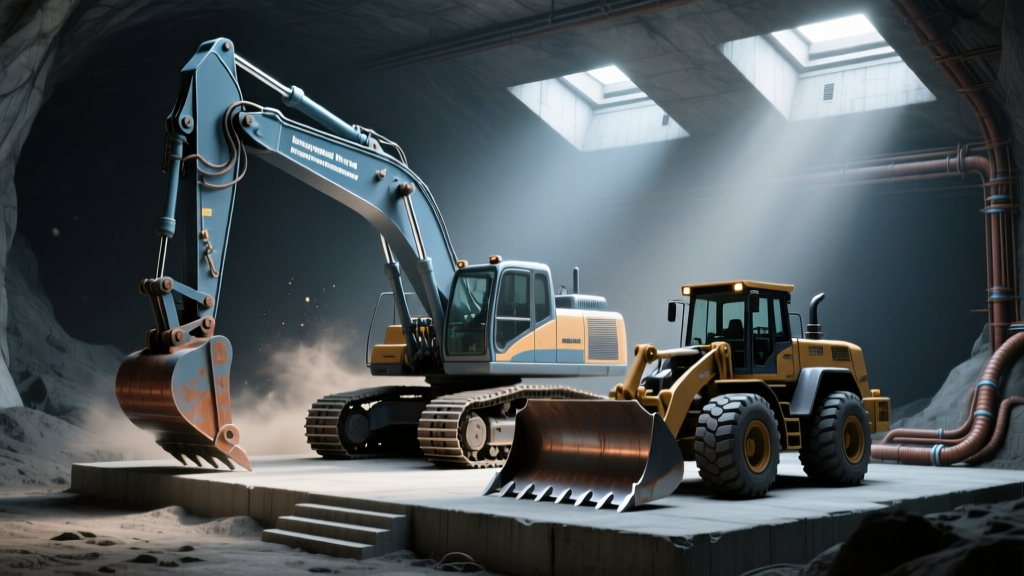
When major construction equipment manufacturers like Caterpillar and Komatsu adapt their surface earthmoving architectures for subterranean extraction, they fundamentally alter the maintenance paradigm. Underground mining equipment types—specifically Load-Haul-Dump (LHD) loaders, articulated haul trucks, and drill jumbos—operate in high-humidity, silica-dense, and thermally constrained environments. Consequently, the service schedules dictated by these major construction equipment manufacturers are not merely suggestions; they are strict operational baselines designed to prevent catastrophic drivetrain failures and subterranean fire hazards.
⚠️ Critical Ventilation Constraint: Unlike surface construction sites, underground maintenance bays must account for diesel particulate matter (DPM). Deferring engine oil changes on a Cat R2900 LHD by even 100 hours increases DPM emissions by up to 14%, directly impacting the mine's primary ventilation requirements and violating MSHA compliance thresholds.Primary Underground Equipment Types and Baseline Service Schedules
Understanding the specific maintenance cadences for core underground equipment types requires looking at the exact hour-intervals mandated by the OEMs. Below is a breakdown of the most critical subterranean assets and their service frameworks.
Load-Haul-Dump (LHD) Loaders
The LHD is the workhorse of sub-level stoping and drift development. Taking the Caterpillar R2900 (a 15-tonne capacity LHD) as the benchmark, major construction equipment manufacturers design these machines with heavy-duty planetary axles that require precise lubrication schedules. The standard 500-hour service interval focuses heavily on the powertrain and hydraulic tramming systems.
- Engine Oil: Cat DEO 15W-40 or equivalent API CK-4. Capacity: 45 liters. Interval: 500 hours.
- Hydraulic System: Cat HYDO Advanced 10. Interval: 2,000 hours, but fluid analysis is required at every 500-hour mark to check for ingressed stope muck.
- Axle Differentials: SAE 80W-90. Interval: 1,000 hours. Failure to change this fluid leads to planetary hub seizing, a repair that typically exceeds $18,000 in parts and underground labor.
Underground Articulated Haul Trucks
For high-production declines, trucks like the Cat AD60 (60-tonne payload) replace traditional surface rigid haulers. Because these machines navigate 1:7 gradients with fully loaded beds, their transmission and torque converter cooling systems endure immense thermal stress. Major construction equipment manufacturers mandate strict torque converter lockup clutch inspections every 1,500 hours to prevent slip-induced overheating, which can boil transmission fluid and trigger automatic machine deration.
Drill Jumbos and Roof Bolters
While pure-play mining OEMs like Epiroc and Sandvik dominate the drill jumbo space, major construction equipment manufacturers supply the carrier platforms and power packs. For hydraulic roof bolters (e.g., Cat RB225), the water flushing systems used for dust suppression require daily strainer cleaning. If the 100-mesh water filters are bypassed or ignored, drill steel gets stuck in the chuck, resulting in an immediate $2,400 repair bill and 4 hours of lost development time.
Comprehensive Service Interval Matrix: LHD Fleet Standard
The following matrix outlines the standard maintenance schedule for a 15-tonne class LHD operating in a hard-rock underground environment, reflecting the 2026 telemetry-integrated service standards.
| Service Interval | Primary Tasks | Estimated Cost (USD) | Machine Downtime |
|---|---|---|---|
| Daily (10 hrs) | Grease all boom/bucket pins, check tramming brake fluid, inspect fire suppression nozzles. | $45 (Consumables) | 45 mins |
| 250 Hours | Replace primary engine fuel filters, clean turbocharger air intake screens, sample coolant. | $320 | 2.5 hours |
| 500 Hours | Engine oil & filter, hydraulic return filters, adjust valve lash, inspect drive shaft U-joints. | $2,850 | 6 hours |
| 1,000 Hours | Axle differential oil change, brake cooling system flush, replace hydraulic pilot filters. | $4,500 | 10 hours |
| 2,000 Hours | Full hydraulic oil replacement, torque converter oil change, alternator/water pump rebuild. | $11,200 | 24 hours |
Fluid Specifications and Filtration Tolerances
Major construction equipment manufacturers engineer their underground powertrains around specific fluid viscosities. Substituting OEM-specified fluids with bulk generic alternatives is a primary cause of premature component failure in subterranean fleets.
For instance, the tramming hydraulics on modern LHDs operate at pressures exceeding 350 bar (5,000 psi). Using a standard AW46 hydraulic fluid instead of the specified high-zinc, high-VI (Viscosity Index) fluid like Cat HYDO Advanced 10 results in a 22% increase in internal pump leakage when the machine idles in hot, poorly ventilated crosscuts. Furthermore, hydraulic filtration must be maintained at a 10-micron absolute rating. Silica dust particles in underground environments are highly abrasive; allowing filter bypass valves to open due to clogged elements will score the tramming pump swash plates within 40 operating hours.
"The transition from surface construction to underground mining requires a fundamental shift in filtration philosophy. In a sub-level stope, the air is saturated with moisture and micro-particulates. We recommend dropping OEM air filter replacement intervals from 1,000 hours to 250 hours if the mine's primary ventilation airflow drops below 2.5 meters per second at the working face."
— Fleet Reliability Engineering Report, 2026
Predictive Maintenance: Moving Beyond the 500-Hour Interval
In 2026, the most advanced underground operations are no longer relying strictly on hour-based maintenance schedules. Major construction equipment manufacturers now integrate telematics and fluid-sensing nodes directly into the chassis of underground equipment types.
Systems like Cat MineStar Health monitor real-time parameters such as torque converter outlet temperature and hydraulic tank water content. If the water content sensor detects moisture levels exceeding 0.1% in the hydraulic reservoir—often caused by condensation in deep, humid shafts—the system automatically flags the machine for an offline centrifuge purification cycle, preventing the formation of acidic byproducts that destroy servo valves.
The Cost of Deferred Maintenance in Sub-Level Stoping
Deferring maintenance in underground mining carries a multiplier effect on costs compared to surface construction. Replacing a failed transmission on a surface wheel loader takes 8 hours with a crane. Performing the same swap on an AD45 underground truck in a 5-meter-high x 5-meter-wide drift requires specialized underground lifting rigs, extended rigging times, and halts all mucking traffic in the decline. The direct repair cost of $35,000 easily balloons to $110,000 when factoring in lost production tonnage and specialized underground labor rates.
Frequently Asked Questions
How do underground mining equipment types differ in maintenance from surface construction gear?
Underground equipment features heavily modified cooling packages, fire suppression systems (like Ansul A-101), and enclosed cabs with HEPA filtration. Maintenance requires specialized training for working in confined spaces and managing explosive atmospheres, which is heavily regulated by bodies like the NIOSH Mining Program.
Do major construction equipment manufacturers provide specific underground support?
Yes. Companies like Caterpillar and Komatsu maintain dedicated underground mining divisions. They provide specialized dealer support, including on-site rebuild facilities and underground-specific parts logistics, recognizing that pulling a machine to the surface for a major service is often economically unviable.
What is the most common cause of LHD hydraulic failure underground?
Water ingress into the hydraulic tank due to failing breather caps in high-humidity environments, combined with silica dust bypassing clogged return filters. This creates a grinding paste that destroys axial piston pumps within 150 hours of contamination.