Railroad Maintenance Equipment Types & JBC Heavy Equipment Specs
Explore technical specs of railroad maintenance equipment types, from 32-stone tampers to hi-rail jbc heavy equipment and track geometry cars.
The Mechanics of Trackbed Stability: Tamping Machines
Railroad track degradation is primarily a function of dynamic wheel loads, thermal expansion, and ballast fouling. To restore precise track geometry, modern tamping machines utilize a 3-point measurement system combined with high-frequency vibration. According to engineering guidelines published by Plasser & Theurer, a standard 32-stone continuous action tamping machine operates with a vibration frequency between 35 Hz and 50 Hz. The tines penetrate the ballast and apply a squeeze pressure of 120 to 150 kN, consolidating the crushed rock beneath the sleepers (ties) without fracturing the aggregate.
Modern units like the Plasser & Theurer 09-3X Dynamic feature integrated dynamic track stabilizers. These stabilizers apply a controlled horizontal vibration (typically 30-35 Hz) and a vertical downward force of up to 120 kN, simulating the passage of a 100,000-lb freight car. This allows trains to run at line speed immediately after maintenance, eliminating costly slow-order restrictions.
Operational Tolerance Warning: Under FRA Track Safety Standards (49 CFR Part 213), Class 6 track (high-speed passenger) requires cross-level tolerances of just 0.25 inches over 62 feet. Automated tamping systems must be calibrated daily using laser-photogrammetry to prevent over-lifting, which can induce harmonic roll in passenger rolling stock.Ballast Regulators and Right-of-Way Management
Following tamping, excess ballast must be redistributed to maintain structural integrity. Ballast regulators utilize center plows (up to 16 feet wide) and wing plows to sweep excess stone from the track center to the shoulders. The shoulder ballast is then shaped to a precise 3:1 or 4:1 slope to ensure proper drainage, preventing water from pooling and softening the subgrade.
Integrating JBC Heavy Equipment for Hi-Rail Operations
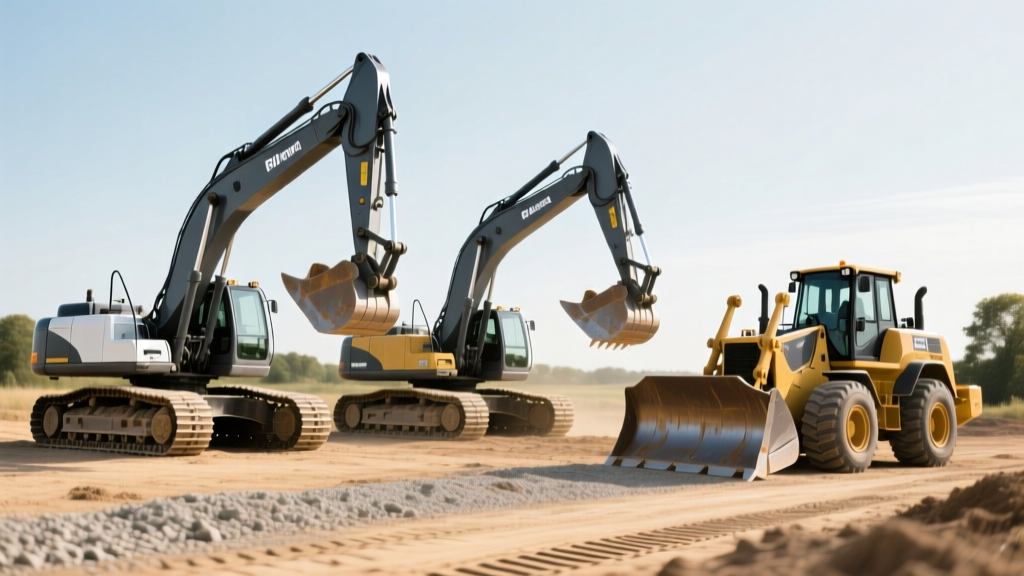
While dedicated track machines handle the rails, right-of-way (ROW) clearance, drainage ditching, and shoulder ballast management frequently rely on specialized jbc heavy equipment configurations. In 2026, contractors heavily utilize jbc heavy equipment hi-rail excavator conversions. These units feature heavy-duty flange-lubrication systems, hydraulic lock-ups for the guidance wheels, and auxiliary hydraulic flows exceeding 150 GPM to run rotary ditchers and brush-cutting mulchers. When evaluating jbc heavy equipment for ROW maintenance, ensure the base carrier possesses a minimum 25-ton counterweight capacity to offset the lateral reach required for deep drainage ditching alongside live tracks.
Rail Grinding: Restoring the Wheel-Rail Interface
Rail surface fatigue, including rolling contact fatigue (RCF) and corrugation, compromises the wheel-rail interface and accelerates wheel wear. High-speed rail grinders utilize multiple grinding stones (typically 48 to 96 stones per machine) spinning at 1,800 RPM.
- Material Removal: 0.1 mm to 0.3 mm of rail head metal per pass.
- Operating Speed: 3 to 15 mph during active grinding; up to 60 mph in transit.
- Sensor Tech: Optical and acoustic sensors measure spark intensity to adjust stone pressure in real-time, preventing thermal damage to the rail martensite layer.
Spike Pullers and Tie Inserters
When trackbed rehabilitation requires complete tie replacement, spike pullers and tie inserters take over. Modern spike pullers utilize hydraulic jaws generating up to 40,000 lbs of vertical extraction force per jaw, capable of removing cut spikes and screw spikes without damaging the tie plate. Tie inserters use specialized clamping mechanisms to slide new hardwood or composite ties into the rail seat. The hydraulic push-pull arms operate with a lateral force of 15,000 lbs, requiring precise alignment to avoid bending the rail web during the extraction and insertion cycle.
Comparative Technical Specifications Matrix
| Equipment Type | Primary Function | Key Technical Spec | 2026 Avg. Capital Cost |
|---|---|---|---|
| 32-Stone Tamper | Track alignment & ballast consolidation | 120-150 kN squeeze pressure | $3.8M - $5.5M |
| Ballast Regulator | Stone distribution & shoulder shaping | 16-ft center plow width | $1.2M - $1.8M |
| 96-Stone Grinder | RCF removal & profile restoration | 1,800 RPM / 0.3mm removal | $8.5M - $12.0M |
| JBC Hi-Rail Excavator | ROW clearance & drainage ditching | 150+ GPM auxiliary flow | $650K - $950K |
| Track Geometry Car | Defect detection & compliance logging | 250mm laser sampling rate | $4.0M - $6.5M |
Track Geometry Cars: The Diagnostic Backbone
Maintenance scheduling is dictated by track geometry cars. These vehicles do not alter the track; they measure it. Using inertial measurement units (IMUs), Linear Variable Differential Transformers (LVDTs), and laser-photogrammetry, they sample track conditions at 250 mm intervals while traveling at line speeds up to 125 mph.
Key parameters measured include gauge, cross-level, alignment, profile, and twist. LVDTs measure gauge spread with an accuracy of 1/32nd of an inch, ensuring the 56.5-inch standard gauge remains within FRA Part 213 compliance limits. When a geometry car detects a twist fault exceeding thresholds, it automatically drops a GPS-tagged defect marker, dispatching a tamper to the exact coordinate. In 2026, the integration of machine-learning algorithms allows these cars to predict ballast fouling rates based on micro-settlement patterns, shifting maintenance from reactive to predictive.
Maintenance Cycles and Component Depreciation
Procuring railroad maintenance equipment requires a strict understanding of wear-component lifecycles. Tamping tines, for instance, are subject to extreme abrasive wear from quartz-heavy ballast. Standard forged steel tines require replacement every 400 to 600 operating hours. Upgrading to tungsten-carbide overlay tines increases upfront costs by 40% but extends service life to 1,200 hours, drastically reducing machine downtime.
Similarly, rail grinding stones must be matched to the specific metallurgy of the rail. Harder head-hardened rails require softer, more friable grinding stones to maintain the 1,800 RPM cutting efficiency without glazing the stone surface. Fleet managers must track stone consumption rates per mile, which typically range from 0.5 to 1.2 stones per mile depending on the severity of the RCF being treated.