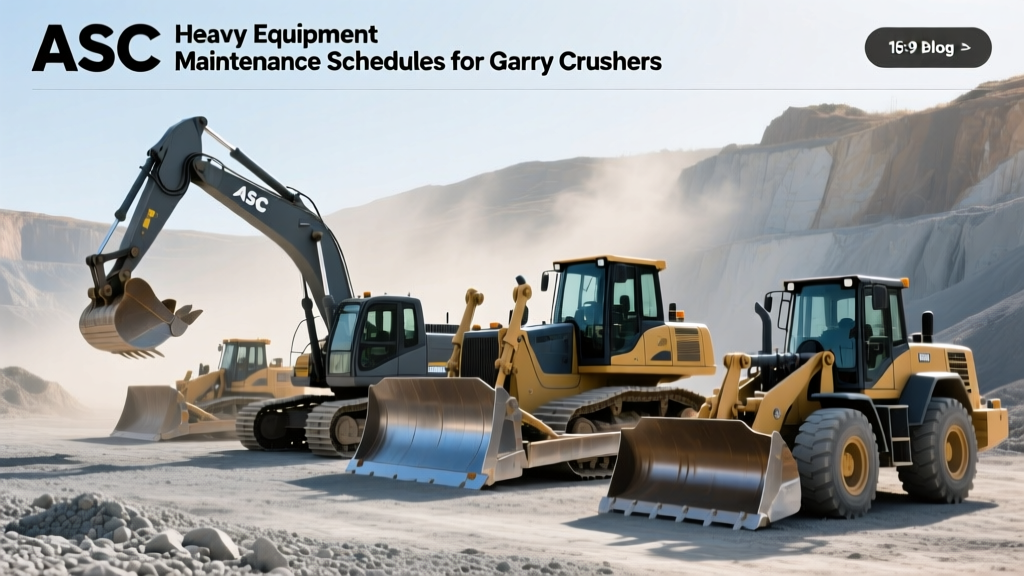
ASC Heavy Equipment Maintenance Schedules for Quarry Crushers
Optimize your ASC heavy equipment fleet with precise maintenance schedules for quarry crushers, screeners, and conveyors to reduce downtime.
Quarry environments subject machinery to severe shock loads, high-silica dust, and continuous vibration. Standard OEM manuals often fail to account for the extreme abrasion encountered when processing hard rock like quartzite or granite. For fleet managers overseeing ASC heavy equipment (Advanced System Control integrated machinery), relying on baseline 500-hour service intervals is a proven recipe for catastrophic bearing failure and unplanned downtime. This guide details the exact, field-proven maintenance schedules for jaw crushers, cone crushers, and vibrating screens operating in high-tonnage aggregate processing facilities.
The 250-Hour vs. 500-Hour Grease Interval Reality
Most OEM manuals for heavy crushing equipment recommend greasing main bearings and pitmans every 500 operating hours. In a controlled, low-dust environment, this is sufficient. However, in an open-pit quarry processing high-silica aggregates, microscopic quartz particles rapidly infiltrate labyrinth seals and degrade standard lithium-complex greases.
Field data from high-production aggregate sites dictates a strict reduction to 250-hour grease intervals for all primary jaw crusher pitman bearings and cone crusher countershaft boxes. Furthermore, the choice of lubricant is critical. Standard NLGI #2 greases will channel and fail under the high-vibration loads of a 42x48 jaw crusher. Transitioning to a specialized adhesive grease like Kluberplex AG 11-461 or Mobilith SHC 100 provides the necessary film strength and resistance to water washout during wet processing cycles.
WARNING: Automatic Lubrication System (ALS) CloggingIf your ASC heavy equipment fleet utilizes automated single-line parallel lubrication systems, silica dust mixed with moisture creates a concrete-like paste at the injector nozzles. Inspect all secondary divider valves weekly. A single blocked injector will starve the corresponding bearing, leading to a $25,000+ bearing replacement within 40 hours of operation.
Component-Specific Maintenance Matrix
The following matrix outlines the adjusted service intervals required for aggregate processing equipment operating in severe-duty quarry applications. These schedules supersede standard OEM baselines.
| Component | Standard OEM Interval | Quarry-Specific Interval | Specification / Fluid | Action Required |
|---|---|---|---|---|
| Jaw Crusher Toggle Plate | Daily Visual | Daily + 50-hr Torque | N/A | Retorque tension bolts to 450 ft-lbs; check for tramp iron damage. |
| Cone Crusher Countershaft | 500 Hours | 250 Hours | Kluberplex AG 11-461 | Purge old grease until fresh grease exits the labyrinth seal. |
| Vibrating Screen Exciter | 1,000 Hours | 500 Hours | Mobilgear 600 XP 220 | Drain and refill; check magnetic plug for brass/bronze shavings. |
| Radial Stacker Gearbox | 2,500 Hours | 1,000 Hours | ISO 18/16/13 Target | Sample oil; deploy kidney-loop filter if particle count exceeds limits. |
Vibrating Screen Deck Tensioning and Bearing Thermography
Vibrating screens are the bottleneck of most aggregate circuits. A screen operating with improper deck tension or failing bearings will rapidly degrade product spec and cause structural fatigue to the side plates. Modern ASC heavy equipment telemetry often tracks motor amperage, but it cannot detect localized bearing spalling or screen panel blinding.
Bearing Temperature Thresholds
Standard spherical roller bearings will operate at 140°F to 160°F under normal vibration loads. However, heavy-duty screens utilizing specialized bearings (such as the SKF Explorer VA991 series designed specifically for vibrating applications) can safely sustain temperatures up to 185°F (85°C).
- Baseline Recording: Use a FLIR thermal imaging camera to record baseline temperatures on all four bearing housings during the first 50 hours of operation after a rebuild.
- The 15-Degree Rule: If any single bearing housing spikes 15°F above its baseline, or 15°F above the opposing bearing on the same shaft, halt operations immediately. This indicates uneven load distribution, typically caused by a broken screen deck cross-member or severe panel blinding.
When processing highly abrasive river gravel, 1-inch thick polyurethane screen panels on the top deck will typically yield 1,800 to 2,200 operating hours before the aperture degrades beyond 5% tolerance. Woven wire in the same application will fail in 400 hours. Factor this $4,500 panel replacement cost into your annual operating budget rather than reacting to off-spec aggregate stockpiles.
ASC Telemetry and Motor Amperage Tracking
Integrating ASC heavy equipment dashboards into your daily maintenance workflow transforms reactive repairs into predictive maintenance. For a standard Metso Nordberg HP400 cone crusher, the main drive motor is typically rated for 315 kW (420 hp).
By monitoring the real-time kW draw via the ASC interface, maintenance teams can detect chamber packing before the crusher stalls. If the motor amperage consistently draws above 290 kW (roughly 92% load) during steady-state feeding, the crushing chamber is likely packed with fines, or the closed-side setting (CSS) has drifted due to liner wear. According to safety and operational guidelines highlighted by the NIOSH Machine and Device Safety division, ignoring these telemetry warnings frequently leads to catastrophic drive belt failures and severe flyrock hazards during unjamming procedures.
Decision Framework: Rebuild vs. Replace the Eccentric Assembly
When vibration analysis confirms eccentric assembly wear on a 45-inch cone crusher, site managers face a critical financial decision. Use this framework to determine the most cost-effective route:
- Inspect the Head and Mantle Seating: If the machined seating surfaces show less than 0.005 inches of runout and no fretting corrosion, proceed with an in-house rebuild.
- Cost of Rebuild: Replacing the eccentric bushing, counterweight guards, and seals in-house costs approximately $12,000 to $15,000 in parts and requires 16 man-hours.
- Cost of Replacement: Purchasing a factory-remanufactured exchange assembly costs between $38,000 and $45,000, plus freight.
- The Tipping Point: If the main shaft shows any microscopic cracking (verified via magnetic particle inspection) or if the head seating runout exceeds 0.010 inches, do not rebuild. The risk of catastrophic failure at 1,200 RPM warrants the $45,000 replacement. Industry safety advocates like the National Stone, Sand & Gravel Association (NSSGA) consistently emphasize that structural fatigue in high-speed rotating assemblies is a leading cause of fatal quarry incidents.
Fluid Analysis: The True Indicator of Drivetrain Health
Changing gearbox oil based strictly on calendar time or operating hours is an outdated practice that wastes capital and masks underlying mechanical issues. Implementing a strict fluid analysis program is mandatory for modern aggregate processing plants.
For crusher gearboxes and radial stacker drives utilizing Mobilgear 600 XP 220, the target ISO cleanliness code is 18/16/13. This code represents the number of particles per milliliter greater than 4µm, 6µm, and 14µm, respectively.
- Silica Ingress: A spike in the 4µm particle count (e.g., moving from 18 to 21) almost always indicates a failing breather cap allowing silica dust into the gearbox. Replace standard breathers with desiccant-style breathers featuring a 3-micron absolute filter.
- Water Contamination: If the Karl Fischer water content test returns a value above 500 ppm, the oil's load-carrying capacity is compromised. Deploy an offline kidney-loop filtration system equipped with a vacuum dehydrator to strip moisture before it causes hydrogen-induced spalling on the gear teeth.
- Wear Metals: An increase in iron (Fe) particles exceeding 50 ppm over the previous sample indicates active gear or bearing wear. Cross-reference this with copper (Cu) and lead (Pb) levels to isolate whether the wear is originating from the bronze eccentric bushing or the main roller bearings.
By abandoning generic OEM schedules and adopting these aggressive, quarry-specific maintenance protocols, fleet managers can extend the operational lifespan of their primary crushers and screens by up to 30%, ensuring that the heavy equipment telemetry data translates directly into higher margins and safer site conditions.