Snow Fleet Transport: DOT Tie Down Requirements for Heavy Equipment
Learn DOT tie down requirements for heavy equipment transport alongside critical winter maintenance schedules for snow removal fleets and loaders.
Pre-Transport Winterization & Hydraulic Lock-Outs
Relocating snow removal heavy equipment—such as Oshkosh H-Series airport snowblowers, Caterpillar 950 GC wheel loaders with snow pushers, and John Deere 872 motor graders—between municipal depots or regional contractor sites requires precise coordination. Transporting these machines is not merely a logistics task; it is an extension of the equipment's maintenance schedule. Before any machine is loaded onto a lowboy or step-deck trailer, specific winterization and lock-out protocols must be executed to prevent catastrophic hydraulic failures or structural shifting during transit.
For articulated wheel loaders utilized in snow removal, the articulation joint must be mechanically locked. Relying solely on hydraulic pressure to maintain the steering angle during transport is a critical failure point. Temperature fluctuations on the road can cause hydraulic fluid contraction, leading to unexpected articulation swing that can snap tie-down chains or shift the machine's center of gravity. Maintenance crews must install the factory articulation lock pin and secure it with a hardened steel retainer bolt torqued to the manufacturer's specification (typically 250–300 lb-ft for mid-sized loaders).
Additionally, all exposed hydraulic cylinders controlling snow wings, plow lifts, and blower chutes must be fully retracted or mechanically pinned. Exposed chrome cylinder rods are highly susceptible to pitting from road salt spray kicked up by the transport truck. If a cylinder must remain extended to accommodate a specific trailer configuration, the rod must be wrapped in a heavy-duty, UV-resistant neoprene sleeve and coated with a synthetic, sub-zero rated rust inhibitor.
Decoding DOT Tie Down Requirements for Heavy Equipment
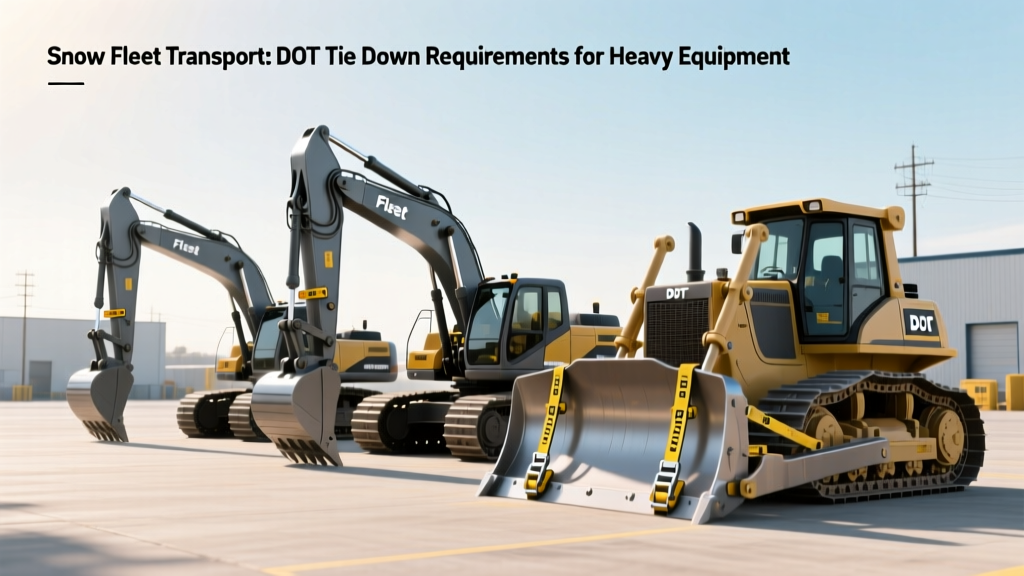
Compliance with federal transport regulations is non-negotiable when moving multi-ton winter maintenance assets. The Federal Motor Carrier Safety Administration (FMCSA) mandates strict cargo securement rules under 49 CFR Part 393, Subpart I. Understanding the DOT tie down requirements for heavy equipment is essential for fleet managers to avoid severe fines, out-of-service (OOS) orders, and catastrophic load shifts.
The foundational rule for heavy machinery transport is the Aggregate Working Load Limit (WLL). The combined WLL of all tie-down devices used to secure an article of cargo must be at least 50% of the equipment's total weight. For example, if you are transporting a 44,000 lb motor grader equipped with a front snowplow and underbody scraper, the aggregate WLL of your chains and binders must equal or exceed 22,000 lbs.
WARNING: FMCSA Enforcement & PenaltiesDuring winter months, DOT enforcement agencies conduct targeted inspections on heavy haulers moving snow removal fleets. Violations for inadequate WLL or missing edge protectors on snowplow moldboards routinely result in fines ranging from $300 to over $5,000 per violation, alongside immediate OOS orders that delay critical storm-response deployments.
When selecting tie-down hardware, fleet managers must reference the National Association of Chain Manufacturers (NACM) standards. Grade 70 transport chain is the industry baseline, but Grade 80 or Grade 100 alloy chains are increasingly preferred for heavy snow equipment due to their higher WLL-to-weight ratio, which reduces the physical strain on operators handling the chains in freezing conditions.
Equipment-Specific Securement & Service Matrix
Different classes of snow removal equipment present unique securement challenges and require specific pre-transit maintenance checks. The matrix below outlines the operational parameters for common winter fleet assets.
| Equipment Type | Approx. Weight | Min. Aggregate WLL | Chain Configuration (Grade 70) | Critical Pre-Transit Maintenance |
|---|---|---|---|---|
| Wheel Loader (e.g., Cat 950 GC w/ Pusher) | 42,000 lbs | 21,000 lbs | Four 3/8" chains (6,600 lbs WLL each) | Lock articulation pin; retract pusher lift cylinders; check bucket linkage grease. |
| Motor Grader (e.g., JD 872 w/ Plow) | 44,000 lbs | 22,000 lbs | Four 1/2" chains (11,300 lbs WLL each) | Lower moldboard to deck; lock circle turn mechanism; pin wing hinges. |
| Airport Snowblower (e.g., Oshkosh H-Series) | 55,000 lbs | 27,500 lbs | Six 1/2" chains (total 67,800 lbs WLL) | Lower discharge chute; lock auger drive; secure cab tilt mechanism. |
| Skid Steer (e.g., Bobcat T870 w/ Blower) | 12,500 lbs | 6,250 lbs | Two 3/8" chains & two binders | Lower attachment to deck; engage parking brake; remove auxiliary hydraulic quick-disconnects. |
Managing Overhang: Snow Wings, Pushers, and Blower Chutes
Snow removal equipment rarely conforms to standard rectangular footprints. Motor grader snow wings, massive containment snow pushers, and airport blower discharge chutes create significant overhang and irregular weight distributions. DOT regulations require that any attachment not permanently fixed to the primary machine must be secured independently or integrated into the primary securement system with calculated WLL adjustments.
- Snow Pusher Containment Boxes: Large rubber-edged containment pushers mounted on wheel loaders act as massive wind sails during highway transport. The lift arms must be lowered completely to the trailer deck, and a dedicated cross-chain must be routed over the top of the pusher box to prevent vertical bouncing, which can fatigue the loader's Z-bar linkage.
- Motor Grader Wings: Hydraulic snow wings must be folded into their transport position and secured with both the hydraulic lock valves and physical steel safety pins. Relying on hydraulic holding valves alone is a violation of securement best practices, as micro-leaks in aging valve spools will cause the wing to deploy on the highway.
- Blower Chutes: The discharge chute on heavy snowblowers must be lowered to its minimum travel position and pinned. If the chute extends beyond the trailer's rear bumper by more than 4 feet, federal law mandates the attachment of oversized load flags and, during low-light winter transit, specialized LED overhang markers powered by an independent battery pack to prevent drain on the snowblower's primary electrical system.
Post-Transport Service Schedules & Torque Verification
The maintenance cycle does not end when the equipment is unloaded. Highway transport subjects heavy machinery to high-frequency, low-amplitude vibrations that differ vastly from operational shock loads. These transit vibrations are notorious for backing out fasteners on snowplow mounting hardware and loosening undercarriage tensioners on tracked snow tractors.
Fastener Torque Specifications
Upon arrival at the deployment site, maintenance technicians must execute a post-transport torque verification protocol before the machine is dispatched to a snow route:
- Moldboard Mounting Bolts: Re-torque all A-frame and moldboard pivot bolts. For standard 1-inch Grade 8 bolts used on municipal plow hitches, the target torque is typically 450–500 lb-ft.
- Track Tension (Tracked Loaders/Tractors):strong> Vibrations can cause track tension cylinders to settle. Verify track sag is within the manufacturer's 1.5 to 2.5-inch specification before operating in deep snow, where a thrown track will result in hours of recovery time in sub-zero conditions.
- Hydraulic Quick-Disconnects: Inspect all auxiliary hydraulic couplers used for snow attachments. Transit dust and road grime can infiltrate exposed coupler faces. Flush with clean, low-viscosity hydraulic solvent before reconnecting to prevent valve spool scoring.
Fleet Manager Insight: Implementing a mandatory 'Post-Transit' checklist in your CMMS (Computerized Maintenance Management System) reduces mid-storm breakdowns by up to 18%. Tracking the exact transit miles and subsequent torque checks ensures warranty compliance on specialized winter attachments.
Heavy Equipment Transport FAQ
Do I need edge protectors when chaining down a steel snowplow?
Yes. While the snowplow moldboard is steel, the sharp cutting edges and hardened steel trip-arms can act as shearing points against Grade 70 transport chains under high tension. FMCSA regulations require edge protection whenever a tie-down device is subject to abrasion or cutting. Use heavy-duty polymer or steel corner protectors designed for flatbed securement to preserve the chain's WLL and prevent catastrophic snapping.
How does extreme cold affect chain and binder tension?
Steel contracts in extreme cold. A chain tensioned at 40°F in a maintenance bay will experience increased tensile stress when exposed to 0°F highway temperatures during a winter storm deployment. Conversely, binders can freeze solid if packed with snow and ice. Always use lever binders with anti-ice guards or ratchet binders, and apply a dry-film PTFE lubricant to the binder threads to prevent freezing while avoiding the accumulation of abrasive road grit.
Can I use synthetic ratchet straps instead of chains for snow removal equipment?
While heavy-duty synthetic straps (e.g., 20,000 lb WLL polyester) are legal for certain heavy loads, they are highly discouraged for primary securement of snow removal equipment. The sharp edges of snowplow blades, the abrasive nature of salt-caked undercarriages, and the risk of cutting the webbing during loading/unloading make Grade 70+ steel chains the only reliable choice for winter fleet transport.