Best Paint for Heavy Equipment in Underground Mining: Cost Guide
Analyze the true cost of the best paint for heavy equipment in underground mining. Compare epoxy, polyurethane, and zinc systems for LHDs and jumbos.
The Hidden Economics of Subterranean Coating Failure
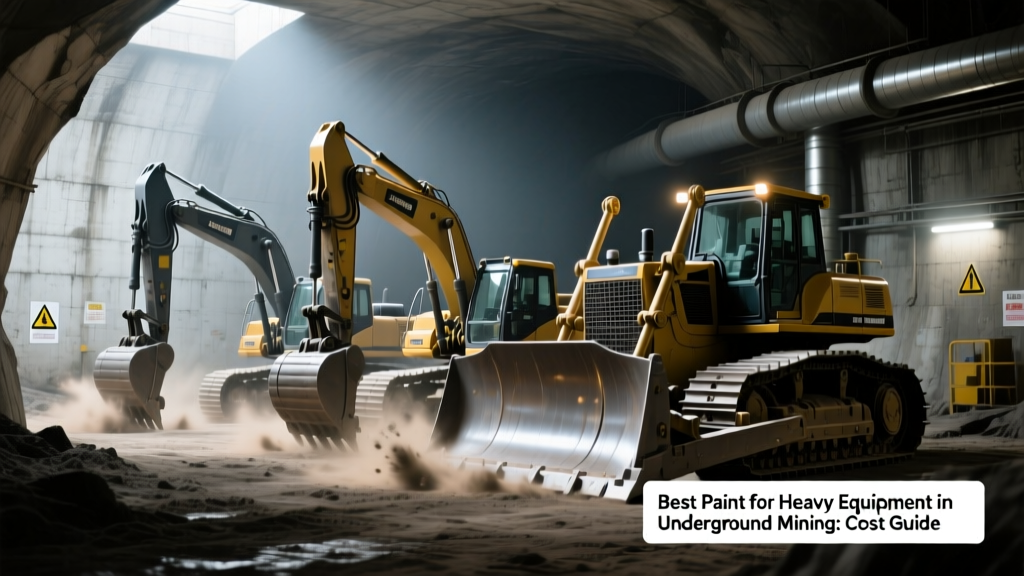
Underground mining environments subject heavy machinery to a unique triad of coating destroyers: high ambient humidity, acidic groundwater (often pH 3.5 to 5.0), and continuous high-impact rock abrasion. When fleet managers search for the best paint for heavy equipment operating below the surface, the initial material cost per gallon is often the wrong metric to evaluate. The true cost analysis must account for surface preparation labor, application downtime, and the financial impact of premature structural degradation.
Standard OEM alkyd enamels typically fail within 14 to 18 months in active subterranean stopes. This failure leads to 'rust jacking'—where expanding iron oxides exert up to 10,000 psi of pressure, compromising structural welds on articulated joints and hydraulic cylinder mounts. Budgeting for a premium industrial coating system is not merely an aesthetic choice; it is a critical asset preservation strategy that directly impacts total cost of ownership (TCO).
Budgeting Rule of Thumb: For every $1 spent on premium subterranean coating materials (zinc-rich primers and polysiloxane topcoats), expect to spend $3.50 to $5.00 on proper surface preparation (SSPC-SP10 Near-White Metal Blast). Cutting the prep budget to afford better paint will result in 100% coating failure within 24 months.Coating Systems Matrix: Cost vs. Subterranean Lifespan
To determine the most financially sound coating strategy for your fleet, we must compare the three primary chemical systems used in heavy mining equipment. The following matrix outlines material costs, required dry film thickness (DFT), and expected service life in active hard-rock mining conditions.
| Coating System | Material Cost (Per Gallon) | Target DFT (Mils) | Expected Lifespan | 5-Year ROI Profile |
|---|---|---|---|---|
| Standard Alkyd Enamel | $45 - $65 | 3.0 - 4.0 | 12 - 18 Months | Negative (Requires 3x recoats) |
| 2-Part Polyamide Epoxy | $95 - $130 | 6.0 - 8.0 | 3 - 4 Years | Neutral (Good for low-abrasion zones) |
| Zinc Primer + Polysiloxane | $180 - $245 (Blended) | 8.0 - 12.0 | 7 - 10 Years | Highly Positive (Zero mid-life recoats) |
According to guidelines published by the Society for Protective Coatings (SSPC), the polysiloxane topcoat provides superior UV and chemical resistance, but in underground environments, its primary value lies in its extreme hardness and abrasion resistance against muck and shotcrete blowback.
Equipment-Specific Budget Planning
A blanket coating budget for an entire underground fleet is inefficient. Different underground mining equipment types experience distinct wear patterns, requiring targeted coating allocations.
1. Load-Haul-Dump (LHD) Loaders
Equipment like the Sandvik LH518B or Caterpillar R1700 faces severe abrasion on the bucket edges and articulation points.
- Budget Strategy: Do not waste expensive polysiloxane topcoats on the interior of the bucket or the cutting edge, as these are sacrificial wear zones. Apply a high-build, abrasion-resistant epoxy novolac (e.g., Sherwin-Williams Sher-Plate) to the bucket exterior and boom arms.
- Cost Allocation: Budget $1,200 - $1,500 per LHD specifically for articulation joint sealing and flexible polyurethane coatings that resist cracking during 40-degree steering articulation.
2. Drill Jumbos and Roof Bolters
Machines like the Epiroc Boomer 282 operate in wet, newly blasted faces where acidic groundwater drips continuously onto the mast and hydraulic hoses.
- Budget Strategy: Prioritize galvanic protection. A zinc-rich primer (such as PPG DIMETCOTE) is non-negotiable for the boom and mast structures. If the topcoat chips from rock fall, the zinc sacrifices itself to protect the underlying steel.
- Cost Allocation: Allocate 30% of the jumbo coating budget to high-visibility, high-gloss topcoats. The CDC NIOSH Mining Program emphasizes that equipment visibility is directly tied to collision avoidance in low-lux subterranean environments. Bright safety yellow or orange polysiloxanes retain their gloss and reflectivity far longer than standard epoxies, which chalk and fade within months.
3. Battery-Electric Vehicles (BEVs)
The rapid adoption of BEVs, such as the Sandvik Artisan Z50 haul truck, introduces new thermal management variables. Battery enclosures and thermal management housings require coatings that do not act as thermal insulators. Standard thick-film epoxies can trap heat. Budget for specialized thermally conductive ceramic-reinforced coatings for battery housings, which typically carry a 20% premium over standard industrial topcoats but prevent battery derating due to thermal throttling.
Pro-Tip for Fleet Managers: When specifying the best paint for heavy equipment to OEMs or third-party fabricators, mandate that all internal structural box sections (like boom arms) receive a wax-based corrosion inhibitor (e.g., LPS 3 or equivalent) via flood-coating before final assembly. This prevents internal-out rusting, which no exterior coating can stop.Surface Preparation: The True Budget Driver
The most expensive polysiloxane topcoat will delaminate in weeks if applied over poorly prepared steel. In underground mining equipment maintenance shops, the bottleneck is rarely paint application; it is abrasive blasting.
"Fleet operators frequently attempt to save $2.00 per square foot by specifying an SSPC-SP6 (Commercial Blast) instead of an SSPC-SP10 (Near-White Blast). In the acidic, high-humidity environment of a hard-rock mine, that $2.00 savings will result in under-film corrosion that costs upwards of $15.00 per square foot to remediate once the machine is pulled from production." — Industrial Coatings Engineering Consensus
When planning your annual maintenance budget, use the following labor and material estimations for a standard 25-ton underground haul truck (approx. 850 sq. ft. of coatable surface area):
- SSPC-SP10 Blasting Labor: $3.50 - $4.50 / sq. ft. ($2,975 - $3,825 total)
- Media (Steel Grit / Garnet): $0.80 / sq. ft. ($680 total)
- Primer & Topcoat Material: $1.20 / sq. ft. ($1,020 total)
- Application Labor (Airless Spray): $1.50 / sq. ft. ($1,275 total)
Total Recoating Budget per Haul Truck: $5,950 to $6,800. While this figure may cause sticker shock compared to a $1,500 'roll-and-brush' alkyd touch-up, the premium system guarantees 7+ years of service, effectively removing the haul truck from the coating maintenance ledger for the remainder of its operational life.
Frequently Asked Questions: Mining Coating Economics
Can we use standard automotive or agricultural equipment paint on underground LHDs?
No. Agricultural and standard automotive coatings are designed for atmospheric UV resistance and cosmetic gloss retention. They lack the high-build thickness (8+ mils DFT) and chemical resistance required to withstand acidic mine water (pH < 5.0) and the continuous impact of abrasive muck. Using these coatings will result in failure within 6 months, wasting 100% of the material and labor budget.
How does ventilation affect coating selection and budget?
Underground ventilation constraints heavily dictate your budget. Solvent-based epoxies and polyurethanes emit high levels of VOCs, requiring the mine to shut down ventilation in specific zones or halt production to prevent toxic gas accumulation in the air stream. To avoid production downtime (which costs thousands of dollars per hour), budget for 100% solids epoxy or water-based acrylic polyurethanes. These materials carry a 15-25% higher upfront material cost but eliminate the need for costly auxiliary ventilation setups and production delays.
What is the most cost-effective high-visibility color for underground equipment?
While safety yellow is standard, it shows hydraulic fluid leaks and grease stains immediately, leading to unnecessary and costly 'cosmetic' wash-downs. Many modern mining operations are shifting to high-visibility orange or fluorescent green topcoats for the main chassis, paired with reflective striping. This maintains NIOSH visibility standards while extending the time between required aesthetic wash-downs, saving roughly 12 hours of labor per machine, per month.