Training on Different Types of Heavy Equipment: Airport GSE Guide
Master operator training for airport ground support equipment. Learn best practices for towbarless tractors, belt loaders, and de-icing rigs.
The High-Stakes Environment of Airport Ramp Operations
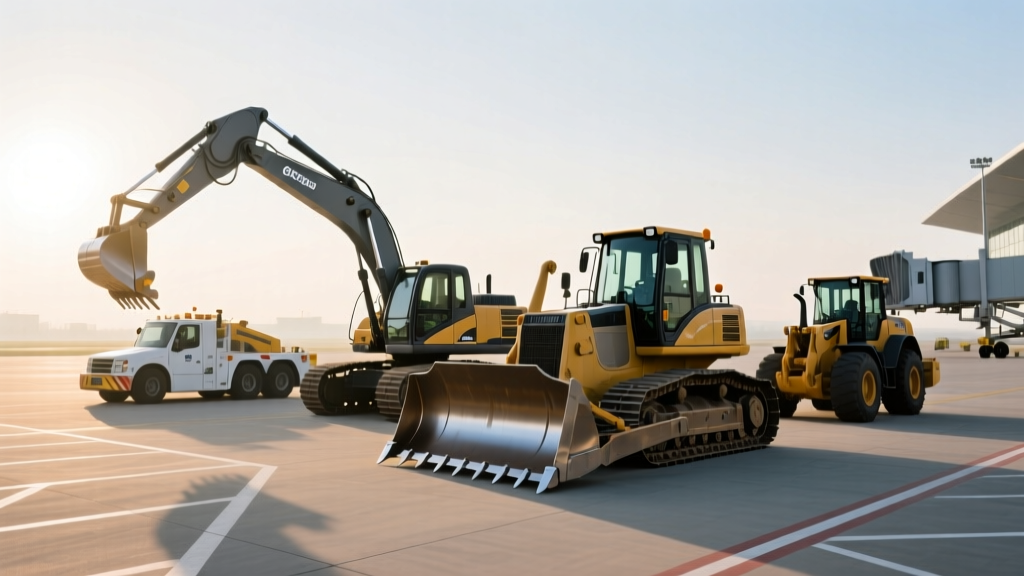
Operating machinery on an airport apron is fundamentally different from managing a construction or earthmoving site. When evaluating the different types of heavy equipment used in aviation, ground support equipment (GSE) requires a hyper-specialized operational mindset due to the immediate proximity to multi-million-dollar aircraft hulls and strict regulatory oversight. A single miscalculation in approach speed or clearance distance can result in catastrophic financial losses; for instance, a radome strike by a pushback tractor routinely incurs repair costs exceeding $150,000, not including aircraft downtime and passenger compensation.
Data Highlight: The Cost of GSE Incidents
According to aviation safety audits, ramp accidents cost the global airline industry over $10 billion annually. Approximately 65% of these incidents involve GSE colliding with aircraft fuselages, cargo doors, or engine nacelles. Operator error and inadequate spatial awareness training account for nearly 80% of these collisions.
Effective operator training must move beyond basic vehicle maneuvering. It requires an intricate understanding of aircraft geometry, jet blast hazard zones, and the specific hydraulic and mechanical limitations of the GSE fleet. The Flight Safety Foundation's Ground Accident Prevention (GAP) program emphasizes that standardized, recurrent training is the only proven method to reduce ramp incident rates below the industry baseline of 1.2 incidents per 1,000 departures.
Core Training Protocols for Towbarless Aircraft Tractors
Towbarless tractors, such as the Goldhofer AST-1X or Trepel Airportr, represent the pinnacle of heavy GSE engineering. Unlike conventional towbar tractors, these units lift the aircraft's nose landing gear directly into a hydraulic cradle. This design improves maneuverability and braking efficiency but introduces severe risks if the cradle pressure is mismanaged.
Nose-Gear Engagement and Hydraulic Limits
Operators must be trained on the exact hydraulic parameters required to secure the landing gear without exceeding the aircraft manufacturer's shear pin torque limits. For a Boeing 777 or Airbus A350, the cradle clamping force must be precisely calibrated.
- Visual Verification: Confirm the nose gear steering bypass pin is installed and the steering collar is locked.
- Approach Speed: Approach the gear at a maximum of 3 km/h (2 mph), stopping exactly 1 meter away to align the cradle centerline.
- Pressure Monitoring: Engage the hydraulic lift. Operators must monitor the cabin PSI gauge; system pressure typically peaks at 3,500 PSI, but the relief valve must be set to prevent over-torquing the gear strut.
- Clearance Check: Ensure a minimum 10 cm (4 inch) clearance between the aircraft fuselage and the tractor's raised cradle arms.
If an operator forces the cradle closed on a misaligned gear, the aircraft's steering shear pin will snap. This is a critical failure that grounds the aircraft immediately, requiring a full landing gear inspection and a mandatory towbar recovery procedure.
Belt Loaders and Cargo Conveyor Best Practices
Belt loaders, like the TLD TB-150 or JBT Commander, are high-frequency GSE assets. The primary training focus for belt loaders is the "Approach and Dock" procedure, specifically managing the clearance between the conveyor's leading edge and the aircraft cargo door sill.
The 3-Inch Rule and Auto-Leveling Sensors
The industry standard mandates that the belt loader bumper must stop exactly 2 to 4 inches from the aircraft sill. Contacting the sill can damage the aircraft's structural skin and compromise the cargo door's pressure seal, leading to hull damage claims averaging $50,000.
| Aircraft Type | Sill Height (Empty) | Sill Height (Loaded) | Auto-Leveler Sensitivity | Max Belt Speed |
|---|---|---|---|---|
| Airbus A320 / B737 | 118 inches | 102 inches | High (Rapid sink rate) | 120 ft/min |
| Boeing 777-300ER | 190 inches | 165 inches | Medium (Gradual sink) | 140 ft/min |
| Airbus A380 (Main Deck) | 265 inches | 240 inches | Low (Massive displacement) | 100 ft/min |
Modern belt loaders are equipped with auto-leveling ultrasonic sensors that lower the conveyor belt as the aircraft's suspension compresses under the weight of loaded cargo. Operators must be trained to manually override these sensors if ice, snow, or heavy rain obscures the ultrasonic beam, which can cause the belt to crash into the sill.
De-Icing Rig Operations and Fluid Dynamics
Operating heavy de-icing rigs, such as the Vestergaard Elephant Beta, requires a dual competency in heavy machinery maneuvering and chemical fluid dynamics. De-icing operators must understand the distinct rheological properties of SAE/ISO de-icing fluids to prevent wing contamination and ensure safe holdover times.
Type I vs. Type IV Fluid Application
- Type I (Orange, Unthickened): Applied at high temperatures (>80°C / 176°F) to melt existing ice. It provides minimal holdover time (typically 5-15 minutes) and is used strictly for de-icing, not anti-icing.
- Type IV (Green, Pseudoplastic): Applied at lower temperatures (>60°C / 140°F). This fluid contains polymeric thickeners that allow it to adhere to the wing surface, providing a holdover time of up to 80 minutes in active snow. Operators must adjust the nozzle spray pattern to a fan-shaped, low-pressure output to avoid shearing the fluid's polymer chains, which would destroy its anti-icing properties.
"The most common failure mode in de-icing operations is not mechanical, but thermal. Operators who rush the heating process and spray Type IV fluid at 85°C will degrade the pseudoplastic polymers, rendering the anti-icing layer useless before the aircraft even reaches the runway."
— Senior Ramp Safety Auditor, International Air Transport Association (IATA)
Cross-Training Matrix: Transitioning Between GSE Categories
Fleet managers often attempt to cross-train operators across various GSE categories to maintain operational flexibility during staff shortages. However, skill transferability is not universal. The matrix below outlines the transition difficulty and required supplementary training hours when moving operators between different heavy equipment types.
| Current Certification | Target Equipment | Transition Difficulty | Required SIM / Line Hours | Primary Knowledge Gap |
|---|---|---|---|---|
| Towbarless Tractor | Conventional Pushback | Low | 8 Hours | Towbar geometry and shear pin limits |
| Belt Loader | Catering Truck (High-Lift) | High | 24 Hours | Scissor-lift stability and wind shear limits |
| Baggage Tug | De-Icing Rig | Very High | 40+ Hours | Fluid chemistry, boom articulation, holdover times |
Certification and Recurrency Requirements
Compliance with global aviation standards is non-negotiable. Training programs must align with the IATA Ground Operations Manual (IGOM) and local civil aviation authority regulations (such as FAA Advisory Circulars or EASA Part-ORO). A robust training program consists of three distinct phases:
- Classroom Theory (20%): Focuses on aircraft geometry, ERA (Equipment Restraint Area) markings, FOD (Foreign Object Debris) awareness, and fluid dynamics.
- Simulator / Closed-Ramp Practice (40%): Operators practice docking maneuvers using retired aircraft hulls or high-fidelity VR simulators that replicate wind shear, night operations, and sensor failures.
- Line Induction (40%): Minimum of 50 supervised live-aircraft pushbacks or dockings under the direct observation of a certified line check airman or ramp supervisor.
Recurrency training must be conducted every 12 months, or immediately following any GSE incident, near-miss, or change in fleet equipment. By treating airport ground support machinery with the same rigorous training standards applied to flight crew operations, ground handlers can drastically reduce hull damage incidents and optimize turnaround times.