Road Construction Classes: Heavy Equipment Lull Buying Guide
Explore road construction equipment classification and learn how to select the right heavy equipment Lull telehandler for material handling on paving sites.
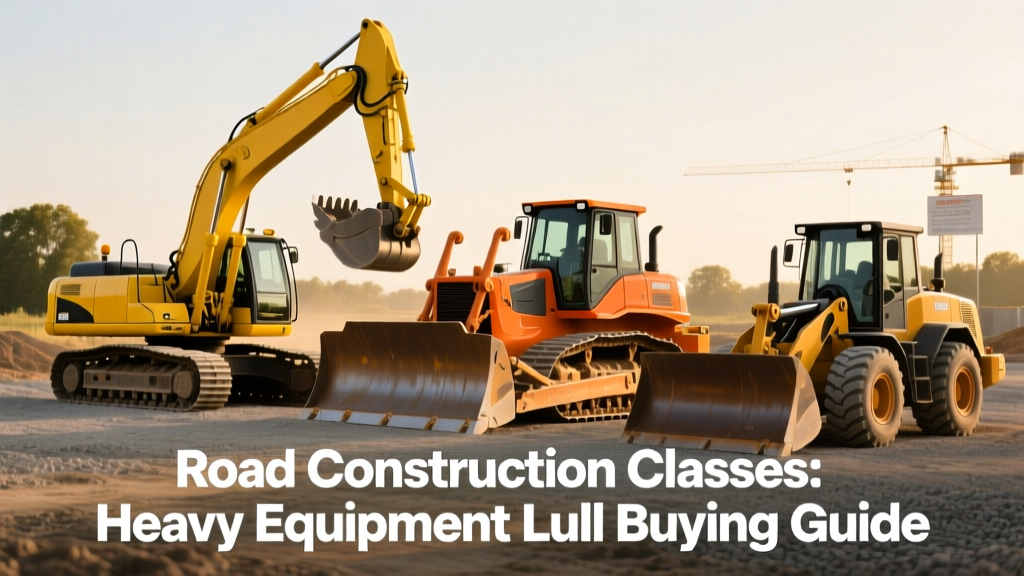
Road construction projects demand a highly orchestrated sequence of machinery, from initial earthmoving to final asphalt surfacing. While excavators and pavers often dominate the visual landscape of a highway job site, the material handling class is what keeps the project on schedule. Specifically, the heavy equipment Lull telehandler has become the undisputed standard for moving palletized materials, drainage pipes, and concrete barriers across uneven, unpaved subgrades. This guide breaks down road construction equipment classification and provides a technical buying framework for selecting the right Lull telehandler for your 2026 paving and infrastructure contracts.
The 4 Core Classes of Road Construction Equipment
Before spec'ing a material handler, it is critical to understand where it fits within the broader road construction equipment classification system. Highway and municipal road projects rely on four distinct machinery classes, each with specific operational mandates.
| Equipment Class | Primary Function | Key Machinery Examples |
|---|---|---|
| 1. Earthmoving & Grading | Subgrade preparation, trenching, and bulk material relocation. | Motor graders, track-type tractors, hydraulic excavators. |
| 2. Material Handling | Lifting, placing, and transporting palletized or bundled loads across rough terrain. | Telehandlers (Lull), rough-terrain forklifts, wheel loaders. |
| 3. Paving & Compaction | Laying asphalt/concrete and achieving required density specifications. | Asphalt pavers, pneumatic-tired rollers, vibratory steel drum rollers. |
| 4. Traffic Control & Safety | Managing work zone safety and moving temporary barriers. | Truck-mounted attenuators (TMAs), barrier transfer machines. |
According to the Federal Highway Administration (FHWA), proper subgrade preparation and material staging are the highest predictors of long-term pavement performance. The Material Handling class bridges the gap between the supply yard and the active paving zone, which is where the heavy equipment Lull telehandler proves its value.
Material Handling on Road Sites: Why the Lull Dominates
Standard warehouse forklifts fail on road construction sites due to low ground clearance, rigid suspensions, and inadequate traction on milled asphalt or muddy clay. Conversely, wheel loaders lack the precise vertical reach and fork-leveling capabilities required to stack concrete jersey barriers or unload PVC drainage pipes without damaging the materials.
The heavy equipment Lull telehandler—now manufactured under the JLG brand but universally known by its legacy Lull name—solves this by combining the boom reach of a crane with the pallet-handling utility of a forklift. The signature Lull feature is the traversing boom carriage, which allows the operator to move the forks forward and backward horizontally without changing the boom angle. This is critical on road sites for sliding pallets of asphalt patch or retaining wall blocks precisely into place over trenches or freshly laid geogrids.
Spec'ing the Right Model: 644E vs. 944E for Road Crews
When navigating the JLG telehandler lineup, road construction fleet managers typically choose between two primary heavy equipment Lull models based on their specific contract requirements.
- Lull 644E (19,000 lb capacity, 42 ft reach): The workhorse for heavy civil road projects. Ideal for unloading 20-foot sections of reinforced concrete pipe (RCP), moving heavy steel manhole rings, and transporting bulk aggregate pallets. The 19,000 lb capacity ensures it can handle dense, water-logged construction materials without tipping on lateral slopes.
- Lull 944E (9,000 lb capacity, 55 ft reach): Optimized for highway signage installation, lighting pole placement, and over-the-barrier material staging. The extended 55-foot reach allows operators to place materials over temporary concrete lane dividers without driving the machine into active traffic lanes.
When ordering your Lull, do not skip the auxiliary hydraulic package. Road construction requires frequent attachment swaps. Ensure the machine is spec'd with at least 25 GPM (gallons per minute) of auxiliary flow to operate hydraulic pipe grapples and rotary sweepers effectively. Standard flow (15 GPM) will cause sluggish grapple rotation when handling 12-inch diameter corrugated metal pipes.
Tire Selection: Pneumatic vs. Foam-Filled for Subgrades
A common failure point in road construction equipment classification is mismatching the tire compound to the terrain. Road sites transition from cleared, debris-heavy dirt to milled asphalt, and finally to fresh, hot-mix asphalt.
- Standard Pneumatic Tires: Best for municipal road overlays where the subgrade is stable and debris (nails, rebar offcuts) is minimal. They provide a smoother ride, reducing operator fatigue during 10-hour shifts.
- Foam-Filled Tires: Mandatory for new highway construction and rural road building. The subgrade will be littered with sharpened rocks, discarded tie-wire, and metal banding from material pallets. Foam-filling adds approximately $1,200 to $1,800 per axle to the initial purchase price but eliminates the $800 daily cost of downtime caused by flat tires on active paving days.
Financial Framework: Renting vs. Buying for 2026 Contracts
Deciding whether to add a heavy equipment Lull to your permanent fleet or rent it per project depends on your annual utilization rate. Based on 2026 heavy equipment market data, here is the financial breakdown for a mid-sized 644-class telehandler.
| Cost Factor | Purchasing (New 2026 Model) | Renting (Weekly/Monthly) |
|---|---|---|
| Upfront Capital | $165,000 - $185,000 | $1,400 / week or $3,800 / month |
| Depreciation (Year 1) | ~$35,000 | N/A |
| Maintenance & Parts | $4,500 annually | Included (excluding tire damage) |
| Insurance | $2,200 annually | $150 / week |
| Break-Even Point | ~7.5 months of continuous rental equivalent | |
The Decision Matrix: If your road construction division secures DOT (Department of Transportation) highway contracts lasting longer than 8 months, purchasing is the mathematically sound choice. For short-term municipal patching or 60-day overlay projects, renting preserves capital and shifts maintenance liabilities to the dealer.
Safety and OSHA Compliance on Road Sites
Operating a heavy equipment Lull on a road site introduces unique hazards, primarily related to lateral stability on sloped embankments and blind spots near active traffic. Under OSHA Standard 1926.602 governing material handling equipment, operators must be certified specifically for rough-terrain forklifts. Furthermore, when using a Lull to lift personnel in a work platform for highway sign installation, the machine must be equipped with a factory-approved, hydraulically locked work platform, and the operator must remain at the controls at all times.
Warning: Load Charts on SlopesRoad embankments frequently feature 2:1 or 3:1 slopes. A Lull telehandler rated for 19,000 lbs on flat ground may see its safe working load reduced by up to 40% when operating on a 5-degree lateral slope with the boom extended. Always consult the specific slope load chart in the cab before lifting concrete barriers on graded shoulders.
Final Selection Checklist for Fleet Managers
Before signing a purchase order or rental agreement for a heavy equipment Lull, verify the following specifications against your road construction equipment classification needs:
- Boom Carriage: Confirm the traversing carriage is included (standard on Lulls, but often an expensive add-on for competitor brands).
- ROPS/FOPS Cab: Ensure the cab is equipped with a heavy-duty Falling Object Protective Structure, essential when working near excavators swinging trench boxes.
- Attachment Interface: Verify the machine uses a standard ITA-style carriage or a quick-attach system compatible with your existing fleet of pallet forks and pipe grapples.
- Telematics: Opt for factory-installed GPS and idle-time tracking. Road sites are sprawling, and tracking machine utilization is vital for accurate job-costing on DOT contracts.
By correctly classifying your machinery needs and understanding the precise capabilities of Lull telehandlers, you can eliminate material handling bottlenecks, reduce manual labor risks, and keep your paving crews supplied continuously.