2026 China Heavy Construction Equipment Market: Renewable Tech Trends
Explore how the 2026 China heavy construction equipment market is driving renewable energy tech with AI cranes, RTK solar drivers, and BEV loaders.
The global acceleration toward wind, solar, and green hydrogen infrastructure requires more than standard earthmovers; it demands highly specialized, precision-engineered iron. Over the past five years, the china heavy construction equipment market has undergone a radical transformation, pivoting from mass-producing generic diesel machinery to dominating the niche of renewable energy construction technology. As turbine hub heights exceed 170 meters and solar arrays span tens of thousands of acres, domestic OEMs like XCMG, SANY, and Zoomlion have engineered purpose-built fleets that leverage AI, RTK-GPS, and high-voltage battery electric architectures.
Market Snapshot: Renewable Equipment Demand
According to the International Energy Agency (IEA), global renewable capacity additions are scaling at unprecedented rates, with China accounting for nearly 60% of new installations. This domestic volume acts as a massive proving ground, allowing Chinese OEMs to iterate on specialized renewable construction equipment faster than Western competitors, subsequently exporting these high-tech solutions to global markets.
Wind Energy Erection: Scaling to 170-Meter Hub Heights
Modern onshore wind turbines have grown exponentially. The latest 7MW to 10MW onshore models feature rotor diameters exceeding 220 meters and nacelle weights pushing 300 metric tons at hub heights of 160 to 170 meters. Standard 500-ton crawler cranes are entirely obsolete for these mega-projects. The U.S. Department of Energy Wind Technologies Market Report consistently highlights the logistical bottleneck of erecting these massive structures, a challenge Chinese manufacturers have addressed with ultra-high-capacity, AI-assisted lattice boom crawlers.
Flagship Models and Technical Specifications
- SANY SCC20000A (2,000-Ton Crawler Crane): Designed specifically for 8MW+ onshore and offshore wind. It features a maximum lifting moment of 28,000 t·m. The critical innovation is its AI-driven Load Moment Limiter (LML) system, which uses anemometers and boom-deflection sensors to make micro-adjustments to the hydraulic winch speed in real-time, compensating for sudden wind gusts at 160+ meter elevations.
- XCMG XLC28000: This unit introduces a modular counterweight system that reduces ground bearing pressure to under 0.15 MPa, allowing it to operate on the compacted gravel pads typical of remote wind farms without requiring extensive concrete matting. The teardown and transport time has been reduced by 30% compared to previous generations due to standardized pin-connection boom sections.
For international contractors, the decision framework for sourcing these cranes hinges on transport logistics. While the CapEx for a 2,000-ton Chinese crawler is roughly 25-30% lower than European equivalents (pricing in the $12M–$15M USD range), the RoRo (Roll-on/Roll-off) shipping costs and specialized heavy-haul trailers required for the counterweights must be factored into the total landed cost.
Solar Array Deployment: RTK-Guided Pile Driving and Grading
Utility-scale solar farms require thousands of steel H-piles driven into the earth with millimeter precision to ensure tracker arrays align perfectly with the sun's trajectory. Manual surveying and traditional vibratory hammers result in costly rework and structural stress on the solar panels.
The latest generation of solar-specific pile drivers emerging from the Chinese market integrates Real-Time Kinematic (RTK) GPS directly into the machine's mast control system.
Traditional vs. RTK-Guided Solar Pile Driving
| Metric | Traditional Vibratory Hammer | RTK-Guided Hydraulic Driver (e.g., Zoomlion ZTT Series) |
|---|---|---|
| Positional Accuracy | ± 50 mm (requires manual layout) | ± 5 mm (automated 3D model tracking) |
| Plumb/Verticality | 2-3 degrees variance | Auto-correcting mast to < 0.5 degrees |
| Daily Output (1 Operator) | 150 - 200 piles | 350 - 450 piles |
| Rework Rate | 8% - 12% | < 1% |
By loading the CAD site plan directly into the cab's telematics display, the operator simply drives to the general vicinity, and the machine's automated mast alignment takes over. This eliminates the need for a three-person surveying crew, fundamentally altering the labor economics of solar site preparation.
Site Prep Electrification: BEV Wheel Loaders and Excavators
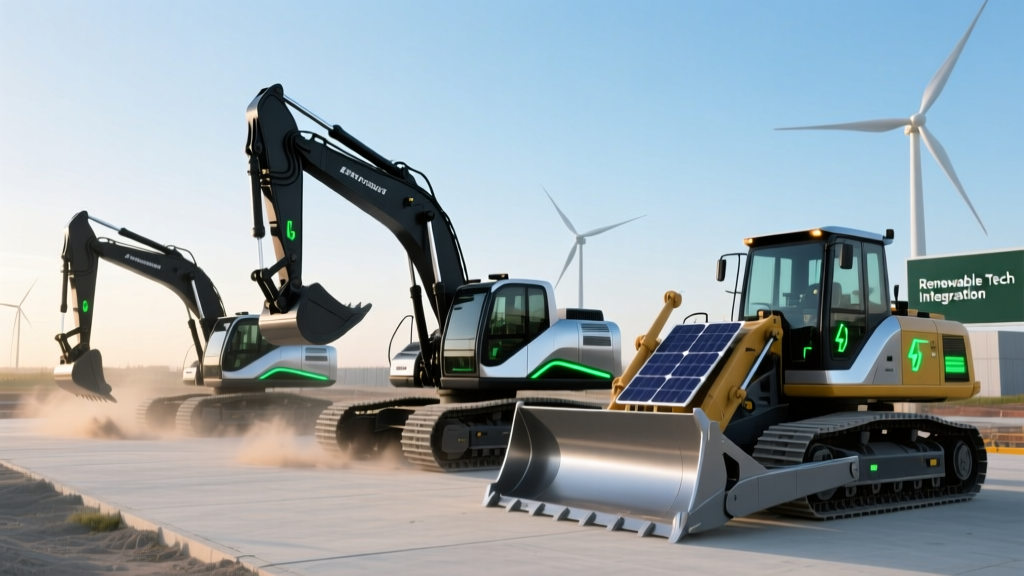
Renewable energy projects are increasingly scrutinized for their Scope 1 emissions during the construction phase. To maintain the 'green' integrity of a project from groundbreaking to operation, developers are mandating zero-emission site preparation. The Chinese supply chain has aggressively scaled Battery Electric Vehicle (BEV) heavy equipment to meet this demand.
Deep Dive: XCMG XC968-EV Wheel Loader
The XC968-EV is a 6-ton class electric wheel loader heavily utilized in solar farm grading and wind farm access road maintenance. It replaces the standard Cummins diesel engine with a dual-motor electric drivetrain powered by a 422 kWh Lithium Iron Phosphate (LFP) battery pack supplied by CATL.
- Thermal Management: The battery utilizes a liquid cooling/heating system that maintains optimal cell temperatures between 15°C and 35°C, ensuring consistent hydraulic flow rates even in sub-zero wind farm environments.
- Charging Architecture: Equipped with dual DC fast-charging ports, it can replenish from 20% to 80% state-of-charge in roughly 55 minutes using a 300kW mobile charging station.
- Export Pricing: FOB pricing for the XC968-EV hovers around $165,000 to $180,000 USD, representing a 60% premium over its diesel counterpart (XC958).
OpEx Analysis: Diesel vs. BEV in Renewable Site Prep
While the initial CapEx of BEV equipment is significantly higher, the operational expenditure (OpEx) on a 2,000-hour annual utilization cycle reveals a rapid break-even point, particularly in regions with high diesel costs.
| Cost Factor (Annual / 2000 Hrs) | Diesel 6-Ton Loader | BEV 6-Ton Loader (XC968-EV) |
|---|---|---|
| Fuel / Energy Cost | $63,000 (at $4.50/gal diesel) | $14,000 (at $0.14/kWh industrial) |
| Engine/Motor Maintenance | $8,500 (fluids, filters, belts) | $1,200 (grease, cabin filters) |
| DEF / Emissions Fluids | $3,200 | $0 |
| Total Annual Running Cost | $74,700 | $15,200 |
Note: BEV battery degradation is warranted for 10,000 cycles (approx. 8-10 years of heavy use) before dropping below 80% capacity, making the lifecycle economics highly favorable for fleet owners.
Navigating Telematics and Export Dynamics
Procuring advanced machinery from the Chinese market for international renewable projects requires navigating complex data security and export regulations. Modern Chinese heavy equipment is heavily integrated with IoT telematics platforms that monitor everything from hydraulic pressure anomalies to GPS location and battery health.
"The primary friction point in exporting smart heavy equipment to North America and the EU is no longer just tariff schedules; it is data sovereignty. Developers building critical grid infrastructure are increasingly requiring OEMs to provide localized, air-gapped telematics servers to ensure machine data does not route through overseas cloud architectures."
For procurement managers sourcing from the Chinese market in 2026, the actionable strategy involves negotiating 'data-localization' clauses in the purchase agreement. Leading OEMs now offer regional server deployments (e.g., hosting the fleet management dashboard on AWS Frankfurt or Azure US-East) to comply with critical infrastructure cybersecurity standards. Furthermore, buyers must verify that the machine's electronic control modules (ECMs) do not require mandatory over-the-air (OTA) authentication from domestic servers to start the engine, ensuring the equipment remains fully operational regardless of international internet routing disruptions.
Strategic Equipment Selection Framework
When planning a renewable energy megaproject, contractors should apply the following decision matrix to optimize fleet composition:
- Wind Projects (>100MW): Prioritize CapEx allocation toward ultra-high-capacity crawler cranes with AI wind-compensation. The cost of crane downtime due to wind-safety lockouts far exceeds the premium paid for advanced LML systems.
- Solar Projects (Undulating Terrain): Mandate RTK-GPS integration on all pile drivers and motor graders. The savings in surveying labor and the elimination of pile-realignment rework will yield ROI within the first 50 acres of deployment.
- Emission-Sensitive Zones: Deploy BEV wheel loaders and compact excavators for site prep. Factor in the cost of mobile DC fast-charging trailers (approx. $45,000 USD) into the initial site mobilization budget to prevent operational bottlenecks.
The evolution of specialized machinery within the global supply chain proves that building the green energy grid requires equipment that is just as technologically advanced as the turbines and panels it installs. By leveraging precision automation and electrified powertrains, contractors can drastically reduce the levelized cost of energy (LCOE) construction premiums, accelerating the global energy transition.