How Heavy Equipment Makers Train Operators for Renewable Energy Sites
Discover how top heavy equipment makers train operators for renewable energy construction, featuring wind and solar site best practices and safety protocols.
The transition to utility-scale solar, onshore wind, and geothermal energy has fundamentally altered the heavy machinery landscape. Unlike traditional commercial building sites, renewable energy projects are frequently located on remote, uncompacted, or highly variable terrain. Furthermore, the sheer scale of modern wind turbine components and solar panel arrays requires hyper-precise load management. Leading heavy equipment makers have responded by completely overhauling their operator training protocols, moving away from generic earthmoving manuals to highly specialized, site-specific simulation and telematics coaching.
The Shift in OEM Training for Green Energy Sites
Historically, operator training focused on standard digging, grading, and lifting cycles. Today, heavy equipment makers like Caterpillar, Liebherr, and Tadano integrate augmented reality (AR) and high-fidelity simulators into their baseline certification programs. As of 2026, a certified crane operator for wind farm construction must demonstrate proficiency in handling asymmetric loads—such as 115-meter turbine blades—in variable wind shear conditions before ever touching a physical joystick.
Simulator training, utilizing platforms like CM Labs or OEM-specific Cat Simulators, typically costs between $15,000 and $25,000 per unit. However, fleet managers report savings exceeding $4,000 per operator in reduced fuel consumption, undercarriage wear, and hydraulic shock damage during the crucial first 40 hours of field training. These simulators now include specific 'Wind Farm' and 'Solar Array' modules that replicate the exact ground-bearing pressures and side-slope limits found on renewable sites.
Wind Farm Crane Operations: Load, Wind, and Ground Limits
Erecting a modern 3.5 MW to 5.0 MW onshore wind turbine requires main cranes capable of lifting 120+ metric tons to heights exceeding 100 meters. The Liebherr LR 1400/2 and Tadano GR-1600EX are industry staples for these lifts. However, the primary failure mode in wind farm crane operation is not mechanical; it is geotechnical and meteorological.
Ground Bearing Pressure and Matting
Renewable energy sites are rarely graded to the strict compaction standards of commercial real estate. Operators must calculate ground bearing pressure (GBP) dynamically. A fully rigged LR 1400/2 can exert point loads exceeding 3,500 pounds per square foot (psf) on the outriggers or crawler tracks. Heavy equipment makers now mandate the use of engineered composite crane mats or heavy timber mats (minimum 8x8 inch hardwood) to distribute this load to a safe 1,500 psf or less, depending on soil core samples.
⚠️ WARNING: Wind Shear and MicroburstsAccording to the OSHA 1926 Subpart CC standards for cranes and derricks, operators must halt lifts when wind speeds exceed the manufacturer's limits. For large blade lifts, this threshold is typically 8 to 10 meters per second (18-22 mph). However, operators are now trained to monitor for wind shear—sudden changes in wind direction and speed at different altitudes—which can cause catastrophic load swings even if ground-level anemometers read safe levels.
Solar Farm Material Handling: Telehandlers on Uncompacted Soil
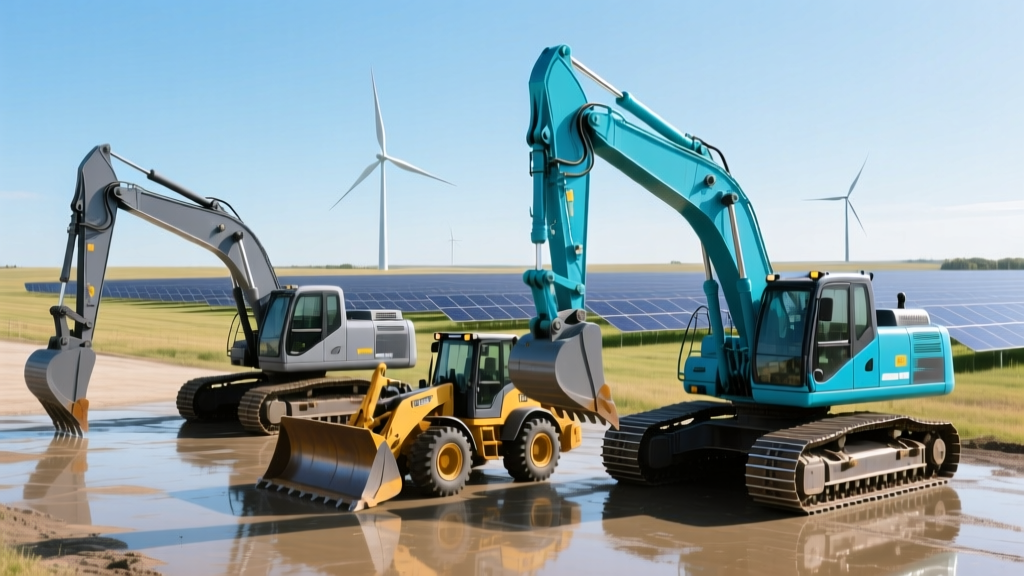
Utility-scale solar farms span hundreds of acres, often featuring uneven, soft, or sandy topsoil. The primary machines for moving pallets of solar modules (weighing 1,200 to 1,800 lbs) and steel racking are rough-terrain telehandlers, such as the Manitou MHT-X 10130 or the JCB 540-200.
The most common training focus for solar site telehandler operators is side-slope management. When traversing uncompacted terrain with a fully extended boom, the center of gravity shifts dramatically. OEM best practices dictate a strict 15-degree maximum side-slope limit when carrying loads. Operators are trained to use the machine's frame-leveling oscillation axles to keep the chassis plumb, but they must manually verify the terrain gradient using onboard inclinometers before initiating travel.
Machine Selection and Ground Pressure Matrix
Selecting the right undercarriage and tire configuration is critical to preventing soil rutting, which can lead to severe water pooling and long-term site degradation.
| Machine Type | Model Example | Tire/Track Config | Avg. Ground Pressure | Best Application |
|---|---|---|---|---|
| Rough-Terrain Telehandler | Manitou MHT-X 10130 | Wide-base foam-filled pneumatic | 25 - 35 psi | Solar panel pallet transport on graded paths |
| Crawler Crane | Liebherr LR 1400/2 | Wide crawler shoes (1.5m) | 12 - 18 psi (without matting) | Wind turbine nacelle and hub lifts |
| Compact Track Loader | Cat 299D3 XE | Rubber tracks (18-inch width) | 4 - 6 psi | Solar site trenching for underground cabling |
Geothermal Drilling Rig Operator Protocols
Geothermal energy construction requires heavy drilling rigs, such as the Schramm T685WS or the Drillmec HH102. These machines operate in extreme conditions, dealing with high-pressure mud systems and deep-bore casing operations. The U.S. Department of Energy notes that geothermal site prep and drilling demand rigorous adherence to hydraulic safety limits.
Operator training for geothermal rigs focuses heavily on 'kick' detection—the sudden influx of formation fluids into the wellbore. Modern rigs are equipped with automated mud-pump pressure sensors, but operators must be trained to recognize the physical signs of a kick, such as changes in return flow rate or pump stroke pressure drops, and execute the shut-in procedure within seconds. Heavy equipment makers now integrate haptic feedback into rig control joysticks to simulate pipe sticking and mud pressure blowouts during training.
Telematics as a Continuous Training Tool
Training does not end with certification. Heavy equipment makers utilize advanced telematics platforms to provide continuous, data-driven coaching. Systems like John Deere's JDLink and Caterpillar's VisionLink capture granular operational data that fleet managers use to correct bad habits in real-time.
- Hydraulic Shock Tracking: Telematics log instances where operators drop the boom or swing the superstructure too aggressively, which causes micro-fractures in the slew ring over time. Managers target operators with high 'shock event' counts for refresher training.
- Idle Time and Fuel Burn: On remote solar sites, fuel delivery is expensive. Telematics identify operators who leave 130-horsepower telehandlers idling for more than 5 minutes between loads, triggering coaching on auto-idle features.
- AdBlue/DEF Consumption: For Tier 4 Final and Stage V engines, improper shutdowns (failing to let the DEF pump purge) can crystallize the fluid and destroy the injector. Telematics flag operators who consistently turn the master battery disconnect switch before the ECU completes its purge cycle.
Industry Standards and Certification Renewal
According to data from the Solar Energy Industries Association (SEIA), the rapid expansion of utility-scale solar has led to a surge in demand for specialized material handling certifications. Operators are increasingly required to renew their site-specific endorsements every 24 months, rather than the traditional 5-year heavy equipment cycle, due to the rapid evolution of solar module sizes and mounting hardware weights.
Frequently Asked Questions (FAQ)
How many simulator hours are required before operating a wind farm crane?
Most heavy equipment makers and specialized training academies require a minimum of 20 to 30 hours of high-fidelity simulator time specifically focused on asymmetric load handling and wind-shear response before an operator is cleared for supervised field lifts on turbine components.
What is the biggest cause of telehandler tip-overs on solar farms?
Traversing uncompacted side-slopes exceeding 15 degrees with a fully extended boom and heavy solar pallet load. Operators must be trained to keep the load low to the ground during travel and utilize the machine's frame-leveling oscillation axle to maintain a plumb chassis.
Do OEM telematics systems automatically shut down machines for safety violations?
While some modern telematics can enforce 'geofencing' (shutting down travel outside a designated zone) or limit maximum RPMs for novice operators, they generally do not automatically shut down the machine for dynamic operational errors like harsh braking, as this could create an immediate safety hazard on a busy site. Instead, they log the event for manager review.